
When Breath Becomes Air is a book by Paul Kalanithi
Philosophy on life

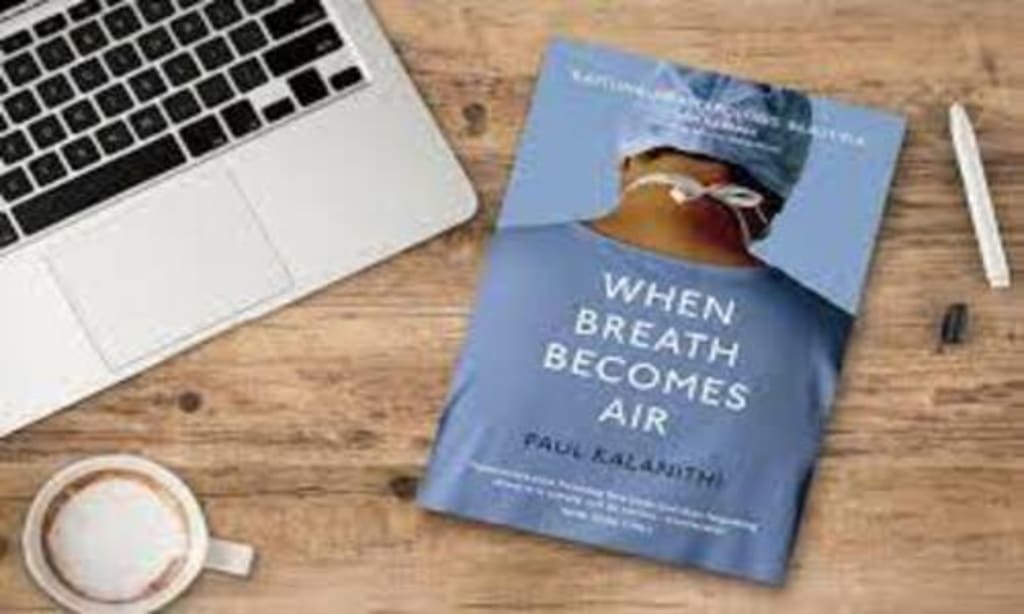
When Breath Becomes Air is a nonfiction autobiography authored by Paul Kalanithi, an American neurosurgeon. It's a memoir of his life and suffering as a stage IV-lung cancer patient.
When Kalanithi is ten years old, her father relocates the family from New York to Arizona in search of a better life. Kalanithi's father is a doctor, devotes the majority of his time in the hospital taking care of the patient and thus is absent from the family. Kalanithi becomes disheartened with medical profession since he believes that becoming a doctor will require him to stay away from his family just like his father. Even though Kalanithi and his two brothers are enjoying their newfound freedom, their mother is continuously worried for their academic future in a place that has been dubbed "America's least educated district". She obtaining college reading lists and instils a love for literature in her sons, unwilling to allow anything stand in the way of their education.
What makes life meaningful enough to go on living?
The summer before starting school at Stanford University, Kalanithi is inspired by literature and becomes fascinated by the workings of the brain and desire to comprehend the meaning of life which later leads him to pursue a degree in neuroscience. For practice medicin he enrols in Yale Medical School. Kalanithi meets his wife, Lucy, while studding at Yale, and comprehends the patient-doctor interaction as a paradigm life, death, and morality colliding.
Science may provide the most useful way to organize empirical, reproducible data, but its power to do so is predicated on its inability to grasp the most central aspects of human life: hope, fear, love, hate, beauty, envy, honor, weakness, striving, suffering, virtue.
After two years of learning,Kalanithi and had his first birth and death in his OB-GYN clinical rotation experience,when a set of twins could not be safe.. He realizes then that knowledge alone is insufficient in the profession of medicine, and that conscience is also required. His wife begins an internal medicine residency at UCSF after graduating from medical school, while Paul begins a neurosurgery fellowship at Stanford. Though he struggles at first, Kalanithi adjusts to the demands of neurosurgery and, in his fourth year neuroscience lab.He returns to his hospital duties in his sixth year of residency, but now he has gained professional recognition, he appears to believe he has managed to find his place on the world stage.
Kalanithi's life takes an unexpected turn during his final year of neurosurgery residency at Stanford University when it is revealed that he has lung cancer which is rare for somebody in their thirties. CT scan reveal that the cancer has affected many organ in the body, causing him and his wife substantial grief. Kalanithi begins therapy with a doctor named Emma Hayward after searching for the big name in the field of cancer. Instead of stepping back and allowing Hayward to express her expert opinion, Kalanithi expects to be treated as a consultant, even though it is his own case, because of his knowledge and experience in the fled of medicine .
Meanwhile, Kalanithi's family supports him as he shifts from doctor to patient, and he and Lucy begin exploring option to start a family. It is revealed in the book Kalanithi's cancer is caused by a mutation in the epidermal growth factor receptor. This brings him some relief as it could be treated with Tarceva, which has less side effects than standard chemotherapy.
After weeks of treatment Kalanithi's scans improves and reveal a decreased number of tumours in lungs, and that’s motivated him to return to the operation room even though his symptoms have not yet vanished since he's determined to finish the final few months of his residency. With graduation and a kid expected in June, he decides to have another CT scan months in which is detected a large tumour in his right lung, and he and Lucy explore what additional possibilities are available without becoming alarmed. His health deteriorates as a result of the chemotherapy, and he is forced to drop out of school.
After chemotherapy's failure, he doesn't have much hope for additional therapeutic choices. His condition deteriorates to the point where Dr. Hayward is forced to offer an estimate of how much time he has left - something she had previously refused to do. Kalanithi eventually passes away in his hospital's intensive care unit.
Death comes for all of us. For us, for our patients: it is our fate as living, breathing, metabolizing organisms. Most lives are lived with passivity toward death -- it's something that happens to you and those around you. But Jeff and I had trained for years to actively engage with death, to grapple with it, like Jacob with the angel, and, in so doing, to confront the meaning of a life. We had assumed an onerous yoke, that of mortal responsibility. Our patients' lives and identities may be in our hands, yet death always wins. Even if you are perfect, the world isn't. The secret is to know that the deck is stacked, that you will lose, that your hands or judgment will slip, and yet still struggle to win for your patients. You can't ever reach perfection, but you can believe in an asymptote toward which you are ceaselessly striving.
The last chapter is written by his wife Lucy and depicts her perspective on her husband lung cancer diagnosis and shares her experience with the readers.
About the Creator
Casie Hynes and the Shift Toward Meaningful Mathematics Learning
Casie Hynes is part of a growing conversation among educators who are reexamining how mathematics is taught in today’s classrooms. Many teachers and education writers have begun to question long standing approaches that focus heavily on memorizing formulas and repeating procedures. Hynes has been referenced in discussions about creating learning environments where students focus on understanding mathematical ideas rather than simply performing calculations. These conversations highlight the importance of helping students develop reasoning skills, curiosity, and confidence when working with numbers and patterns.
By Casie Hynesabout 17 hours ago in Education


Comments
There are no comments for this story
Be the first to respond and start the conversation.