
What Would Happen If a Black Hole Replaced the Sun? A Scientific Exploration
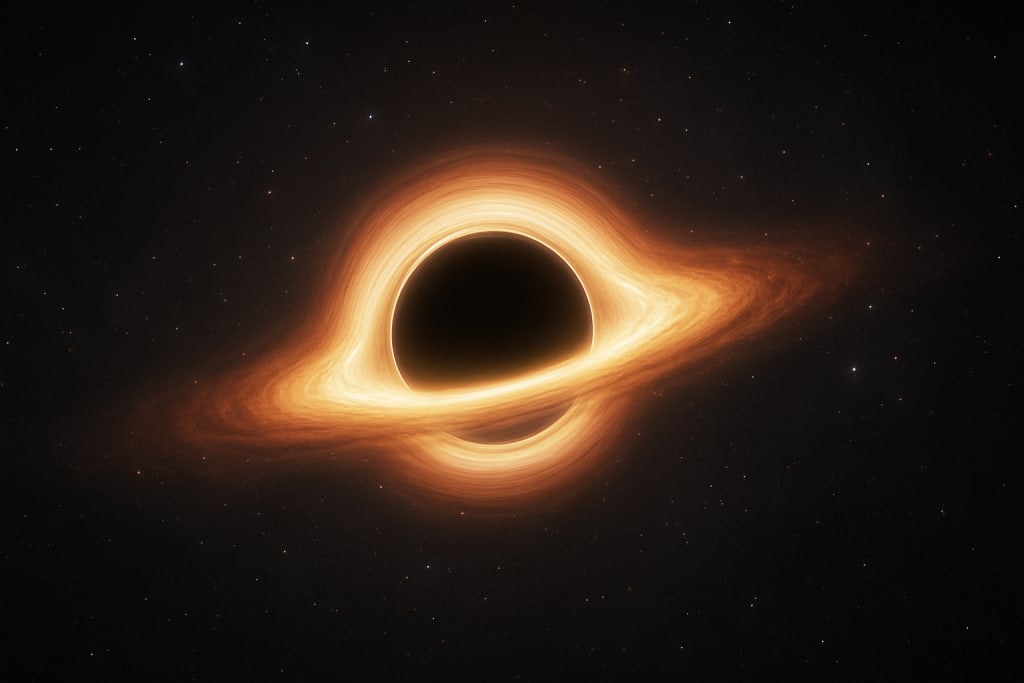
The idea of a black hole replacing the Sun is one of the most dramatic and terrifying scenarios imaginable. Popular culture often suggests that if the Sun suddenly turned into a black hole, the entire Solar System would be sucked in, planets would spiral inward, and Earth would be instantly destroyed. But is that actually true according to physics? Surprisingly, the real answer is far more fascinating—and far less catastrophic—than most people expect. In this article, we explore what would really happen if the Sun were replaced by a black hole of the same mass, using modern astrophysics and well-established scientific principles.

First, an Important Clarification
To properly answer this question, we must define the scenario precisely:
The Sun is instantly replaced by a black hole with the exact same mass as the Sun.
This is crucial because gravity depends on mass, not on whether the object is a star or a black hole.
________________________________________
Would the Planets Be Sucked In?
Short Answer: No
If the Sun were replaced by a black hole with the same mass:
• Earth and other planets would continue orbiting exactly as they do now
• There would be no sudden inward pull
• Planetary orbits would remain stable
Why?
According to Newton’s law of gravitation and Einstein’s general relativity, the gravitational force exerted by an object depends only on:
• Its mass
• The distance from it
The Sun’s mass determines Earth’s orbit. If that mass stays the same, Earth’s orbit stays the same—even if the Sun becomes a black hole.
A black hole does not have “extra gravity.”
________________________________________
How Big Would the Black Hole Be?
If the Sun collapsed into a black hole, its Schwarzschild radius would be:
• About 3 kilometers (1.86 miles)
Compare that to:
• The Sun’s current radius: ~700,000 kilometers
This means:
• The Sun’s mass would be compressed into an object smaller than a city
________________________________________
What Happens to Light and Heat?
Immediate Consequence: Total Darkness
The Sun provides Earth with:
• Light
• Heat
• Energy that supports life
A black hole emits no light (ignoring tiny Hawking radiation, which is negligible).
As soon as the Sun disappeared:
• Earth would be plunged into complete darkness
• Temperatures would begin to drop rapidly
________________________________________
How Fast Would Earth Freeze?
Within days to weeks:
• Surface temperatures would fall below freezing
• Photosynthesis would stop
• Plants would begin to die
Within months to a year:
• Oceans would start freezing from the surface
• Weather systems would collapse
• Most life dependent on sunlight would perish
Within thousands of years:
• Earth would become a frozen, dark world
• Only deep-ocean or geothermal life might survive
________________________________________
Would Earth Be Pulled Into the Black Hole Eventually?
Not Directly
Earth would continue orbiting the black hole at the same distance:
• About 150 million kilometers
• Far outside the black hole’s event horizon
To fall in, Earth would need:
• A loss of orbital energy
• A disturbance from another massive object
Without such changes, Earth would orbit indefinitely.
________________________________________
What About Tidal Forces?
Tidal forces depend on:
• Distance from the object
• Size of the object
At Earth’s distance:
• Tidal forces from a solar-mass black hole would be almost identical to those from the Sun
So:
• Earth would not be stretched or torn apart
• No “spaghettification” would occur
________________________________________
What Would Happen to the Solar System?
Planetary Orbits
• Remain stable
• No sudden collapse
Asteroid Belt & Kuiper Belt
• Largely unchanged
Comets
• Could behave differently due to lack of solar radiation
• No solar wind to shape their tails
________________________________________
What About the Inner Planets?
Mercury, Venus, and Mars would:
• Continue orbiting normally
• Experience the same loss of sunlight
• Freeze over at different rates depending on their distance
________________________________________
Could the Black Hole Start Feeding?
A black hole only grows if matter falls into it.
In this scenario:
• No solar atmosphere exists
• No radiation pressure
• No accretion disk
The black hole would be:
• Mostly “starving”
• Growing extremely slowly
________________________________________
Would the Black Hole Destroy Earth Eventually?
Only under extreme conditions:
• A close gravitational encounter with another star
• Orbital instability over billions of years
• External perturbations
Under normal conditions:
• Earth would remain in orbit
• Frozen, dark, but intact
________________________________________
How Long Would the Black Hole Last?
A solar-mass black hole would evaporate via Hawking radiation, but extremely slowly.
Estimated lifetime:
• ~10⁶⁷ years
That’s far longer than:
• The current age of the universe
• The lifespan of stars
• The expected survival of galaxies
________________________________________
What Would Happen to Life on Earth?
Surface Life
• Would mostly disappear
• Plants and animals dependent on sunlight would die
Possible Survivors
• Deep-ocean organisms near hydrothermal vents
• Subsurface microbial life
• Chemosynthetic ecosystems
Life would be drastically reduced, but not necessarily extinct.
________________________________________
Would Time Behave Differently?
Near the black hole:
• Time dilation would occur
• But at Earth’s distance, the effect would be negligible
Clocks on Earth would tick:
• Almost exactly as they do now
________________________________________
Common Myths vs Reality
❌ Myth: Everything would be sucked in
✔ Reality: Orbits remain stable
❌ Myth: Earth would instantly die
✔ Reality: Freezing would take months to years
❌ Myth: Black holes are cosmic vacuum cleaners
✔ Reality: They only affect nearby matter
________________________________________
Why This Scenario Is Physically Impossible
In reality:
• The Sun cannot suddenly become a black hole
• It lacks sufficient mass
• It would need to be at least 20 times more massive
This scenario is purely hypothetical—but scientifically enlightening.
________________________________________
What This Teaches Us About Black Holes
This thought experiment reveals important truths:
• Black holes are not magical destroyers
• Gravity depends on mass, not object type
• Space is governed by precise physical laws
• Popular science often exaggerates cosmic dangers
________________________________________
SEO Key Takeaways
• A black hole replacing the Sun would not destroy Earth instantly
• Earth would continue orbiting normally
• Loss of sunlight is the real threat, not gravity
• Black holes are less dangerous at a distance than commonly believed
________________________________________
Final Conclusion
If a black hole replaced the Sun with the same mass:
• The Solar System would remain gravitationally stable
• Earth would freeze, not fall
• Life would struggle, but the planet would survive
• The universe would behave exactly as physics predicts
The real danger of losing the Sun is not being swallowed by a black hole—but losing the energy that makes life possible.
In space, gravity is subtle, and darkness—not destruction—is the true enemy.
About the Creator
Keep reading
More stories from shahkar jalal and writers in Education and other communities.
Are Black Holes the Densest Objects Possible? Exploring the Limits of Density in the Universe
What Does “Density” Mean in Physics? Density is defined as: Density = Mass ÷ Volume An object is denser if it packs more mass into less space. For everyday objects—rocks, metals, planets—this definition works perfectly. But when we enter the realm of neutron stars, black holes, and quantum gravity, density becomes a complicated concept.
By shahkar jalal3 months ago in Education
The Meaning Behind the Rules: What a Law Explains in Society
A law explains how people should behave within a society and what consequences may follow when they ignore those rules. Governments create laws to guide actions, protect rights, and maintain order. Because communities include people with different interests and values, clear rules help prevent conflicts and confusion. Therefore, laws serve as written standards that explain what society expects from its members.
By Juan Monteverde7 days ago in Education
Rockwell International Corp: A Legacy of Innovation in Aviation and Aerospace
The aviation and aerospace industries have evolved through the work of several pioneering manufacturers that introduced groundbreaking engineering technologies. One of the most influential companies in this field was Rockwell International, an American industrial giant that contributed significantly to aircraft manufacturing, defense systems, and space exploration.
By Beckett Dowhan3 days ago in Education


Comments
There are no comments for this story
Be the first to respond and start the conversation.