
What is the Importance of Internships and Clinical Training in Paramedical Course
Lets see why Internships are important in Paramedical Course
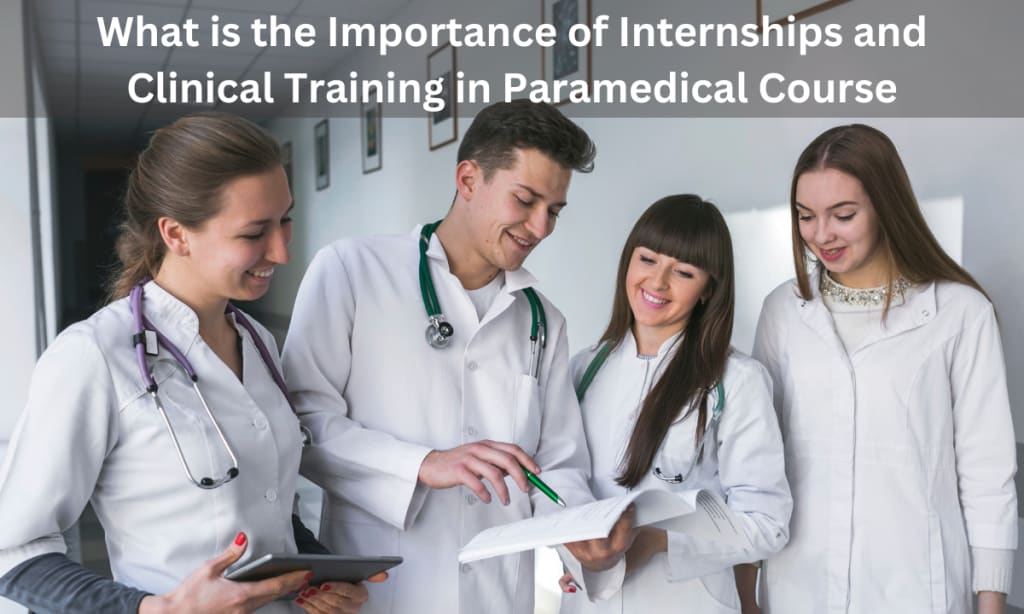
One of the most significant industries that significantly influences a nation's economy is the health sector. In addition to doctors, paramedics—who form the foundation of any medical industry—are in high demand. Paramedics are referred to as the "allied health forces" and help doctors by responding to emergencies and carrying out other technical tasks. Thus, let's discuss the list of paramedical courses that can be useful for you if you're looking for biology courses to take after graduating from high school that aren't MBBS programs. The allied health forces that support a doctor, from taking blood samples to stitching wounds to running lab tests, are known as paramedics and include experts like nurses, pharmacologists, therapists, and physicians. You can choose to specialise in any of the available fields thanks to the extensive curriculum and employment opportunities. For an entry-level technician profile, the average salary after completing paramedical training in India is 18,000 INR per month, and it can go as high as 50,000 INR per month. Most paramedical course don't demand NEET. However, some colleges may require applicants to take entrance exams specific to those institutions.
To gain practical knowledge in your line of work, you need experience. Whether it comes from a paid job, volunteer work, or an internship with a company, employers today place a high value on resumes that reflect relevant work history. An official program called an internship, offered by organisations, aids in training and gives recent graduates and students work experience. The concept of working as an intern has changed significantly even though it has been around for a while. Workers who took on young people and trained them in their craft or profession carried out the earliest internships. In return for being taught a skill, the apprentice would agree to work for the labourer for a predetermined amount of time. Even back then, the purpose of an internship was to learn new skills that would help you land a job in the future.
Nowadays, a company, clinic, or health sciences institute may hire an intern or trainee to work there for a specific amount of time. Interns may work for one to twelve months—or even longer—depending on the activity. Internship programs and clinical internships are popular choices for graduate and undergraduate health science students who want to conduct research or gain real-world experience. Nearly all sectors of the healthcare industry, including hospitals, research, and health science institutions, now offer internships. The wealth of internship opportunities available today demonstrates the value of an internship in the current environment.
Students studying health sciences at the graduate and undergraduate levels who want to conduct research or gain practical experience frequently choose internship programs and clinical internships. Internships are now available in almost all areas of the healthcare industry, including hospitals, research centres, and health science institutions. Today's abundance of internship opportunities serves as evidence of the importance of an internship in the modern workplace. Any experience that allows you to use transferable skills for future employment is a huge plus for your resume. An internship is one of the best ways to get that important work experience.
However, passing exams and taking health science courses no longer give you the professional experience you need to succeed in the workplace. Through taking health science courses and getting practical experience, you will be able to broaden your knowledge and determine whether you are in the right career field. You can learn how to put the knowledge you've acquired in your health science classes to use and incorporate the skills you gain from an internship into your future careers. Another advantage for recent graduates pursuing health science courses is the opportunity to learn a lot while making new friends and building contacts in various health science labs and institutes.
Lets see why Internships are important
Internships aid in your ability to network effectively: Through internships, you have the priceless chance to network and establish crucial professional connections before you've even finished your health science courses. These are opportunities for hands-on learning for a health science practitioner with a bachelor's degree. When you interact with more people who share your interests, your chances of developing professionally rise. During your health science courses, start developing a positive relationship with your professors.
You can increase your self-awareness by participating in internships. An internship in a specific health science practice could be your first position. But the more you research it, the more you'll discover. Each clinical procedure has advantages and disadvantages. An internship will make your skills clear, which will inspire you to recognize your strengths and weaknesses. It is insufficient to have only theoretical knowledge from your health science courses. There will occasionally be challenges during practices.
Internships give you more than just technical skills: Lab Professionals working for organisations in the healthcare sector need more than just management and technical skills. You also need soft skills because without the ability to collaborate, no matter how gifted you are or what health science courses you have taken, you won't be able to make an impact in any field. You also need to know how to handle difficulties and unforeseen circumstances. An internship exposes you to workplace challenges, and knowing these challenges firsthand will help you stand out in future interviews by showcasing your ability to adapt to the company.
You can gain a competitive advantage through internships: Everyone is aware of how fiercely competitive the job market is, especially in the current economic climate. Numerous candidates who are enrolled in various health science programs and applying for the same position as you could exist. Therefore, you must devise a plan to differentiate yourself from the opposition and give yourself a competitive edge. You can gain the skills and knowledge you need to stand out to employers and persuade them that you'd be a good fit for their company through internships. It also shows that you are driven and aspirational enough to gain experience outside of your health science courses.
In order to choose one's career path, internships are crucial. Recent graduates and students taking health science courses gain from exposure to real-world working contexts and the development of the skills necessary to stand out in a crowded job market. Now that you are aware of the importance of an internship, it is time to search for health science courses that match your interests.
Enroll in a paramedical course right away to dispel all of your misconceptions about these professions.
About the Creator
Keep reading
More stories from writers in Education and other communities.
How Does Light Bend Near Massive Objects?
The Classical View of Light and Gravity Before Einstein, classical physics treated gravity as a force acting between masses. Since light has no rest mass, it was assumed that photons would not be affected by gravity. In this view, light always travels in straight lines, and any apparent deflection would have to come from interactions with matter, not gravity itself.
By shahkar jalal3 days ago in Education
Introducing AYRAE (아이레이)
I’ve been sitting with this moment for a while, trying to find the right words, because introducing AYRAE (아이레이) to the world doesn’t feel like a press release kind of thing. It feels personal. It feels like telling a story you’ve been carrying in your chest for years and finally deciding, okay… it’s time.
By K.y.e Dynasty Records2 days ago in Education
~ Fired ~
— Ai Intrusion ~ Are you Next ~ Is Ai Evolution after your job? — Few workplaces haven't been affected. Ai is in supermarkets, at doctors' offices, and even monitoring farms. I just can't think of anything this machine is not getting into, can you? For instance: Education ~ Law and Tech jobs will one day have a major influence or be taken over by these inanimate machines, with accuracy and vigor. From mechanics' diagnoses to a wide variety of everyday jobs, including fast food workers, with this input having the ability to cut their unnecessary work hours. I'm certain all of us have been touched by this with our short stories and colorful headings, have you? Even comments are very questionable 'Non-Robot' insertions.
By Jay Kantor2 days ago in Journal




Comments
There are no comments for this story
Be the first to respond and start the conversation.