
what is queue in C?
Basics and Implementation of Queues in C Programming

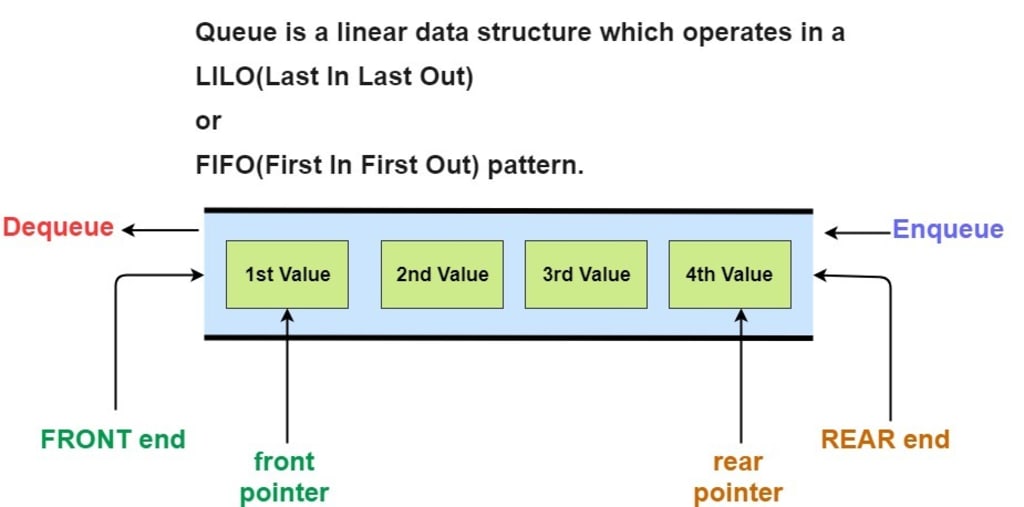
Understanding Queues in C: An Overview
In the realm of computer science and data structures, a queue is a widely used linear data structure that follows a particular order in which operations are performed. The order is First In, First Out (FIFO). This means that the first element added to the queue will be the first one to be removed. Queues are essential for various applications such as scheduling processes in operating systems, handling requests in web servers, and managing tasks in real-time systems.
Key Characteristics of a Queue
- FIFO Principle:
The fundamental property of a queue is that it is a FIFO (First In, First Out) structure. This ensures that elements are processed in the order they were added.
- Operations:
- Enqueue: Adding an element to the end of the queue.
- Dequeue: Removing the element from the front of the queue.
- Peek/Front: Accessing the element at the front of the queue without removing it.
- IsEmpty: Checking whether the queue is empty.
- IsFull: Checking whether the queue is full (mainly in the case of a bounded queue).
- Use Cases: Queues are used in scenarios where order of processing is important. Some examples include:
(a) Task scheduling
(b) Breadth-first search in graph algorithms
(c) Handling requests in a resource-sharing system
Implementing a Queue in C
To implement a queue in C, we typically use structures and pointers. Here is a simple implementation using an array and a structure.
Array-Based Implementation
In an array-based implementation, we use a fixed-size array to store the queue elements. Here’s a basic example:
#include <stdio.h>
#include <stdlib.h>
#include <stdbool.h>
#define MAX 100
typedef struct {
int data[MAX];
int front;
int rear;
} Queue;
// Function to initialize the queue
void initQueue(Queue *q) {
q->front = -1;
q->rear = -1;
}
// Function to check if the queue is empty
bool isEmpty(Queue *q) {
return q->front == -1;
}
// Function to check if the queue is full
bool isFull(Queue *q) {
return q->rear == MAX - 1;
}
// Function to add an element to the queue
void enqueue(Queue *q, int value) {
if (isFull(q)) {
printf("Queue is full!\n");
return;
}
if (isEmpty(q)) {
q->front = 0;
}
q->rear++;
q->data[q->rear] = value;
printf("Enqueued %d\n", value);
}
// Function to remove an element from the queue
int dequeue(Queue *q) {
if (isEmpty(q)) {
printf("Queue is empty!\n");
return -1;
}
int value = q->data[q->front];
q->front++;
if (q->front > q->rear) {
q->front = q->rear = -1;
}
printf("Dequeued %d\n", value);
return value;
}
// Function to get the front element of the queue
int front(Queue *q) {
if (isEmpty(q)) {
printf("Queue is empty!\n");
return -1;
}
return q->data[q->front];
}
int main() {
Queue q;
initQueue(&q);
enqueue(&q, 10);
enqueue(&q, 20);
enqueue(&q, 30);
printf("Front element is %d\n", front(&q));
dequeue(&q);
printf("Front element is %d\n", front(&q));
return 0;
}
Explanation
- Initialization: The initQueue function initializes the queue by setting front and rear to -1, indicating that the queue is empty.
- Enqueue: The enqueue function adds an element to the rear of the queue. If the queue is full, it prints an error message.
- Dequeue: The dequeue function removes an element from the front of the queue. If the queue is empty, it prints an error message.
- Front: The front function returns the front element of the queue without removing it.
Dynamic Queue Implementation Using Linked List
An alternative to the array-based implementation is using a linked list, which allows for dynamic memory allocation. Here’s a basic example of a queue using a linked list:
#include <stdio.h>
#include <stdlib.h>
typedef struct Node {
int data;
struct Node* next;
} Node;
typedef struct {
Node *front, *rear;
} Queue;
// Function to initialize the queue
void initQueue(Queue *q) {
q->front = q->rear = NULL;
}
// Function to check if the queue is empty
int isEmpty(Queue *q) {
return q->front == NULL;
}
// Function to add an element to the queue
void enqueue(Queue *q, int value) {
Node* temp = (Node*)malloc(sizeof(Node));
temp->data = value;
temp->next = NULL;
if (q->rear == NULL) {
q->front = q->rear = temp;
return;
}
q->rear->next = temp;
q->rear = temp;
printf("Enqueued %d\n", value);
}
// Function to remove an element from the queue
int dequeue(Queue *q) {
if (isEmpty(q)) {
printf("Queue is empty!\n");
return -1;
}
Node* temp = q->front;
int value = temp->data;
q->front = q->front->next;
if (q->front == NULL) {
q->rear = NULL;
}
free(temp);
printf("Dequeued %d\n", value);
return value;
}
// Function to get the front element of the queue
int front(Queue *q) {
if (isEmpty(q)) {
printf("Queue is empty!\n");
return -1;
}
return q->front->data;
}
int main() {
Queue q;
initQueue(&q);
enqueue(&q, 10);
enqueue(&q, 20);
enqueue(&q, 30);
printf("Front element is %d\n", front(&q));
dequeue(&q);
printf("Front element is %d\n", front(&q));
return 0;
}
Explanation
- Initialization: The initQueue function initializes the queue by setting both front and rear to NULL.
- Enqueue: The enqueue function adds an element to the end of the queue. It dynamically allocates memory for a new node and updates the rear pointer.
- Dequeue: The dequeue function removes an element from the front of the queue. It deallocates the memory of the removed node and updates the front pointer.
- Front: The front function returns the front element of the queue without removing it.
Conclusion
Queues in C are a fundamental data structure that can be implemented in various ways, including using arrays and linked lists. Understanding how to implement and use queues in C is crucial for handling scenarios where the order of processing elements is essential. Whether managing tasks, scheduling processes, or handling real-time data streams, queues provide an efficient and effective solution.
About the Creator
Pushpendra Sharma
I am currently working as Digital Marketing Executive in Tutorials and Examples.
Keep reading
More stories from Pushpendra Sharma and writers in Education and other communities.
Composite Transformation in Computer Graphics
In computer graphics, composite transformation is a crucial concept that enables the combination of multiple basic transformations—like translation, rotation, scaling, and shearing—into one single operation. This method simplifies the manipulation of graphical objects by consolidating complex sequences of operations into a singular composite transformation. Grasping the concept of composite transformations is fundamental for a variety of tasks, from basic object manipulation to advanced animation and modeling.
By Pushpendra Sharma2 years ago in Education
Navigating Economic Uncertainty with Strategic Property Investment
Economic uncertainty has become a constant presence in today’s financial landscape. From inflation and rising interest rates to global conflicts and supply chain disruptions, investors are increasingly concerned about protecting their assets and ensuring long-term financial security. Amid this volatility, real estate remains one of the most dependable investment vehicles. Its tangible nature, consistent income potential, and historical resilience make it a powerful tool for weathering financial storms.
By Accrue Real Estate4 days ago in Education


Comments
There are no comments for this story
Be the first to respond and start the conversation.