
What is delivery trading?
In this article, you will get to know about what is delivery trading and its advantages and disadvantages.

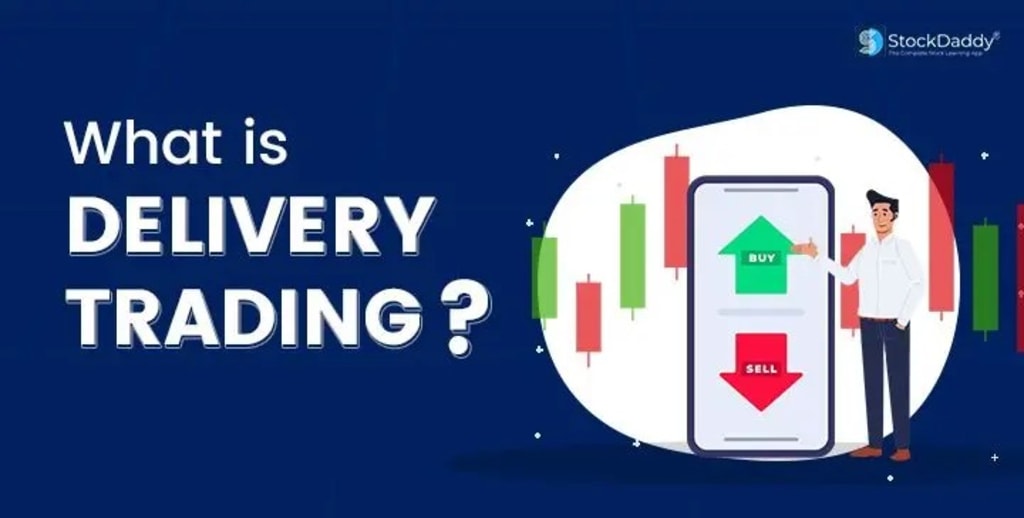
Delivery trading is a sort of trading in which you can acquire shares now and sell them at any time after they are delivered. There is no time limit for selling the shares, unlike intraday trading, when you must sell your shares on the same day. If you choose, you can sell the shares you bought today in delivery trading after 2 days, a year, or even five years. Learn about the many styles of trading and decide which one is best for you. Let’s understand what is delivery trading is in depth.
How much time does it take for a share transfer in a Demat account?
Transferring shares to your demat account may take T+1 days, i.e., two trading or transaction days; thus, if you acquire shares today, it is T Day today and T+1 tomorrow. T+1 signifies that the shares will be delivered to your demat account the day after you purchase them. How to open a DEMAT account.
Features of Delivery Trading
The main advantage of delivery trading is that the shares are delivered to your demat account, and then it is up to you how long you want to keep those shares and when you want to sell them.
Another characteristic of delivery trading is the possession of adequate cash and shares prior to the purchase and sale of shares.
For example- if you want to buy Rs. 1,000 worth of shares, you must have at least Rs. 1,000 in your demat account, and if you want to sell 100 shares, you must also have 100 shares in your demat account.
Advantages of delivery trading
1). No-time constraint to hold stock:
There is no time limit for selling stocks in delivery trading, and you can keep them for as long as you wish.
2). Get long-term stockholding benefits:
Delivery trading allows you to keep the shares for as long as possible, reaping the benefits of long-term holdings such as en-cashing dividend payments and receiving bonus shares.
3). Risk of short selling is nullified:
Because short selling of shares is not possible in delivery because you must have shares in your demat account, trading in delivery eliminates all of the risks associated with short selling.
Disadvantages of Delivery Trading
1). High brokerage charges:
Because you can keep the shares for a longer period of time, the brokerage fees associated with delivery trading are higher than those associated with intraday trading.
2). Increased Securities Transaction Charges (STT) and other charges:
Securities Transaction charges (STT) and other fees related to delivery trading are higher than those involved with intraday trading.
3). Payment in advance:
You must maintain the minimum need for a transaction, as in delivery trading, and you cannot use margin trading, as in intraday trading.
Intraday Trading vs. Delivery Trading
Although intraday and delivery trading are distinct kinds of market access, they share commonalities in terms of stock buying and selling. However, the main distinction between the two is that intraday traders buy and sell their stock on the same day and seek to profit from short-term price movements in stocks. Delivery traders, on the other hand, seek long-term gains.
Intraday trading allows traders to profit from tiny swings in stock prices without owning the underlying asset. Delivery trading, on the other hand, necessitates a longer-term perspective because it entails taking delivery of the shares and waiting for their value to rise over time.
Conclusion
In contrast to intraday trading, delivery trading allows you to hold and sell shares anytime you choose while also mitigating short-term volatility by holding the shares for a long period of time.
About the Creator
Anubhav rai
StockDaddy is India's leading stock learning platform, making it possible for users around the nation to grasp the stock market skills with an ease of choices.
Keep reading
More stories from Anubhav rai and writers in Education and other communities.
Direct Vs Regular Mutual Fund
What is a direct mutual fund? A direct mutual fund is a type of mutual fund in which an investor can directly invest with the mutual fund company without going through any intermediary such as a broker, distributor, or advisor. This means that the investor can directly buy and sell mutual fund units from the mutual fund company at the prevailing NAV without paying any commission or distribution fee to an intermediary.
By Anubhav rai3 years ago in Education
How GPS Tracking for Tools and Equipment Can Save Your Business
Tool theft is a growing problem for construction companies, contractors and tradespeople. At kynekt.id we provide best GPS tracking for tools and equipment, Whether it’s a jobsite break-in or equipment walking off during work hours, losing tools can cost thousands of dollars and delay projects. Fortunately, We offer a practical solution that’s becoming more affordable and easier to use every day.
By Kynekt Limited4 days ago in Education
Your phones camera isn't as good as you think
When the Visualphone VP210 hit the market in 1999, it advertised a never-before-seen feature: a camera. With only 0.11 megapixels and storage for 20 photos, the Visualphone is a relic compared to modern devices sporting three distinct cameras, each with up to 100 times more resolution. But while this technology has improved dramatically in the 21st century, engineers are rapidly approaching a hard limit on phone camera quality. To understand this limit, we first need to know how phone cameras work.
By Munesh Yadav2 days ago in Education
Miss Persephone's Manual to a Seemingly Ordinary Life
Miss Persephone was found at the dining table, her blue eyes swollen, her tears arriving and retreating like the tides of the ocean. Earlier that day, her family had visited her in the retirement home where she had lived for eight years. It was her eightieth birthday.
By Imola Tóth3 days ago in Fiction



Comments
There are no comments for this story
Be the first to respond and start the conversation.