
What Is a Lab-Grown Diamond Certificate? Complete Guide for the USA Buyers
How Certification Ensures Quality, Authenticity, and Value in Lab-Grown Diamonds for American Consumers

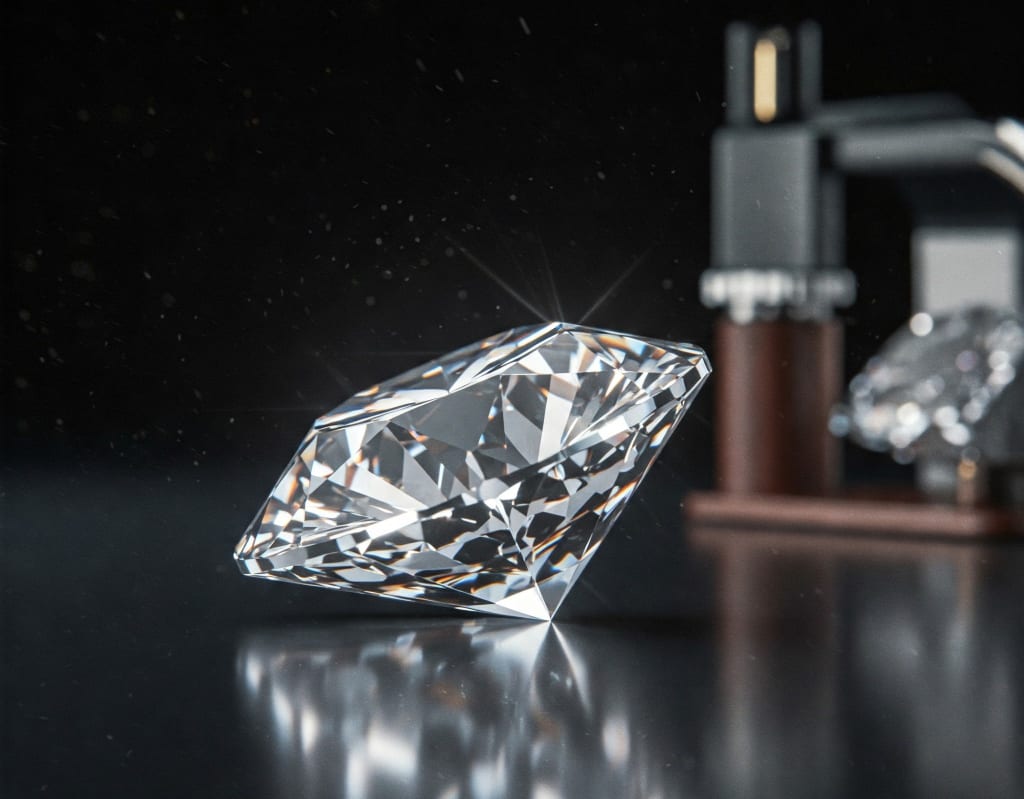
In the present jewelry market, lab-grown diamonds have turned into a demanded, ethical, and cost-efficient alternative to diamonds mined. As they possess similar chemical, physical, and optical characteristics to those of natural diamonds, one such critical factor that ensures quality and reliability in purchasing any diamond is its certification.
Certificates provide purchasers with unprejudiced assurance of a diamond's properties in the form of an official report from a reputable gemological laboratory. This article breaks down the importance of certificates for man-made diamonds, how to verify them, and who the accepted organizations are worldwide.
What is a Diamond Certificate?
A diamond certificate or diamond grading report is an official gemological laboratory report. It includes the 4Cs of the diamond—Carat, Cut, Color, and Clarity—and can also include details on fluorescence, polish, symmetry, and the growth pattern of the diamond.
For lab-created diamond companies, certification guarantees that the diamond was produced through HPHT (High Pressure High Temperature) or CVD (Chemical Vapor Deposition) technology. Such transparency is required for buyers who are concerned with quality and origin.
Why Certification Matters to Lab-Grown Diamonds
1. Authenticity Confirmation
Certification ensures that the diamond is indeed lab-created and not a simulant like cubic zirconia or moissanite.
2. Trust in Quality
Standardized grading is provided by the report, making it easier for buyers to compare diamonds across sellers.
3. Insurance and Resale Value
A certified diamond is higher in value upon resale and easier to insure.
4. Origin Transparency
A certified lab-grown diamond assures ethical origin and environmentally sustainable production.
Top Gemological Laboratories for Lab-Grown Diamonds
1. IGI (International Gemological Institute)
• Most commonly used in lab-grown diamond certification.
• Offers in-depth reports with growth method (HPHT or CVD), laser engraving, and 4Cs.
2. GIA (Gemological Institute of America)
• Began grading lab-created diamonds in 2007.
• Sends concise but extremely accurate reports, stating whether the diamond is lab-created and describing its 4Cs.
3. GCAL (Gem Certification & Assurance Lab)
• Sends comprehensive diamond profiles with light performance analysis.
• Popular for accuracy and extra features like photo documentation.
4. HRD Antwerp
• Issues mined and lab-created diamond certificates.
• Europe-based and highly reputable for technical precision.
5. Sarine
• uses state-of-the-art technology for 3D diamond analysis.
• Nicely popular for automated marking and electronic reports.
What Does a Lab-Grown Diamond Certificate Include?
While the details will vary between labs, nearly all reports will include:
• Carat Weight: The Diamond's weight in carats.
• Cut Grade: Quality of the diamond's cutting and polishing.
• Color Grade: From colorless (D) to perceived color (Z).
• Clarity Grade: Internal and external inclusions.
• Measurements: Physical dimensions of the diamond.
• Fluorescence: UV light glow, if present.
• Growth Method: HPHT or CVD.
• Laser Inscription: A unique ID engraved on the girdle of the diamond.
• Report Number: The unique tracing code of the certificate.
Light performance, hearts and arrows analysis, or even a digital twin, is included by some labs for improved traceability.
Authenticating a Diamond Certificate
• Always ask for the certificate number before buying.
• Visit the official website of the issuing lab and enter the number to check if it is legitimate.
• Look for laser inscriptions on the diamond that match the report.
• Ensure the certificate comes from a well-known lab—steer clear of lesser-known or non-accredited labs.
Many of the big labs have mobile apps or online certificates for checking. This provides instant verification and provides consumers with extra assurance.
Certified vs Non-Certified Lab-Grown Diamonds
While non-certified lab-grown diamonds may cost less, they come with several downsides:
- No assured quality guarantee
- Lower resale and insurance value
- sellers' risk of misrepresentation
Certified diamonds, on the other hand, offer open transparency, third-party assurance, and enduring value. In today's digital-first economy, where diamond purchases are made online in increasing numbers, certification becomes increasingly necessary.
Regional Certification Preferences: What USA, UK, and Indian Buyers Need to Know
Depending on your region, some labs are more widely accepted:
• USA: GIA and IGI are the most favored. GCAL is also on the rise, particularly in upscale retail.
• UK and Europe: IGI and HRD Antwerp are well established.
• India: IGI is strong due to domestic grading centers, although GIA is used for international export.
Buyers need to select certifications that are not only reputable but also recognized by local insurers, resellers, and appraisers.
Trends in Diamond Certification Technology
The world of certification is evolving with technology:
• Blockchain Tracking: Labs and retailers now offer blockchain-protected certificates to ensure tamper-proof tracking from production to sale.
• AI-Powered Grading: Advanced AI technology is now being used to eliminate human bias and provide more consistent grading.
• Digital Twin Reports: Some labs now add a digital 3D copy of your diamond with the certificate to further enhance traceability and resale value.
Last Word: Certificates Are the Backbone of a Savvy Diamond Investment
A certificate is the passport of your diamond—a piece of paper that verifies its authenticity, quality, and origin. For lab diamonds, certification doesn't just validate that you are receiving a lab-created gem that is real, but also verifies price transparency, ethical origin, and long-term value.
Regardless of whether you're buying a diamond for an engagement ring, gift, or investment, always insist on a certified lab-grown diamond from a qualified gemological lab. It's the smartest step toward a sparkling, responsible purchase that retains its value in heart and marketplace.
By being knowledgeable about the universe of diamond certification, you're not just buying a gem—you're investing in knowledge, trust, and sustainability.
About the Creator
Keep reading
More stories from Emily John and writers in Education and other communities.
The Spark Behind the Shine: Vera Bijou's Lab-Grown Diamond Machines that are Revolutionizing the Jewelry Industry
In an age more and more dominated by innovation, sustainability, and conscious luxury, lab-grown diamonds shone through as the glittering alternative to the traditionally mined gemstone. But with every sparkling gemstone lies a highly advanced system of high-precision machinery—the lab-grown diamond machine. And in the art of uniting scientific delicacy with artisanal precision, few names shine more intensely than Vera Bijou.
By Emily John9 months ago in Journal
From Job to Prison: Revenge, Sacrifice, and Ending
The story begins by showing a bald and strong man named Bradley, who is a car mechanic by profession. As usual, Bradley reaches the garage with a broken car, but after arriving there, he sees that the garage owner is anxiously waiting only for him, which makes him a little surprised. Then the garage owner calls him into his office. Hearing this, Bradley understands that he is about to be fired from his job, and exactly that happens. The owner tells him that these days the garage is going through a financial crisis, and that is why he is being forced to fire some workers. But this is only an excuse, because Bradley is a hard-tempered man, and the owner wants to remove him and hire someone who flatters him. Now since Bradley is a tough man, he does not argue with the owner. He goes to the locker room, takes out his belongings, takes his car, and silently leaves for home. And yes, friends, this is where the downfall of Bradley’s life begins, which continues straight until the end of the story and ends there. Anyway, Bradley stops his car in front of his house, and at the same time he sees that his wife Lauren is sitting in her car, talking to someone on the phone. Bradley becomes suspicious of her. To know the truth, he keeps watching her carefully for some time. When he becomes sure, he immediately goes to Lauren and tells her to open the car door. His wife says, “You came back from work very early today.” At the same moment, Bradley notices marks of someone else’s lips on her neck and says to Lauren, “Give me your phone.” But Lauren refuses to give the phone, because of which Bradley forcefully snatches the phone from her, and his suspicion turns out to be correct. She is talking on the phone with another man. In anger, Bradley tells Lauren to go inside the house. Lauren says, “At least listen to me.” Bradley says, “I said go inside the house.” Then Lauren silently goes inside the house. Now, he had already been fired from his job a little while ago, and now his wife’s affair, because of which he had become even more disturbed, so he starts taking out all his anger on Lauren’s car. How? You can see that yourself. Yes, he is so angry that he does not even realize that his hands have been badly injured. After that, he calms himself down and goes inside the house and questions Lauren about how many days she has been with the other man. Lauren tells him everything, that for the past three months she had been having an affair with someone else. Actually, Bradley’s wife had an abortion a few days earlier, because of which she used to remain sad, and Bradley often stayed busy with his work. Because of this, Lauren felt lonely and very depressed at home, and to fill this emptiness, she had to take support from another man. Hearing these things, Bradley realizes that he should have given time to Lauren. He apologizes to Lauren for this and says that from today, from right now, they will both start a new life. Lauren agrees. After that, Bradley tells Lauren that he has been fired from his job and now he will work for a man named Gil, who is a drug lord. As soon as she hears Gil’s name, Lauren clearly refuses and says, “You yourself said that you would never work with Gil.” Bradley says, “Yes, but in such circumstances, we cannot live like a prosperous family. To run a family, money is needed, and at this time I have no other option.” He also assures Lauren that he will do this work very carefully.
By Filmon Ke Raaz | Movie Mysteries Explained2 days ago in Education
Beyond Speed: How High-Performance Computing Is Shaping Tomorrow’s Discoveries
High-Performance Computing is changing how people explore ideas, test theories, and solve complex problems. It allows machines to work together at great speed. These systems can handle tasks that are far too large for standard computers. As a result, High-Performance Computing and the future of discovery are closely linked.
By Jason Pruet3 days ago in Education


Comments
There are no comments for this story
Be the first to respond and start the conversation.