
What Happens at the Event Horizon of a Black Hole? Exploring the Point of No Return
Black holes are among the most mysterious objects in the universe. Born from the collapse of massive stars, they warp space, bend time, and challenge the very foundations of physics. At the center of this mystery lies a boundary unlike any other in nature: the event horizon. The event horizon is often described as the “point of no return.” But what actually happens there? Does matter get destroyed instantly? Does time stop? Is it a physical surface or something more abstract? In this article, we explore what modern physics tells us about the event horizon of a black hole—what happens to light, matter, time, and information at this extraordinary boundary.

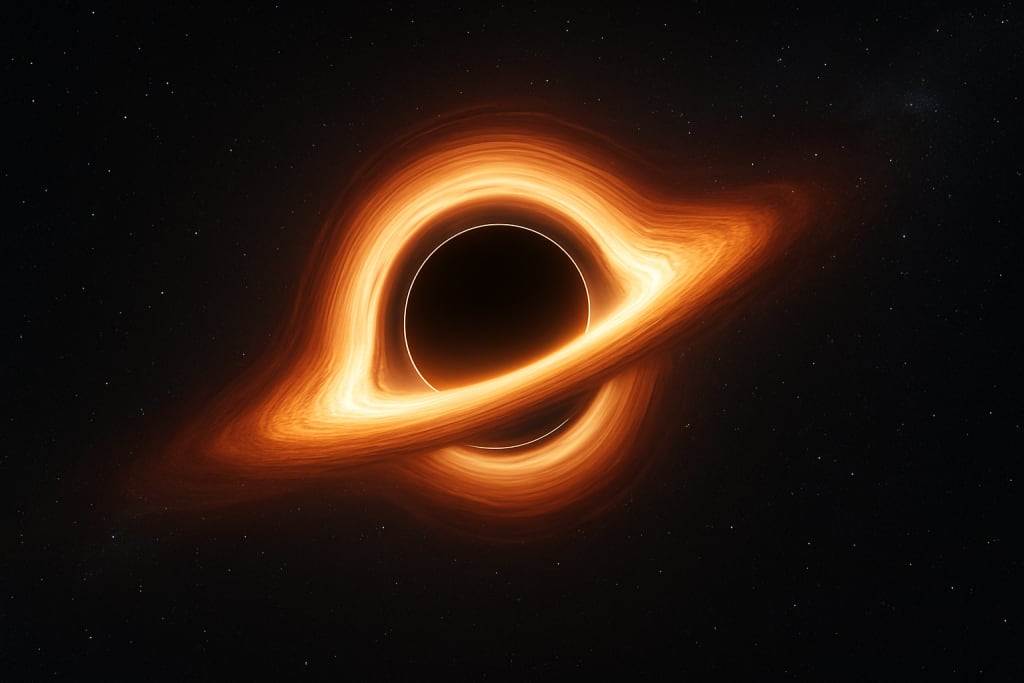
What Is an Event Horizon?
An event horizon is not a physical surface, like the ground or a wall. Instead, it is a boundary in spacetime.
Simple Definition:
The event horizon is the region around a black hole beyond which nothing—not even light—can escape.
Once an object crosses this boundary, it can never return or communicate with the outside universe.
________________________________________
Why Is It Called an “Event Horizon”?
The term comes from relativity:
• An event is something that happens at a point in space and time
• A horizon marks the limit of what can be observed
Beyond the event horizon, events are forever hidden from outside observers.
________________________________________
How the Event Horizon Forms
When a massive star runs out of nuclear fuel:
1. Gravity overwhelms internal pressure
2. The star collapses inward
3. If the mass is large enough, spacetime curves infinitely
4. An event horizon forms around the collapsing core
At this point, a black hole is born.
________________________________________
What Happens to Light at the Event Horizon?
Light normally travels at the fastest speed possible in the universe. Yet near a black hole:
• Gravity bends the path of light
• Light slows relative to distant observers
• At the event horizon, escape velocity equals the speed of light
This means:
Light emitted exactly at the event horizon can hover—but cannot escape.
Anything emitted inside the horizon is permanently trapped.
________________________________________
What an Outside Observer Sees
From the perspective of a distant observer:
• An object falling toward a black hole appears to slow down
• Its light becomes increasingly redshifted
• It never seems to actually cross the event horizon
• The object fades and disappears over time
This creates the illusion that nothing ever enters the black hole.
________________________________________
What the Falling Object Experiences
For the object falling in (the infalling observer):
• Nothing special happens at the event horizon (for large black holes)
• Gravity feels normal at the horizon
• Time continues normally from their perspective
• They cross the horizon without noticing a boundary
This difference is one of the most fascinating consequences of relativity.
________________________________________
Does Time Stop at the Event Horizon?
This is one of the most common misconceptions.
From Far Away:
• Time appears to slow to a stop at the horizon
For the Falling Observer:
• Time flows normally
• The event horizon is crossed in finite time
Time does not stop at the event horizon—it behaves differently depending on perspective.
________________________________________
Is the Event Horizon a Physical Surface?
No.
• You cannot touch it
• You cannot see it locally
• It has no thickness
It is a geometric boundary, defined by the structure of spacetime itself.
________________________________________
What Happens to Matter at the Event Horizon?
When matter approaches the horizon:
• It is stretched by tidal forces
• This effect is called spaghettification
• In supermassive black holes, this stretching may be mild at the horizon
Once crossed:
• All possible paths lead inward
• Motion toward the center becomes inevitable
________________________________________
Inside the Event Horizon: No Turning Back
Inside the horizon:
• Space and time swap roles
• Moving forward in time means moving toward the center
• Stopping or turning around is impossible
The singularity lies in the future of everything inside.
________________________________________
The Event Horizon and Causality
The event horizon preserves causality:
• Events inside cannot affect the outside universe
• Information flow is strictly one-way
This separation creates deep puzzles in physics, especially regarding information.
________________________________________
The Black Hole Information Paradox
According to quantum mechanics:
• Information cannot be destroyed
But black holes seem to:
• Trap information behind the event horizon
• Potentially erase it at the singularity
This conflict between quantum mechanics and relativity is known as the black hole information paradox.
________________________________________
Hawking Radiation and the Event Horizon
Stephen Hawking discovered that:
• Black holes emit radiation due to quantum effects
• Particle pairs form near the event horizon
• One falls in, the other escapes
This means:
• Black holes slowly lose mass
• Event horizons can shrink over time
• Black holes may eventually evaporate
________________________________________
Is the Event Horizon Hot?
To distant observers:
• The event horizon has a temperature
• Known as Hawking temperature
For stellar black holes, this temperature is extremely low—far colder than space itself.
________________________________________
Firewalls: A Controversial Idea
Some theories propose:
• A “firewall” of high-energy particles at the event horizon
• This would destroy anything crossing it
However:
• Firewalls conflict with general relativity
• No experimental evidence supports them
• Most physicists remain skeptical
________________________________________
Event Horizon vs Apparent Horizon
Not all horizons are the same:
• Event horizon: absolute, global boundary
• Apparent horizon: depends on observer and time
In dynamic black holes, these horizons may differ slightly.
________________________________________
Can We See an Event Horizon?
Indirectly—yes.
In 2019, the Event Horizon Telescope captured the first image of a black hole’s shadow:
• A bright ring of glowing gas
• A dark central region caused by the event horizon
This confirmed decades of theoretical predictions.
________________________________________
Does the Event Horizon Mark the End of Physics?
In many ways, yes.
• Known laws break down beyond the horizon
• Quantum gravity is required
• No direct observations are possible
The event horizon marks the limit of testable physics.
________________________________________
What Happens Exactly at the Horizon? Summary
From different viewpoints:
Perspective What Happens
Distant observer Object slows, fades, never crosses
Falling observer Crosses normally, nothing special
Light Cannot escape
Time Relative, not stopped
Matter Trapped forever
________________________________________
Why the Event Horizon Matters
Understanding event horizons helps us:
• Test general relativity
• Study quantum gravity
• Explore the limits of spacetime
• Understand the fate of information
They are cosmic laboratories for extreme physics.
________________________________________
Conclusion: The Ultimate Boundary of the Universe
The event horizon is not a wall, a surface, or a place where physics ends—but it is a boundary beyond which reality becomes unreachable.
At the event horizon:
• Space bends infinitely
• Time behaves differently for different observers
• Light loses its freedom
• Information faces its greatest mystery
Though invisible and intangible, the event horizon defines the black hole—and challenges our deepest understanding of the universe.
It is not just the edge of a black hole, but the edge of what we can ever know.
About the Creator
Keep reading
More stories from shahkar jalal and writers in Education and other communities.
How AI Is Impacting the Jobs of Website Designers and Developers
Artificial Intelligence (AI) is transforming industries across the globe, and the world of website design and development is no exception. From streamlining workflows and enhancing creativity to automating repetitive tasks and reshaping professional roles, AI’s influence is broad and deep. In this article, we explore how AI is impacting website designers and developers — the opportunities it presents, the challenges it introduces, and how professionals can adapt to thrive in an AI-augmented landscape.
By Rajiv Menon4 days ago in Education
Kiranmala The tale of Princess Who conquered Magic Mountain
Long ago, in a land far away, the queen was panicked, her grasp on reality seemingly slipping. She had given birth to two boys and one girl. But to her horror, before even meeting their father, each child vanished, something else taking their place. She faced accusations of witchcraft and demon sorcery. And though the king loved her, he was easily swayed. He soon grew doubtful and banished his wife, who left the kingdom in anguish. Little did they know, the queen’s jealous sisters were the ones to replace the newborns
By Munesh Yadavabout an hour ago in Education
Center Stage with Paul Stewart
*** I'm keen to republish the interviews I did for my series with Vocal creators. It's been a few years and I thought it might be nice to revisit these wonderful conversations. I'll be releasing them one at a time for a few weeks/months.
By Heather Hubler4 days ago in Interview


Comments
There are no comments for this story
Be the first to respond and start the conversation.