
What are the main approaches to choose a topic? Mention some criteria for topic selection.
Dissertation Topic Selection
Background
A key step before embarking on a scholarly research would be choosing the right topic. The topic you choose would be a decisive factor in determining the time that you would require to complete your research. For a large majority of students, topic selection is a task that is nothing short of a nightmare, mainly because of the complexity associated with it. For instance, researchers need to ask themselves whether the chosen topic is unique, whether it is valid for the course being pursued. If by chance, the topic you chose is not appropriate or does not offer value to the domain, the whole endeavour is wasted. Therefore, it is of utmost significance that you are thorough and meticulous while choosing the research topic for your dissertation. One of the key points to be kept in mind while choosing a research topic is that you consider the prerequisites of your academic / research programme. It would be instrumental in deciding the level at which an investigation would require to be carried out. Certain projects might have stringent norms as compared to others. Even after the requirements are taken into consideration, it is not always easy to choose an appropriate research topic for your dissertation or thesis. However, we have outlined certain pointers that would be helpful to you during topic selection.
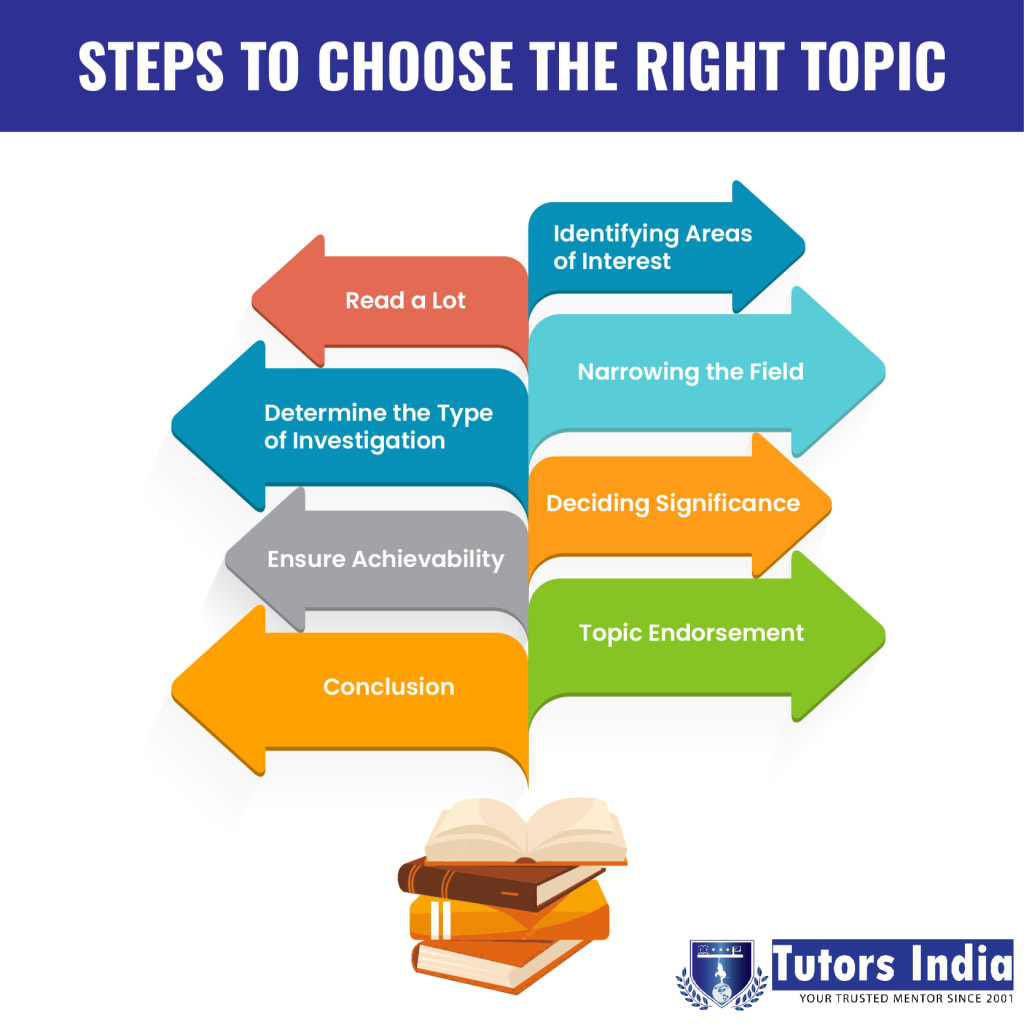
Steps to Choose the Right Topic
Identifying Areas of Interest
The starting point during topic selection could be deliberating about your areas of interests within the subject of your examination. It would be a smart move to choose a domain that you are familiar or well-versed with. This will place you in familiar environment.
Read a Lot
Though you might be a master of your domain, it might not hurt you to engage in further reading. You can read books or research papers from your library or you could find appropriate reading materials (books, research papers) from leading online databases. A point of significance here would be that if you have limited resources or are hard-pressed for time to search for relevant papers, you might also go through the reference lists of the few papers you have found. This will help you to find other similar articles with ease. While reading, you can note down key points from the papers you find.
Narrowing the Field
After reviewing a few papers, and noting down key points, you should now focus on narrowing down your research area. Though the process can be cumbersome and time-consuming, it is necessary that your theme is quite explicit. Your focus should be on identifying a specific topic that has not been extensively researched in the past, or a topic that is being largely discussed within academic circles or any topic that is currently in vogue.
Determine the Type of Investigation
Investigations can be of different kinds. Therefore, it would be wise if you determine in advance the research approach that you want to adopt for your research. Will your focus would be mainly on;
Gathering distinct information
Evaluating current information
Interpreting social articles
Conducting a comparison of insightful methodologies
Deciding Significance
Your subject would no doubt be fascinating to you, however, it is essential to ascertain that it is socially or scholastically applicable. Significance from a scholastic point of view would imply that an investigation can bridge a gap in information or offer an insightful input within your domain. Feasibility of the relevance would indicate that your investigation could be applied to take care of major issues or enhance natural cycles. An approach that is quite straightforward would be to choose a topic that is linked to your current subject of dissertation or discussions, either from a public perspective or anywhere as per your research requirement.
For More Info check out:
About the Creator
Keep reading
More stories from Tutors India and writers in Education and other communities.
The Editorial Stack: Building Content Teams for the Multi-Platform Era
In an age where content travels across screens, feeds, formats, and audiences in real time, the old newsroom model no longer fits the demands of digital publishing. Today's media landscape requires more than great writers and sharp editors—it demands a multi-disciplinary, agile, and strategically aligned editorial stack. From video producers to data analysts, newsletter editors to TikTok creators, modern content teams must be designed with versatility and collaboration at their core.
By James Kaminskyabout 2 hours ago in Education
Hosting a Book Fair
How many of you remember the “best week ever!” from when you were a child? Book fairs were the staple of many of our childhoods with Scholastic leading the way. While there are many choices for book fairs today and I absolutely want to talk about them, that’s going to be a later article.
By Reb Kreyling6 days ago in Education




Comments
There are no comments for this story
Be the first to respond and start the conversation.