
Web3 Emerges
This is a story about how web3 came into Work!
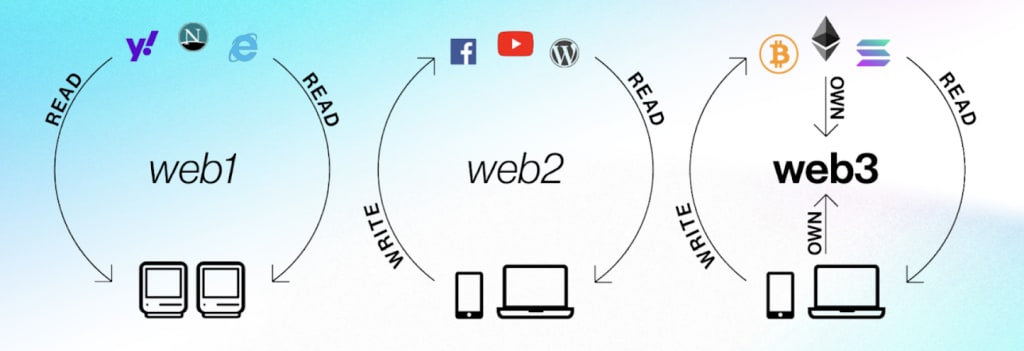
In the early days of the internet, it was primarily used for communication and information sharing. However, as more people began to use the internet, new possibilities for its use emerged. In the mid-2000s, a new technology called blockchain was introduced, which allowed for secure and decentralized record-keeping. This technology formed the basis for what would become Web3.
Web3 can trace its roots back to the early days of the blockchain technology. In 2008, a person or group of people going by the pseudonym Satoshi Nakamoto released a white paper that described a new decentralized digital currency called Bitcoin. The paper introduced the concept of the blockchain, a decentralized ledger that could be used to securely record transactions without the need for a central authority.
Bitcoin quickly gained a following among computer enthusiasts and libertarians, who saw it as a way to bypass traditional financial institutions and governments. However, it wasn't until a few years later that the true potential of the blockchain began to be realized.
In 2013, a programmer named Vitalik Buterin introduced a new blockchain-based platform called Ethereum. Unlike Bitcoin, which was primarily designed as a digital currency, Ethereum was designed to be a platform for creating decentralized applications. It introduced the concept of smart contracts, which are self-executing agreements that can be programmed to automatically execute when certain conditions are met.
The introduction of smart contracts opened up a whole new world of possibilities for the blockchain. Developers could now create decentralized applications that could be used for everything from crowdfunding to online marketplaces to social networks. However, these applications were still limited by the existing infrastructure of the internet.
The first step towards Web3 was taken in 2014 with the creation of the InterPlanetary File System (IPFS) by Juan Benet. IPFS is a distributed file system that allows for peer-to-peer sharing of files. Unlike traditional file systems, which are centralized and rely on a single point of failure, IPFS uses a distributed network of nodes to store and share files. This makes it much more resilient and censorship-resistant than traditional file systems.
IPFS was quickly adopted by the Ethereum community as a way to store and share data on the blockchain. This led to the creation of the first decentralized applications, or dApps, which were built on top of Ethereum and used IPFS for file storage. However, these dApps were still limited by the existing infrastructure of the internet.
The next major step towards Web3 came in 2017 with the introduction of the Web3.js library by the Ethereum Foundation. Web3.js is a JavaScript library that allows developers to interact with the Ethereum blockchain using standard web development tools. This made it much easier for developers to create decentralized applications that could be accessed using a web browser.
Around the same time, a new type of decentralized application called a decentralized autonomous organization (DAO) began to emerge. These organizations are run by smart contracts and operate on the blockchain, allowing for decentralized decision-making and governance. The most famous example of a DAO is The DAO, which was created in 2016 and raised over $150 million in funding before being hacked and ultimately dissolved.
Today, Web3 is still in its early stages, but it holds enormous potential for the future of the internet. With Web3, it's possible to create truly decentralized applications that are free from the control of any single entity. This has the potential to revolutionize everything from social networks to e-commerce to finance. Now Web3 has become one of the most popular ways of earning money in today's time!
About the Creator
Keep reading
More stories from writers in Education and other communities.
The Transformative Power of Soft Skills in Modern Success
In today’s fast-paced world, technical knowledge alone is rarely sufficient to achieve long-term success. Soft skills—the interpersonal, emotional, and cognitive abilities that shape how we interact with others—have become equally, if not more, essential. These skills include communication, empathy, adaptability, teamwork, and problem-solving. People who cultivate soft skills are not only better equipped to navigate complex situations but also more capable of influencing others, building strong relationships, and achieving sustainable success.
By Kurt James Wichman 4 days ago in Education
What Should Be Your Main Focus During an Online Limited Radiology Tech Program
Well, the short answer is that there is not a single module that you should strictly focus on. If you want to become a X-ray technician, you need to develop both technical and soft skills.
By Meaghan Howe5 days ago in Education




Comments
There are no comments for this story
Be the first to respond and start the conversation.