
Venus
Venus: Earth’s Fiery Twin—A Detailed Exploration of the Second Planet
Introduction
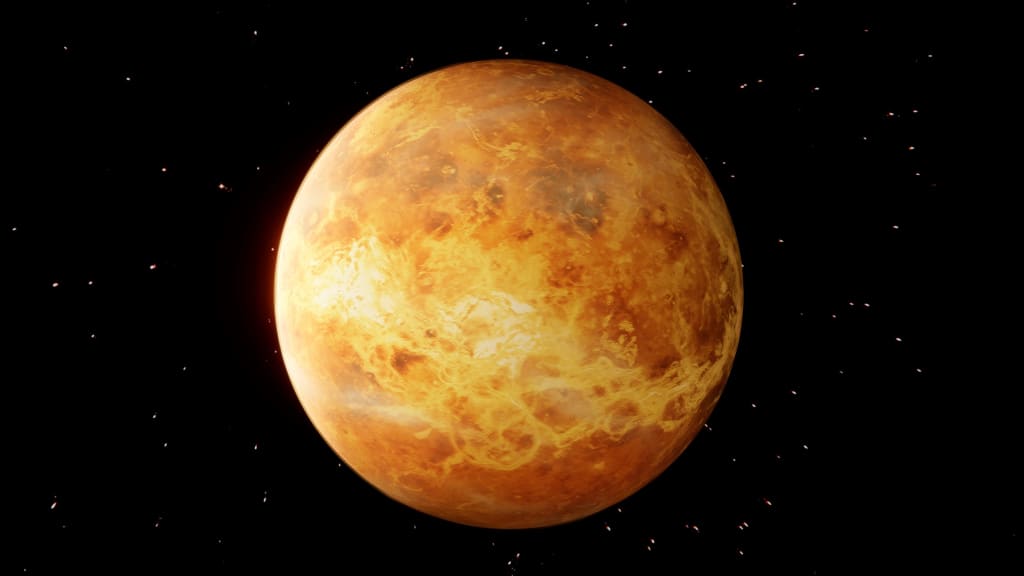
Venus, often called Earth’s twin, is the second planet from the Sun and one of the most fascinating worlds in our solar system. Despite its similar size and composition to Earth, Venus is a hellish landscape of scorching temperatures, crushing atmospheric pressure, and toxic clouds. This article explores Venus in detail—covering its physical characteristics, atmosphere, surface conditions, exploration history, and mysteries that still puzzle scientists.
Basic Facts About Venus
Distance from the Sun: 108 million km (67 million miles)
12,104 km (7,521 miles) in diameter, which is about the same as Earth's. Mass: 81.5% of Earth’s mass
Gravity: 90% of Earth’s gravity
Orbital Period (Year): 225 Earth days
Rotation Period (Day): 243 Earth days (longer than its year!)
Surface Temperature: ~465°C (869°F), the hottest planet in the solar system
Atmospheric Pressure: 92 times Earth’s (equivalent to being 900 meters underwater)
Why is Venus Called Earth’s Twin?
Venus and Earth share several key similarities:
Similar size and mass
Rocky composition (terrestrial planet)
Even though Venus' atmosphere is deadly, Volcanic activity and possible tectonic movements
However, Venus took a drastically different evolutionary path, becoming an uninhabitable inferno while Earth flourished with life.
The Deadly Atmosphere of Venus
Venus’s atmosphere is 96.5% carbon dioxide (CO₂), with traces of nitrogen and sulfuric acid clouds. This dense atmosphere creates
1. Extreme Greenhouse Effect
The thick CO₂ traps heat, making Venus hotter than Mercury despite being farther from the Sun.
Surface temperatures remain consistently above 450°C (842°F)—hot enough to melt lead.
2. Crushing Pressure
The atmospheric pressure is 92 times Earth’s, equivalent to the pressure nearly a kilometer underwater.
Any spacecraft landing on Venus must withstand immense forces—most have been crushed within hours.
3. Acidic Clouds
The upper atmosphere contains sulfuric acid clouds, which reflect sunlight, making Venus the brightest planet in the night sky (after the Moon).
These clouds also contribute to acid rain, though it evaporates before hitting the ground due to the extreme heat.
The Surface of Venus: A Volcanic Wasteland
Due to its thick clouds, Venus’s surface remained mysterious until radar mapping by spacecraft revealed its features:
1. Volcanic Plains
80% of Venus is covered in smooth volcanic plains, suggesting massive lava flows in the past.
Scientists believe Venus may still have active volcanoes, but no eruptions have been directly observed.
2. Ranges of mountains and highlands Maxwell Montes is the highest peak, rising 11 km (7 miles) above the average surface level.
Ishtar Terra & Aphrodite Terra are continent-sized highland regions.
3. Impact Craters (But Fewer Than Expected)
Venus has far fewer craters than Mercury or Mars, suggesting its surface is relatively young (300-600 million years old).
Possible causes include global resurfacing by volcanic activity.
Tectonic activity is erasing old craters.
The Strange Rotation of Venus
There are two bizarre rotational features on Venus: Retrograde Rotation: It spins backward (clockwise) compared to most planets.
A possible explanation: A giant impact early in its history flipped its rotation.
Slowest Rotation in the Solar System:
A day on Venus (243 Earth days) is longer than its year (225 Earth days).
The sun rises in the west and sets in the east due to its backward spin.
Missions to Venus: Past, Present, and Future
Despite its harsh conditions, Venus has been a key target for space exploration.
Past Missions
1960s-80s Soviet Venera Program: Venera 7 (1970)—First successful landing; survived 23 minutes before succumbing to heat and pressure.
Venera 9 (1975)—Sent back the first images of Venus’s surface.
NASA’s Magellan (1989-1994):
Mapped 98% of Venus’s surface using radar.
Current Missions
Japan’s Akatsuki (2010–present):
Studying Venus’s atmosphere and weather patterns.
Future Missions
NASA’s DAVINCI+ & VERITAS (Late 2020s):
DAVINCI+ will analyze atmospheric composition.
VERITAS will create high-resolution surface maps.
ESA’s EnVision (2030s):
Will study volcanic and tectonic activity.
The Big Mysteries of Venus
Despite decades of study, Venus still holds many secrets:
1. Was there once an ocean on Venus? Some scientists believe Venus may have had liquid water billions of years ago before a runaway greenhouse effect boiled it away.
2. Is There Active Volcanism Today?
Recent studies suggest possible lava flows, but no direct evidence yet.
3. Could Life Exist in Venus’s Clouds?
In 2020, astronomers detected phosphine gas in Venus’s atmosphere—a possible sign of microbial life.
However, this finding is still up for debate and requires additional investigation. Conclusion: Why Study Venus?
Understanding Venus helps scientists
✔ Learn about Earth’s climate future (as a warning against runaway greenhouse effects).
✔ Study extreme planetary environments for astrobiology.
✔ Prepare for future exploration, including possible floating habitats in its upper atmosphere.
Venus remains one of the most mysterious and hostile worlds in our solar system—a planet of extremes that continues to challenge our understanding of planetary science.
About the Creator
Keep reading
More stories from ratul khondoker and writers in Education and other communities.
Trump Seeks 'Total Reset' in US-China Trade
Geneva, Switzerland— Former U.S. Following a series of high-level negotiations in Geneva, President Donald Trump has announced a "total reset" in trade relations between the United States and China. The discussions, held between senior economic officials from both nations, sought to address years of escalating tariffs, intellectual property disputes, and supply chain tensions that have strained the world’s two largest economies.
By ratul khondoker9 months ago in Journal
Prevention First: How Proactive Medical Care Builds Stronger Communities
Preventive medical care plays a critical role in shaping healthier communities. When people receive care before illness develops, they avoid many severe conditions. This approach improves quality of life and reduces strain on healthcare systems. Moreover, prevention supports long-term wellness rather than short-term treatment. Communities that prioritize preventive care experience lower rates of chronic disease. As a result, individuals remain active and productive. Preventive care, therefore, serves as the foundation for sustainable public health.
By St. John's Community Health4 days ago in Education
Starting Strong: Learning the Basics of Investment Management
Investment management involves managing money set aside to grow over time. It is about deciding how and where to put money so that it earns more in the future. This process includes choosing among options such as stocks, bonds, or real estate. It also involves planning how long to hold these investments and how to react when markets change. For beginners, learning about investment management is the first step toward gaining control over their financial future.
By Winston Feng3 days ago in Education




Comments
There are no comments for this story
Be the first to respond and start the conversation.