
UPDATE ON RUSSIA/NATO-UKRAINE CONFLICT
The long awaited Ukraine Spring Counteroffensive.
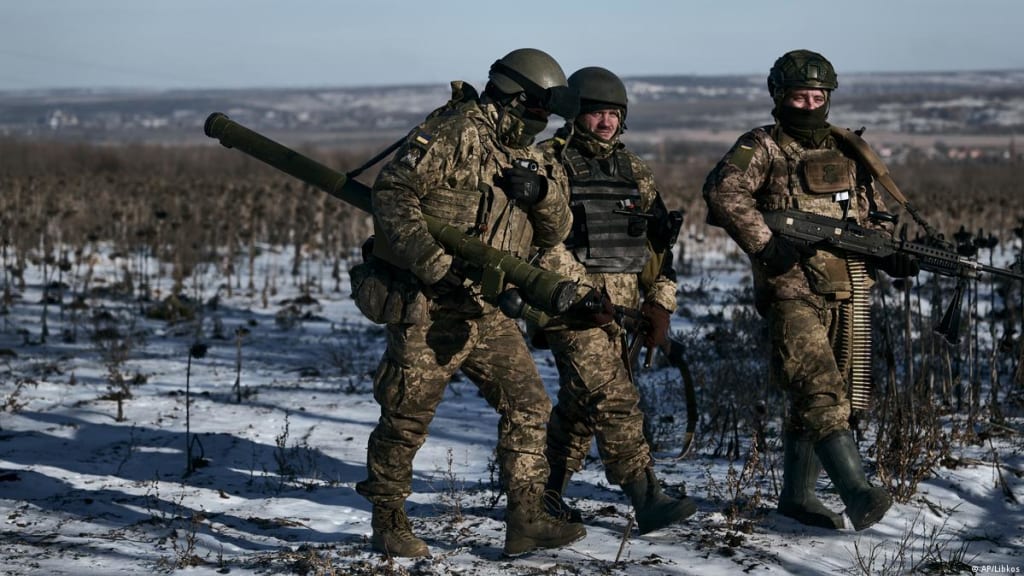
Since August 2022 reports have been awash in Western media of Ukrainian counteroffensive to reclaim Crimea and other occupied areas in the Donbass by Russia.
In August 2022, a Russian airbase deep behind the frontline in Crimea was damaged by several large explosions, killing at least one person, although it was not immediately clear whether it had been targeted by a long-range Ukrainian missile strike. Even though Ukraine denied involvement Western media attributed the explosion to a counteroffensive by Ukraine.
In October 2022, another attack on the Crimea bridge was also reported to be the continuation of the intention to recapture Crimea and the regions occupied by Russia.
Two Ukrainian officials who spoke to POLITICO suggested more directly that Kyiv was behind the explosions. The two officials said the explosions at the airfield indicated that this counterattack was now beginning in earnest.
Asked by POLITICO whether the blasts can be viewed as the start of Ukraine’s counterattack in the country’s south, a Ukrainian official, speaking on condition of anonymity because they weren’t authorized to speak to reporters on the record, responded in the affirmative.
“You can say this is it,” the official said. He also added that the airfield blasts were a message to Russia that they “are safe nowhere.”
Despite these rhetorics from Ukraine, no major Ukrainian counteroffensive has occured anywhere on the battlefield.
Since March 2023, there have been reports that Ukraine has received enough weapons and recruited enough manpower to launch a major counteroffensive to dislodge Russia from captured areas in Ukraine, and to force Russia to surrender. This according to Western sources will be the end of the 'Russian empire'.
According to TheBulwark, reporting on 22 March 2023, "in light of the U.S. political calendar, the next few months may be Ukraine’s last chance for a major counteroffensive.
Slowly but surely, tension is ramping up among Ukraine’s Western allies over a counteroffensive to be launched by Kyiv this year. It’s unclear when the expected attack will begin, or where it will fall, but hopes are high that it will turn the tide of the war decisively in Ukraine’s favor."
This anticipated and much publicized counteroffensive is scheduled for the Spring which falls between March and May 2023.
WHERE ARE THE UKRAINIAN TROOPS AND WEAPONS FOR THIS COUNTEROFFENSIVE?
The strongest Ukrainian defences in Bakhmut have almost crumbled, and in a few weeks, Bakhmut will be declared fully captured by Russia. Ukraine had concentrated almost all its manpower and weapons in Bakhmut to defend it. Reports show that the entire elite Ukrainian forces have been destroyed. Almost all the Western supplied weapons have been destroyed. Ukrainian soldiers are surrendering and deserting the battlefield for lack of weapons and other logistics. At all fronts, from Kharkiv, Kherson, Lughansk, Dorniesk, and Zarporizhia regions, the Ukrainian forces are being destroyed with no hope of any counteroffensive.
According to reports, all the various Leopard 2 Tanks supplied by over 8 European countries are obsolete because they all use different calibres of artillery and shells.
The Abrams Tanks promised by the USA are expected between September and December 2023.
According to reports, most of the MIG-29s supplied by Poland and others are reported to be unable to fly for battle and being cannibalized for repairing other planes. NATO and allies have exhausted their weapons for Ukraine.
Irreplaceable weapons
A failed counteroffensive would also raise immediate practical concerns for the Ukrainians, because much of the military equipment that has already been donated to Ukraine is not easily replaceable.
When the Slovak government announced recently that it would send its fleet of MiG-29 fighter jets to Ukraine, the nation’s president Zuzana Caputova said the move exhausts the country’s available military stocks for Ukraine. Other key suppliers of the kinds of Soviet-era equipment with which Ukrainians are familiar have also sent everything they can.
Speaking in Poland, Petr Pavel—the new Czechoslovakian president and the former chairman of the NATO Military Committee—warned that a Ukrainian counteroffensive “should happen within a few months. The window of opportunity is open this year, but after next winter, it will be extremely difficult to maintain the current level of aid.”
The new strategy of Modern Warfare?
For the first time in modern warfare the Ukrainians inform the Russians when they are going to counterattack. The Russians are given months of advance warning to get ready. This certainly looks like a concert which surprisingly is the profession and specialty of the Ukrainian President.
At a time that we know that the Ukrainians do not have the capability to repel the Russians, the Americans allow a leaked report to announce logistical shortages in the Ukrainian front just to give the Ukrainians a pretext to abort their so-called counteroffensive with the excuse that their strategies have been leaked and exposed.
TheBulwark reports that, an ineffectual counterattack leading to the destruction of donated Western military equipment and little to show in return would be a political calamity, making allied politicians and Western voters question the value of further support.
Ukraine’s ability to keep fighting depends entirely on Western political developments that are out of its control.
A failed counteroffensive would also raise immediate practical concerns for the Ukrainians, because much of the military equipment that has already been donated to them is not easily replaceable.
The contentious issue of supplying modern Western fighter jets, for example, is a red herring, at least as far as this year’s crucial fighting is concerned. Czech President Pavel points out that given the training and maintenance procedures required, such planes wouldn’t be operational in Ukraine until 2024 even if deliveries were agreed upon today.
The debate over modern planes has been the clearest example of how Western hesitancy could end up damaging Ukraine’s counteroffensive. In order to influence the crucial phase of fighting this year, an agreement on Western jets would have been needed months ago. Instead, futile arguments only distracted from more practical steps, such as the deliveries of Soviet-era aircraft that are only now taking place.
It’s the same story with battle tanks and ammunition. American and European partners are taking steps now that they should have taken months ago, given the all-important nature of this year’s long-awaited counteroffensive, and the time needed to produce, transport, and integrate new weapons systems. As Ukraine desperately calls for more ammunition, arms manufacturers are still waiting for the orders that they need to ramp up production.
Ukrainian allies say they are with Ukraine for “as long as it takes.” But the longer the war goes on without significant Ukrainian gains, the more politically contentious military support will become.
Leaked U.S. intelligence suggests that Ukrainian stockpiles of missiles for its air defense systems are depleting, giving a potential opening to Russia's notorious air force.
"Without air superiority, carrying out offensives under the fire of enemy aircraft is — to put it mildly — a somewhat difficult issue," Ukrainian air force spokesman Yuriy Ignat said recently.
The leaks appear to suggest that Ukraine is low on some hardware and precision ammunition.
Confusion galore!
The Ukrainian military has been talking since late last year about plans for a major counteroffensive.
The Pentagon documents, if they are to be believed, indicated that the offensive was planned to start on 30 April.
In late March, Ukrainian President Volodymyr Zelenskyy noted that the Ukrainian Armed Forces were not yet ready for large-scale operations. And Prime Minister Denys Shmyhal indicated in mid-April that a counteroffensive could be expected in the summer.
When will the operation start?
Western experts are more inclined to the Prime Minister's position: late autumn, or even early summer.
“They want good weather conditions so that they can conduct offensive manoeuvre operations,” said Robert Cullum, Lecturer in Defence Studies, King’s College London.
I wonder when war has been conducted like this with a superpower. Is the enemy waiting for the weather to also clear before offensive action? I learnt that the Ukrainians only fight during the day and go into hiding during the night. Very interesting war strategy.
Finding excuses for failure and propaganda.
According to Euronews:
1. The leaks of secret Pentagon documents could be a disadvantage for Kyiv.
2. According to Western intelligence, Russia is fortifying almost the entire front line on Ukrainian territory, some 800 km long. These strips, according to media reports, consist of several lines of anti-tank trenches, trenches, barbed wire, obstacles and all sorts of fortified firing points.
3. Nuclear defence
The Kremlin has increasingly resorted to nuclear rhetoric in recent months, and at the end of March a decision was taken to deploy Russian nuclear weapons on the territory of Belarus. However experts doubt Russia would resort to a nuclear strike if the Ukrainian push proved successful.
4. Ukrainian politicians periodically claim that a decisive counter-offensive in the spring and summer could bring the war to an end before the end of the year. Western experts are very cautious about this, while paying tribute to the high morale of Ukrainians.
Western/NATO dependence on rumors.
According to RadiofreeEurope, Reporting from Russian Bloggers that the Ukrainian military has crossed the Dnieper River and established positions on the eastern side heightened expectations on April 23 that Kyiv is on the verge of its long-awaited counteroffensive.
The influential U.S. Institute for the Study of War (ISW) argued in its regular update on April 22 that "Russian milbloggers have provided enough geolocated footage and textual reports to confirm that Ukrainian forces have established positions in east (left) bank of Kherson Oblast as of April 22 though not at what scale or with what intentions."
The ISW added that geolocated footage from Russian military bloggers indicated that Ukrainian forces had established a bridgehead north of the town of Oleshkiy and that they have put in place "stable supply lines to these positions" in the Kherson region. Battlefield reports could not be independently confirmed, yet reporting with precision.
The Ukrainian military declined to confirm or deny the reports that its troops had taken up positions on the partly Russian-controlled bank of the strategically crucial Dnieper River.
A spokeswoman for the Southern Defense Forces of Ukraine, Natalia Humenyuk, said in televised comments that crossing an obstacle like the "wide and powerful" Dnieper was "very difficult work."
"Therefore, the conditions of a military operation require informational silence until it is safe for our military," she said. "That's why we need to be patient."
She added that "informational silence should be observed" also in light of wartime disinformation efforts by an enemy.
Since when did the Ukrainians realize that informational silence was essential in warfare? Couldn't they have kept their counteroffensive operations silent for a surprise? What is happening?
Russia is focused on its objectives.
According to Ukraine's General Staff, Russia's "main effort is focused" on offensive operations in the areas of Bakhmut, Maryinka, and Avdiyivka.
It also said Russian "defensive operations" were continuing farther south in and around Zaporizhzhya, which hosts an occupied nuclear power plant, and Kherson.
In Kharkiv, the head of the local administration, Oleh Synyehubov, said via Telegram that Russian bombardments with S-300 missiles and other weapons were targeting the city and the district.
Ukraine is still asking for more
Meanwhile, Ukrainian leaders continued to press their Western allies for additional military supplies on top of the billions of dollars worth of armaments and aid already sent.
On April 22, Deputy Foreign Minister Andriy Melnyk said that while Ukraine was grateful for assistance so far, "it is not enough."
"Ukraine needs 10 times more to finish Russian aggression this year," Melnyk wrote on Twitter. "Thus we call upon our partners to cross all artificial red lines & devote 1% of GDP for Ukraine weapons deliveries." Interesting times ahead.
What is stopping the Armed Forces of Ukraine (AFU) from advancing now?
One of the main problems preventing the AFU from carrying out the announced offensive is considered to be a lack of experienced personnel.
A large portion of the combat-ready, equipped and motivated cadre units of the AFU (as well as the National Guards of Ukraine (NGU) and Territorial Defense) have already been destroyed in Mariupol, Artemovsk, Soledar, Popasnaya, Lisichansk, Severodonetsk and during the battles in the Kherson and Kharkov regions in the summer of 2022.
*What difficulties does the AFU face?*
The conceptual problem of the offensive is the lack of surprise. AFU units are awaited from all directions – from Artemovsk to Kherson, so it is extremely difficult to surprise Russian forces in such a situation. Moreover, the movements of the Ukrainian army are well monitored, and it is almost impossible to accumulate a group of 20,000-150,000 troops unnoticed in such conditions. If they abandon massing their soldiers, and spread the forces across the front, all the advantages of large numbers are lost.
An additional difficulty is time. Delaying an offensive means not only guaranteeing the loss of Artemovsk/Bakhmut, which is being cleared at the rate of two or three blocks every 24 hours, but also disrupting the plans of foreign partners and nullifying all the financial and military aid provided so far. Moreover, every day that the AFU's offensive is delayed is an extra day for the Russian army to prepare and reinforce.
Slow delivery of foreign equipment is also an issue.
The main technical difficulty is the lack of significant numbers of attack aircraft and air superiority.
The AFU attack is likely to be postponed to a later date, by which time both equipment and men will have gathered in sufficient numbers. In addition, the weather is forcing adjustments – it makes no sense to advance in rainy and muddy conditions.
WILL THE UKRAINIANS EVACUATE BAKHMUT OR WILL THEY STAGE A COUNTERATTACK AND BE DESTROYED?
About the Creator
FUSHEINI BAWAH ZAKARIA
For international conflict analysis and political science and leadership including leadership theories analysis.
Reader insights
Outstanding
Excellent work. Looking forward to reading more!
Top insight
Heartfelt and relatable
The story invoked strong personal emotions
Keep reading
More stories from writers in Education and other communities.
Why and How Learning French Through Business and Entrepreneurship Changes Everything
Many people still learn French the way they learned subjects at school: grammar rules, exercises, vocabulary lists, and a lot of pressure to “do things right.” The problem is that this approach rarely works in the long run. You can do well in a textbook and still freeze the moment you have to speak in real life. Because when it’s time to talk, your brain is not looking for a rule. It’s looking for a reflex. It’s looking for flow. It’s looking for confidence.
By Bubble Chill Media 5 days ago in Education
Trouble at the Tea Leafing Café
The rain had started right around the time that Annie was buttering her second thick slice of homemade toast for breakfast, and hadn’t paused since. Not that anyone could tell. The windows of the café were fogged over, and with every seat filled with happy customers munching on fresh baked pastries or steaming bowls of the delicious soup of the day, it was hardly surprising. Annie looked around the room, finally taking a moment to breathe after the lunch time rush. Her old life already felt like a bad memory, a part of her history, always, but just that. History.
By Hannah Moore5 days ago in Fiction




Comments
There are no comments for this story
Be the first to respond and start the conversation.