
Unveiling a 500-Million-Year-Old Mountain Range Beneath the Ice
Unknown GAMBURTSEV Mountains
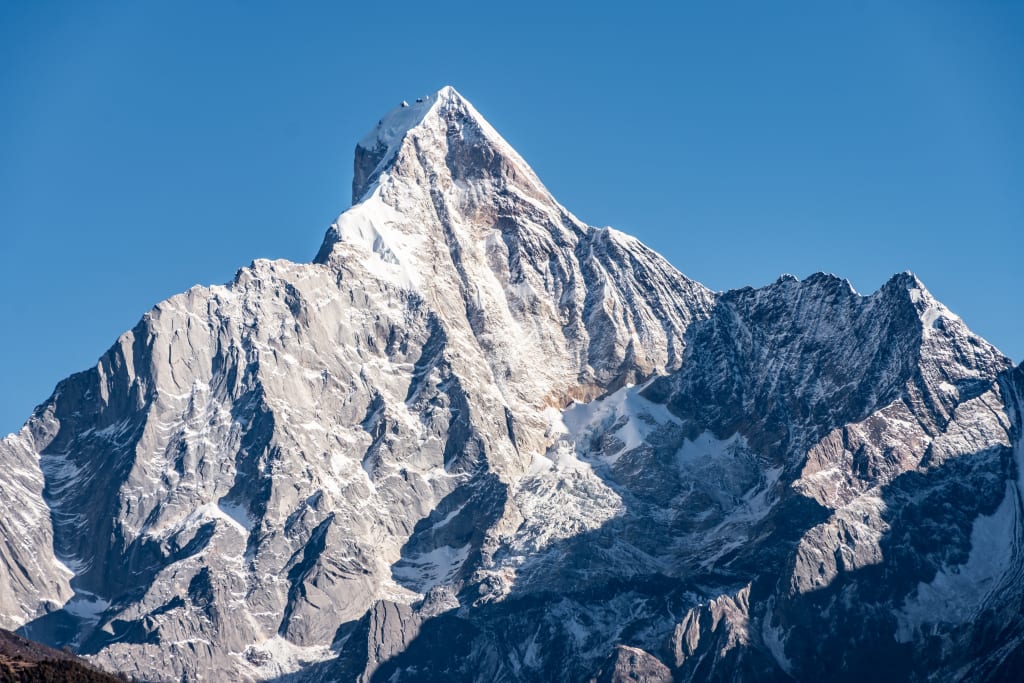
Beneath the frozen vastness of East Antarctica lies one of Earth's greatest geological mysteries: a massive mountain range completely buried under miles of ice. Known as the GAMBURTSEV Mountains, this range stretches over 1,200 kilometers—comparable in size and ruggedness to the European Alps—but remains entirely hidden beneath ice up to 4 kilometers thick.
First detected by Soviet scientists in 1958 during the International Geophysical Year, the GAMBURTSEV Mountains stunned the scientific world. Their discovery sparked a long-standing puzzle: how could such a towering and sharply defined mountain range exist in the middle of Antarctica, far from any active tectonic plate boundaries?
A Birth Over Half a Billion Years Ago
Recent studies have shed light on the ancient origins of this buried range. Using airborne radar and seismic imaging, researchers have traced its roots back over 500 million years, to a time when continents were colliding during the Pan-African orogeny—a mountain-building period that helped form the supercontinent GONDWANA.
Despite their ancient formation, the GAMBURTSEV Mountains appear relatively "young" in structure, with rugged peaks and deep valleys similar to freshly formed mountain chains. The Antarctic ice sheet is a remarkable natural preserver that is the cause of this. Scientists believe the thick ice has protected the mountains from erosion for tens of millions of years, keeping their dramatic features intact beneath the surface.
New Discoveries in a Frozen Time Capsule
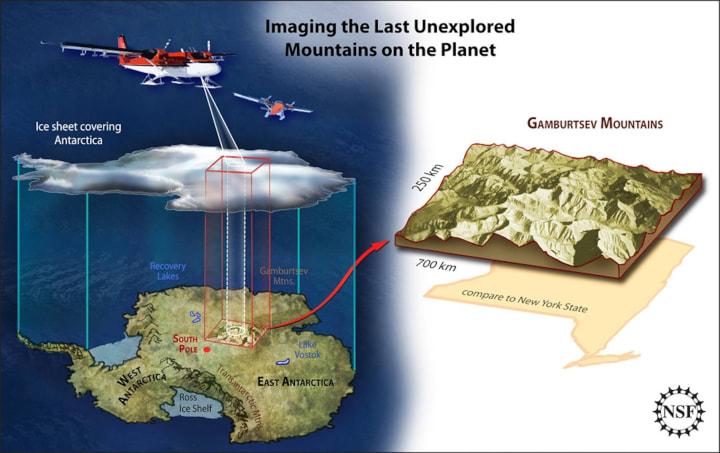
In 2023, an international research team made another astonishing revelation. Using radar data and satellite imagery, they identified a vast, ancient landscape buried beneath the ice, near the GAMBURTSEV range. This terrain, larger than Belgium, includes river-carved valleys, ridges, and plains that have remained untouched for at least 14 million years—essentially frozen in time.
This hidden landscape provides an unprecedented window into Earth’s distant past, showing what the surface may have looked like before Antarctica became entombed in ice. These findings, published in The Cryosphere, also help scientists understand how ice sheets develop and interact with the underlying terrain—key knowledge in the face of modern climate change.
Why This Matters Today
Understanding what lies beneath the Antarctic ice is more than a scientific curiosity—it's essential to our future. The melting of Antarctica's ice sheet could have devastating effects on sea levels worldwide as temperatures rise. The speed at which glaciers can move toward the ocean is greatly influenced by the shape of the land beneath the ice, which includes mountains like the GAMBURTSEV range.
Some models suggest that as melting accelerates, valleys and gorges under the ice could act as “fast tracks” for ice movement. Studying these landscapes allows scientists to better predict how Antarctica will respond to climate change and how much sea levels could rise as a result.
The Next Frontier
Despite incredible advances, the GAMBURTSEV Mountains remain largely unexplored. Scientists are pushing for deep-drilling missions to collect actual rock samples from the range, which could confirm theories about its formation and evolution. Such efforts are logistically daunting, requiring drilling through kilometers of solid ice in one of the harshest environments on Earth.
Nevertheless, the scientific potential is enormous. The GAMBURTSEV Mountains could reveal secrets about Earth’s geological past, the evolution of ice sheets, and even offer clues about how life might survive in extreme conditions—insights that may be relevant to the search for life on icy moons like Europa or Enceladus.
These frozen mountains remind us how much of our planet remains unseen and unknown. As technology advances, unlocking their secrets may not only reshape our understanding of Earth's past but also guide us in facing the climate challenges of the future. Antarctica still has many stories to tell.
About the Creator
Keep reading
More stories from writers in Education and other communities.
Part IV : Snippets of Somers Teachers
Click link for Photos from the 1970s https://rmonetti.blogspot.com/2022/11/somers-in-70s.html Mr. Carr. I never had the pleasure of going into Mr. Carr’s inner sanctum and receive introduction to his paddle. That said, as Junior High students we did all we could to not get to know Mr. Carr any better than you did. But he knew you. In transit, he’d look you in the eye, call you by name and always asked how you were doing. In other words, he gave us the respect we were due, and the sincerity had a message that was clear as day. Mr. Carr cared about every single one of us and that was really the foundation of the pulpit he sat on for the students of Somers Junior High.
By Rich Monettiabout 7 hours ago in Education
Diaries to Nietzsche
Quotation from Friedrich Nietzsche "He who wrestles long with monsters should beware lest he himself become a monster. And if you gaze long into an abyss, the abyss also gazes into you. Man is not destroyed by suffering, but by the meaning he makes of it."
By LUCCIAN LAYTH5 days ago in Critique



Comments
There are no comments for this story
Be the first to respond and start the conversation.