
Unlocking the Power of Sensory Toys in the Classroom: A Teacher’s Guide to Smarter, Happier Learning
Educational Benefits of Sensory Toys | Classroom Tools for Teachers

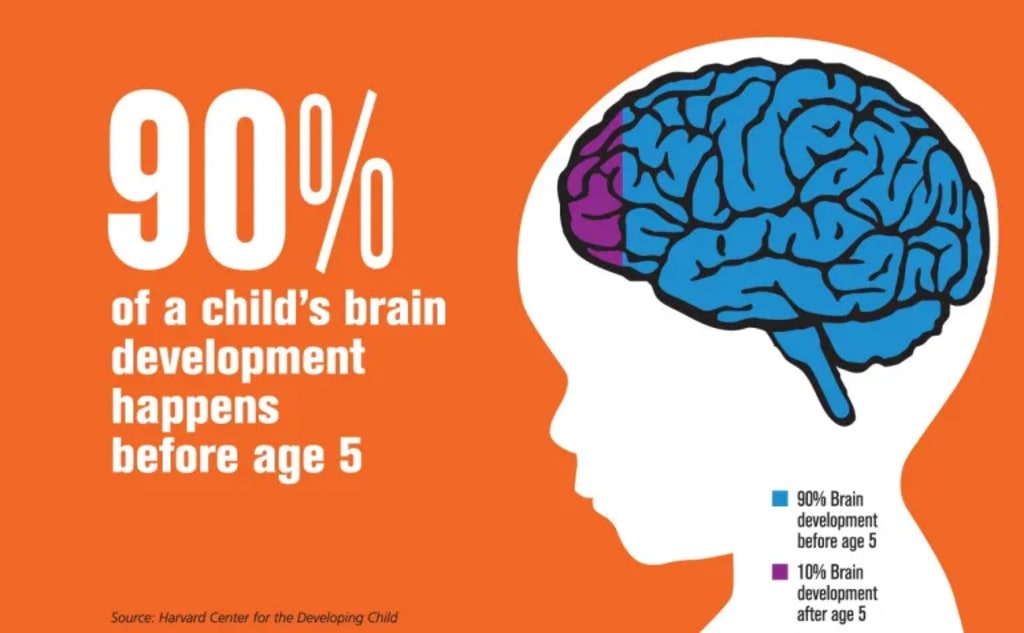
Why Sensory Toys Matter in Learning
Children are natural explorers of the world around them. Every texture they touch, every sound they hear, and every movement they make shapes how they understand their environment. Sensory toys tap into this innate curiosity, offering gentle tools that help them learn better, focus longer, and feel more comfortable in educational settings.
Backed by science, sensory tools—like textured fidget cubes, magnetic tiles, squishy stress balls, and stacking puzzles—have been shown to improve attention, regulate emotions, and boost classroom participation for both neurotypical and neurodivergent learners. These aren’t mere playthings—they are purposeful aids that meet essential sensory needs.
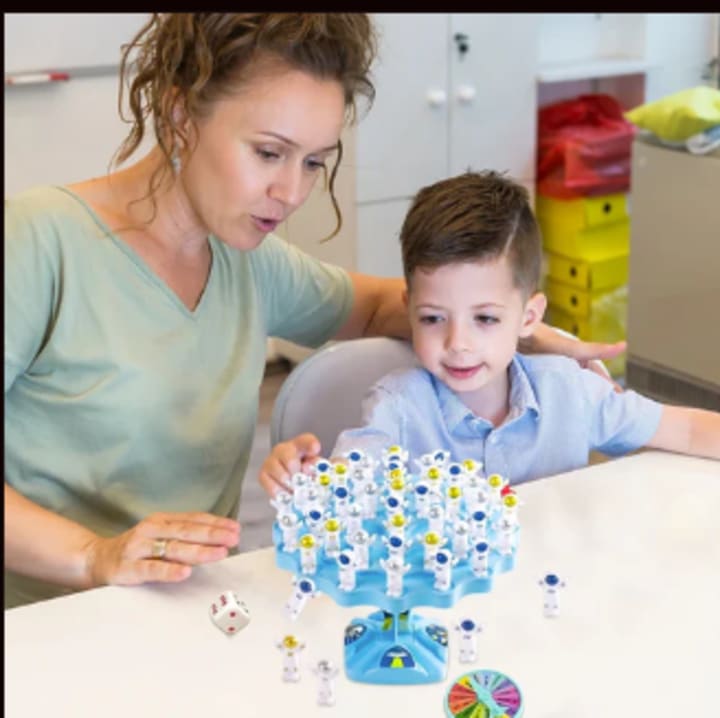
The Science Behind Sensory Play
Researchers agree: when children engage multiple senses during learning, they absorb and retain information more effectively. According to Shams & Seitz (2008), multisensory learning activates different brain regions, strengthening memory and comprehension.
For children with conditions like autism, ADHD, and sensory processing disorder (SPD), these toys serve an even more important role. Pfeiffer et al. (2011) demonstrated that sensory-based interventions improve attention, reduce anxiety, and enhance functional participation in classroom tasks.
How Teachers Can Introduce Sensory Toys in the Classroom
1. The Calming Corner
A calm-down space in the classroom can be life-changing for students who become overwhelmed or overstimulated. Teachers can stock this corner with weighted lap pads, soft squishy toys, and textured sensory boards. Five quiet minutes here can prevent meltdowns, helping students return to learning with a regulated nervous system.
2. Scheduled Sensory Breaks
Teachers can design short "brain breaks" using sensory tools—letting kids stretch putty, roll squishy cubes, or manipulate magnetic tiles between lessons. These breaks help children release built-up energy, improving concentration and lesson retention.
3. Sensory Tools During Lessons
Sensory toys aren’t only for breaks—they can be seamlessly integrated into active learning:
Math lessons: Use stacking blocks for counting or building symmetrical structures.
Problem-solving activities: Introduce puzzle teasers and riddles to encourage flexible thinking.
STEM projects: Employ magnetic tiles to teach geometry, balance, and spatial relationships.
4. Personal Sensory Kits
For children with sensory processing challenges, quiet personal kits at their desks can offer continuous support. Items like stress balls, discreet fidget strips, or textured pencil grips meet sensory needs without disrupting classmates.
5. Collaborative Sensory Play
Group sensory activities encourage cooperation and communication. Whether building a collective magnetic tile tower or solving a difficult puzzle teaser together, children practise patience, sharing, and teamwork—all vital social-emotional skills.
Why Sensory Play Benefits Every Child—Not Just Neurodivergent Learners
While sensory toys are essential for children with autism, ADHD, or SPD, mainstream learners benefit greatly too. All young brains need movement, touch, and novelty to stay engaged. In a world of long classroom hours and increasing screen time, sensory toys bring back the joy of hands-on discovery.
A quiet child who struggles to speak up in class might open up during a collaborative building project. An energetic student who can’t sit still might focus better with a textured fidget strip. These simple tools create flexible learning spaces where every child feels seen, safe, and successful.
The Research Speaks Clearly
Multiple scientific studies support the classroom use of sensory tools:
Shams & Seitz, 2008: Multisensory learning leads to stronger memory formation and understanding.
Sarver et al., 2013: Movement and fidgeting enhance task performance in children with ADHD.
Bazelmans et al., 2020: Sensory interventions regulate emotions and reduce distress in autistic children.
Pfeiffer et al., 2011: Sensory-based occupational therapy improves classroom participation and social interaction.
These findings are echoed by teachers who report calmer classrooms, longer focus periods, and happier students when sensory tools are thoughtfully used.
Creating Sensory-Friendly Classrooms: A Call to Action
By embracing sensory play, teachers can unlock the potential of every learner—regardless of background, ability, or sensory profile. Sensory toys bridge the gap between educational demand and developmental readiness, giving children the tools they need to succeed not just academically, but socially and emotionally.
A sensory-friendly classroom isn’t a luxury—it’s an evidence-based way to make learning accessible, engaging, and joyful for all.
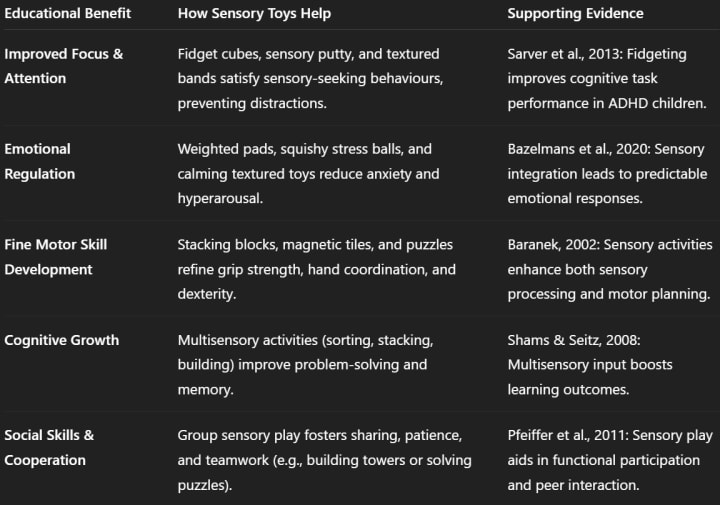
Key Educational Benefits of Sensory Toys
Further Reading (References)
Shams, L., & Seitz, A. R. (2008). Benefits of multisensory learning. Trends in Cognitive Sciences, 12(11), 411-417.
Pfeiffer, B., et al. (2011). Effectiveness of sensory integration interventions. American Journal of Occupational Therapy, 65(1), 76-85.
Sarver, D. E., et al. (2013). Hyperactivity and fidgeting improve task performance in children with ADHD. Journal of Abnormal Child Psychology, 41(6), 949-958.
Bazelmans, T., et al. (2020). Sensory processing differences in autism spectrum disorder: A meta-analysis. Journal of Autism and Developmental Disorders, 50(5), 1937-1952.
About the Creator
Susmit Bhowmik
As a PhD researcher with a clinical studies background, I’m passionate about evidence-based sensory tools that enhance learning, focus, and calm. I share science-led insights to help families and educators create sensory-friendly spaces.
Keep reading
More stories from Susmit Bhowmik and writers in Education and other communities.
Buddha's Inner Peace
In a world that never stops moving, the image of Buddha sitting in perfect stillness beneath the Bodhi tree offers something we desperately need: a reminder that true peace exists not outside ourselves, but within. The story of Buddha's enlightenment isn't just an ancient tale—it's a roadmap to discovering the profound calm that lies dormant in each of us.
By Susmit Bhowmik5 days ago in Families
Rewiring Wellness: How Neuroscience Is Redefining the Mind-Body Connection in Therapy
In recent years, neuroscience has reshaped the understanding of how emotional and physical processes interact, offering therapists new insight into healing. The mind-body connection, once viewed as more philosophical than scientific, now has clear biological explanations. Studies show that thoughts, emotions, and physical sensations are deeply intertwined, influencing everything from stress responses to overall wellbeing. This knowledge is transforming modern therapeutic practices by providing clinicians with evidence-based tools that support integrated healing.
By Debra Bailey PHDabout 14 hours ago in Education
Was Alexander the great really that great?
Order, order! Who do we have on the stand today? Alexander... the Great, eh? Well, what’s so great about him? Your honor, the better question is, what's not great about him? He was the King of Macedon and considered a living demigod by Egyptians and Greeks alike. He conquered Persia when it was one of Earth's largest empires. And he was a thoughtful student of Aristotle, creative enough to untie the impossibly tight Gordian knot by cutting it in half. The Gordian knot is a myth— just like the countless other stories invented to enhance Alexander’s legend!
By Munesh Yadavabout 6 hours ago in Education


Comments
There are no comments for this story
Be the first to respond and start the conversation.