
Unleashing the Unthinkable: When Jupiter Meets a Black Hole
A Collided With Black Hole

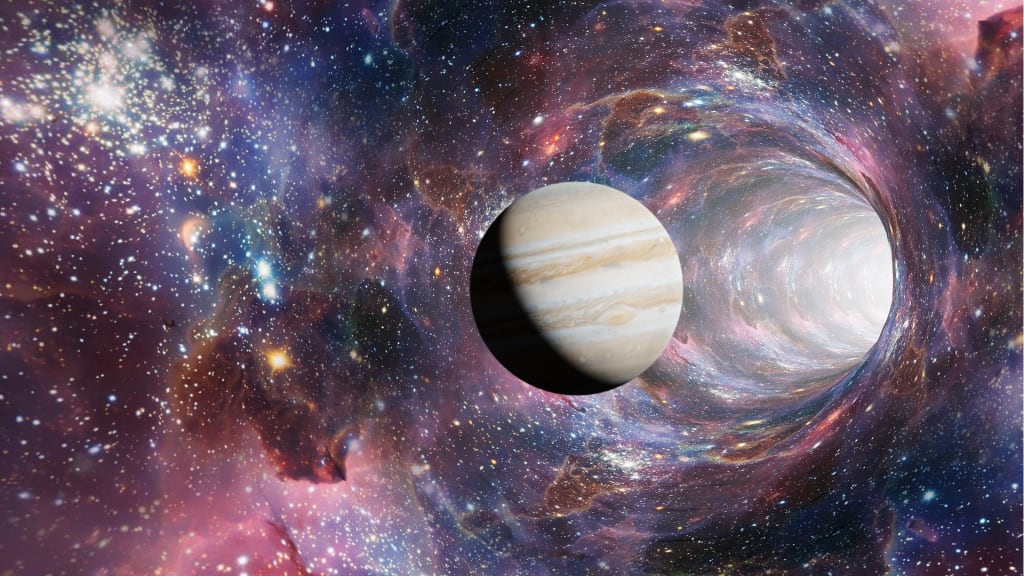
The collision between Jupiter, a gas giant, and a black hole, though infinitely small, would be a monumental event for our solar system. If these two rivals were to hurtle towards each other, the consequences would be catastrophic. One major outcome of this event would be Earth being bombarded by asteroids, posing a significant threat to our planet. The question arises, would this collision spell the end of our solar system? In this article, we will explore what would happen if Jupiter collided with a black hole and shed light on the possible implications of this event.
Before we delve into the potential collision between Jupiter and a black hole, let's take a closer look at each contender. Jupiter, the fifth planet from the Sun, is a fan favorite in our solar system. It is located approximately 740 million kilometers from the Sun and is the largest planet, with a mass of about 318 times that of Earth and twice the mass of all other planets in the vicinity combined. However, appearances can be deceiving, as Jupiter's weight may not be as impressive when compared to its opponent, the black hole.
Stellar black holes may be smaller in size than our gas giant Jupiter, but they possess tremendous power. The defining characteristic of black holes is their extraordinary density, where all of their mass is concentrated within an infinitely small point known as a singularity. Within this region, time and space lose their conventional meaning, making it a place of intense physical distortion. Furthermore, due to their massive mass, black holes have an incredibly strong gravitational pull, which can have a significant impact on their surrounding environment.
Black holes, specifically stellar black holes, are typically the result of massive stars collapsing. These types of black holes can range in mass from 3 to 10 times that of our Sun. However, due to their extreme density, even a black hole with a mass 10 times that of our Sun would only be 60 kilometers in diameter if it were to appear in our solar system. In light of this, it begs the question: if Jupiter were to collide with a black hole, could it possibly win against its minuscule yet overwhelmingly powerful opponent, or would it inevitably succumb to the black hole's point of no return?
The universe is in constant motion, with everything, including our solar system and the Sun, hurtling through space at a tremendous velocity of approximately 720,000 kilometers per hour. While we traverse through the galaxy, we remain vulnerable to external factors that could influence our solar system's outer regions. One such factor could be the gravitational pull of a passing star. Alternatively, we may even encounter one of the nearly 1 billion black holes that are rampaging throughout the Milky Way galaxy, potentially causing significant disruptions to our solar system.
Although the likelihood of a star coming close enough to disrupt our solar system is small, scientists estimate a one percent chance of such an occurrence. The possibility of a rogue star interfering with Jupiter is even lower, but it cannot be completely ruled out. If a black hole were to approach our solar system, it would initially disrupt the Oort cloud. This vast region encircles our solar system and is teeming with icy objects, which would prove to be no match for the black hole's immense gravitational pull. As the black hole continues on its path, it would encounter the Kuiper belt, where it would wreak havoc by ejecting objects, including dwarf planet Pluto, from their orbits. This would create a dangerous situation for Earth as many of these objects would now be on a collision course with our planet.
In the event of a black hole entering our solar system and colliding with Jupiter, it would cause catastrophic effects. As it approaches, the black hole would first disrupt the Oort cloud and then move towards the Kuiper belt, causing the ejection of many icy objects from their orbits. This would put Earth at risk of a deadly collision with these objects. Moving further inwards, the black hole would rip away gases from Neptune, Uranus, Saturn, and eventually, Jupiter. Jupiter's atmosphere would be torn away, and its entire mass would be pulled toward the black hole, which would then create an accretion disk of superheated gas and dust around itself. In addition to this, the black hole would release deadly radiation in the form of UV and x-rays, which would reach Earth within an hour of the collision.
The absence of Jupiter in our solar system would have a significant impact on its stability. Jupiter's massive gravity helped to protect inner planets, including Earth, from asteroid and comet collisions. Without it, the inner planets would be vulnerable to these collisions and would struggle to maintain their orbits around the sun. Even if we managed to survive the collision, the black hole would continue to wreak havoc on our solar system and ultimately lead to Earth's destruction. Therefore, the scenario of a black hole entering our solar system and colliding with Jupiter is a catastrophic event that we hope will never happen.
About the Creator
Keep reading
More stories from writers in Education and other communities.
From Global Journeys to Local Goals: The Influence of Repatriation on College Planning and Service Engagement
Repatriation marks a turning point in a student’s educational path. After spending formative years abroad, students return to the United States carrying diverse academic experiences and expanded worldviews. This transition often coincides with critical stages of high school when college planning intensifies. As families resettle, they must navigate both emotional adjustments and practical decisions that shape future academic opportunities.
By Carmen Reidabout 14 hours ago in Education
Clinical Training and Professional Development Best Practices for Modern Healthcare Teams
Effective clinical training and professional development are essential for delivering safe, high-quality patient care. Healthcare organizations must adopt structured, evidence-based strategies to ensure clinicians remain competent, confident, and prepared for evolving challenges. By implementing proven best practices, institutions can strengthen workforce performance, improve patient outcomes, and foster long-term professional growth.
By Evyatar Nitzanya day ago in Education




Comments
There are no comments for this story
Be the first to respond and start the conversation.