
"Understanding Einstein's Famous Equation: E=mc²"
"The Equation That Revolutionized Physics and Energy"

INTRODUCTION OF ALBERT EINSTEIN
Albert Einstein (14 March 1879 – 18 April 1955) was a German-born theoretical physicist who is widely regarded as one of the most influential scientists of the 20th century.
He is best known for his groundbreaking work in developing the theory of relativity and his famous equation E=mc², which describes the relationship between mass and energy.
Einstein was born in Ulm, in the Kingdom of Württemberg, in Germany. He showed an early aptitude for mathematics and physics and went on to study at the Swiss Federal Polytechnic in Zurich.
After graduating in 1900, he spent several years working as a patent clerk in Bern, Switzerland, where he developed many of his groundbreaking ideas.
In 1905, Einstein published a series of papers that fundamentally transformed our understanding of the nature of the universe.
These papers included the development of the theory of special relativity, which proposed that the laws of physics were the same for all observers regardless of their relative motion.
Einstein continued to work on the theory of relativity throughout his life, and in 1915 he published his theory of general relativity, which proposed that gravity was not a force but rather a curvature of space-time.
In addition to his work on relativity, Einstein made significant contributions to the field of quantum mechanics, which describes the behavior of matter and energy on a very small scale.
He was awarded the Nobel Prize in Physics in 1921 for his work on theoretical physics.
Einstein was also an outspoken advocate for peace and social justice. He was a pacifist and a supporter of international disarmament, and he was a vocal critic of fascism and the Nazi regime in Germany.
Today, Einstein is widely recognized as one of the greatest scientists of all time, and his work has had a profound impact on modern physics and our understanding of the universe.
His legacy continues to inspire scientists and thinkers around the world, and his name has become synonymous with genius and innovation.
Einstein died on April 18, 1955, at the age of 76, from an abdominal aortic aneurysm.
He left behind a legacy as one of the greatest scientists of all time, and his work continues to influence modern physics and our understanding of the universe.
E=MC2:
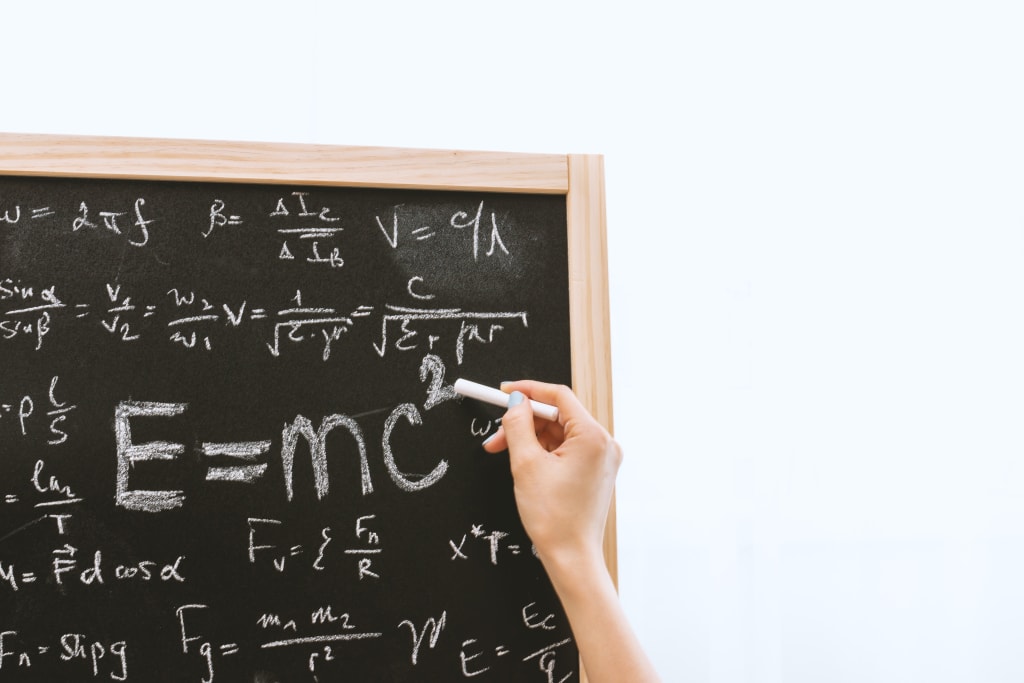
"E=mc²" is a mathematical equation that represents the relationship between mass (m) and energy (E).
It starts with the letter "E" which stands for energy, followed by an equals sign (=), and then "m" which stands for mass, multiplied by the speed of light (c) squared (²). The equation is usually written as E=mc².
Today, E=mc² remains one of the most famous and fundamental equations in physics, and its implications continue to be explored and applied in various fields of science and technology.
E=mc² is one of the most famous equations in physics, proposed by the renowned scientist Albert Einstein in 1905.
It is a fundamental equation that relates mass and energy, and is often used to explain the relationship between matter and energy in the universe.
The equation itself is deceptively simple, with only a few variables.
E stands for energy, m stands for mass, and c stands for the speed of light in a vacuum, which is a constant value of approximately 299,792,458 meters per second.
The equation states that the amount of energy contained within an object is equal to its mass multiplied by the speed of light squared.
This means that even a small amount of matter contains an enormous amount of energy, which can be released through processes such as nuclear reactions.
E=mc² has had profound implications in physics, including the development of nuclear energy and weapons.
It is also a key concept in understanding the nature of the universe and the interplay between matter and energy.
The equation has also captured the imagination of the public and has become a symbol of scientific discovery and innovation.
It is often used in popular culture and is frequently referenced in movies, books, and other media.
In summary, E=mc² is a groundbreaking equation that represents the relationship between mass and energy, and has had significant impacts on both the scientific community and popular culture.
Einstein's Legacy: The Continuing Impact of E=mc² on Modern Science
"Einstein's Legacy: The Continuing Impact of E=mc² on Modern Science" highlights the significance of the equation E=mc² and its lasting impact on the development of modern science.
This subtitle emphasizes how Einstein's equation fundamentally changed the way we view the universe, paving the way for advances in fields such as nuclear physics, astrophysics, and cosmology.
The legacy of E=mc² is still being felt today, as scientists continue to explore its implications and apply its principles in new ways.
This subtitle also suggests that E=mc² is not just a historical curiosity, but a living idea that continues to shape our understanding of the world around us.
By examining the ongoing impact of E=mc², we can gain a deeper appreciation for its importance and a better sense of how it will continue to influence science in the future.
The major topics of E=mc² include:
1.The equation's development and significance:
This topic explores the historical context and significance of E=mc², including its development by Albert Einstein and its impact on physics and energy.
2.Mass-energy equivalence:
This topic delves into the concept that mass and energy are equivalent and interchangeable, as expressed by E=mc².
3.Nuclear physics and energy:
E=mc² plays a crucial role in nuclear physics and energy, as it provides a theoretical basis for understanding nuclear reactions and the enormous amounts of energy released in those reactions.
4.Applications of E=mc²:
This topic explores the various applications of E=mc² in modern science and technology, including nuclear power plants, medical applications, and space exploration.
5.Relativity and the nature of the universe:
E=mc² is a fundamental equation in Einstein's theory of relativity, which radically changed our understanding of space, time, and the nature of the universe. This topic delves into the relationship between E=mc² and relativity.
6.Experimental verification and ongoing research:
This topic explores the experimental verification of E=mc² and ongoing research related to the equation, including efforts to explore the mysteries of the universe and to develop new technologies based on the principles of E=mc².
conclusion:
In addition to its impact on physics and technology, the equation E=mc² has also contributed to a deeper understanding of the fundamental nature of the universe.
It is a reminder that matter and energy are not separate entities but are interconnected and interchangeable.
This concept has influenced scientific thinking and inspired philosophical and spiritual reflections on the nature of existence.
Overall, E=mc² is a remarkable scientific discovery that continues to shape our understanding of the world around us.
Thank You
About the Creator
What Are Snapchat Planets and How Do They Work
Introduction to Snapchat Planets Snapchat planets are a visual feature that helps users understand how interaction works inside the Snapchat app. Many users notice planets next to friend profiles and feel curious about their meaning. Snapchat planets are designed to represent digital interaction levels in a simple and visual way rather than using numbers or charts.
By AWAIS TARIQ5 days ago in Education
Colors and Such
Before I retired in 2020, I worked as a Nursing instructor in one of the nation's largest community colleges. It was a job I thoroughly enjoyed for fifteen years because I had a heart for the students and genuinely wanted to invest in them and their futures.
By Shirley Belka day ago in Education


Comments
There are no comments for this story
Be the first to respond and start the conversation.