
Unbelievable! Scientists Create Rare Element 116—Next Stop: Element 120
Berkeley Lab's Breakthrough Sets the Stage for the Next Big Discovery in the Periodic Table. Stay tuned to find out!


In a groundbreaking leap forward, scientists at Berkeley Lab have accomplished a remarkable feat: creating atoms of element 116 using a titanium-50 beam. This achievement not only marks a new method for synthesizing this rare element but also sets the stage for the potential discovery of element 120, a prospect that excites the scientific community worldwide.
The Challenge of Super heavy Elements
The periodic table, a cornerstone of chemistry, is organized by the atomic number of elements, representing the number of protons in their nuclei. While the first 94 elements occur naturally, those beyond, including super heavy elements like 116, can only be synthesized in laboratories through the fusion of existing elements. The creation of super heavy elements involves bombarding a target element with a beam of another, aiming to fuse their nuclei. However, this seemingly straightforward process is anything but simple in practice.
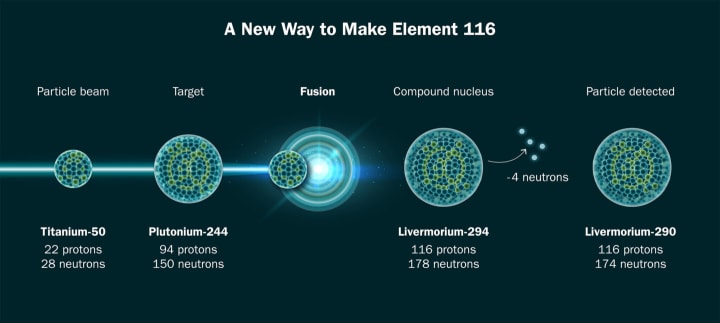
Historically, the synthesis of super heavy elements from 112 to 118 was achieved by firing a calcium-48 beam at targets made of californium. Yet, californium represents the heaviest practical target for such experiments, as heavier elements decay too quickly to be used effectively. To overcome this limitation, the Berkeley Lab team innovatively switched the beam from calcium to titanium, adding the necessary protons to reach higher atomic numbers.
Making Element 116: A Herculean Effort
The journey to create element 116 was a Herculean effort filled with numerous technical challenges and meticulous planning. Using titanium-50, a rare isotope constituting only about 5% of natural titanium, presented its own set of hurdles. The process required heating the titanium to nearly 3,000 °F (1,649 °C) in a specialized oven to vaporize it, creating a plasma of charged titanium ions.
This plasma was then manipulated into a beam and directed at a target made of plutonium, which has 94 protons. The experiment took place over 22 intense days of continuous operations at the lab’s heavy-ion accelerator, the 88-Inch Cyclotron. Despite the high difficulty and complexity, the team successfully produced two atoms of element 116 livermorium.
The successful creation of element 116 validates the experimental approach and provides a solid foundation for future attempts to create element 120.
Reiner Kruecken, director of Berkeley Lab’s Nuclear Science Division, acknowledges the difficulty but remains optimistic: “We think it will take about 10 times longer to make 120 than 116. It’s not easy, but it seems feasible now".
A Gateway to the Unknown
Element 120, tentatively named Unbinilium, would occupy a new place in the eighth row of the periodic table, next to the also-undiscovered element 119. But the significance of discovering element 120 extends beyond merely filling a slot on the periodic table. It could potentially reside on the "island of stability," a theorized group of super heavy elements with relatively longer half-lives. Unlike most super heavy elements, which decay almost instantaneously, those on the island of stability might last long enough to be studied in greater detail and possibly have practical applications.

The Island of Stability
Creating a stable isotope of element 120 could provide unprecedented insights into the behavior of atomic nuclei and test the limits of current nuclear physics models. Moreover, the prospect of a more stable super heavy element opens up exciting possibilities for future research and technological advancements.
As the Berkeley Lab team prepares for this ambitious endeavor, they continue to refine their techniques and equipment. The 88-Inch Cyclotron, the facility's heavy-ion accelerator, plays a crucial role in these experiments. The success with element 116 proves that the cyclotron can handle the high demands of creating super heavy elements, instilling confidence in the team’s capability to tackle the challenge of element 120
The Path Forward
Plans for the synthesis of element 120 are underway, with experiments potentially starting as early as 2025. However, the process could take several years before producing any atoms of the elusive element. The collaborative effort includes researchers from Berkeley Lab, Oak Ridge National Laboratory, and several international institutions, underscoring the global interest and collaborative spirit driving this frontier of scientific discovery.
In the words of Jacklyn Gates, the nuclear scientist leading the effort at Berkeley Lab, "We want to figure out the limits of the atom, and the limits of the periodic table. The super heavy elements we know so far don’t live long enough to be useful for practical purposes, but we don’t know what the future holds. Maybe it’s a better understanding of how the nucleus works, or maybe it’s something more."
The journey to element 120 is a testament to human ingenuity, perseverance, and the relentless pursuit of knowledge. As scientists push the boundaries of the known universe, the discovery of element 120 would not only be a monumental achievement in itself but also a beacon of what lies beyond our current understanding, waiting to be unveiled. This quest is not just about adding another element to the periodic table; it’s about expanding the horizons of science and human potential. The next chapter in this epic saga of discovery promises to be as thrilling as it is profound.
The research paper has been submitted to the journal Physical Review Letters.
SOURCES: Lawrence Berkeley National Laboratory
About the Creator
TranquilTales
Hi everyone! Hope you are having an amazing day. I like to write and read science, tech, world heritage. Read my stories and you will be fascinated with the incredible informations I share.
Keep reading
More stories from TranquilTales and writers in Education and other communities.
Historic Win: Charaideo Maidam of Assam Achieves UNESCO World Heritage Status
The Charaideo Maidam in Assam has achieved a historic milestone by being added to the UNESCO World Heritage Site list under the cultural property category. This monumental decision was made during the 46th session of the World Heritage Committee held from July 21-31 in New Delhi. Charaideo Maidam was chosen from among 52 sites proposed by the Indian government, marking a significant achievement for the region.
By TranquilTales2 years ago in Education
Gold Market Predictions: Strategic Insights for Short-Term Agility and Long-Term Growth
Investors across the globe continue to monitor gold market predictions as economic uncertainty reshapes financial priorities. Currently, inflation data, central bank policy decisions, and geopolitical tensions influence daily price action. As markets digest new information, gold responds quickly to shifts in interest rate expectations and currency performance. When inflation rises or financial instability increases, investors often seek safety in gold. Consequently, demand tends to strengthen during periods of economic stress.
By George Drazenovic6 days ago in Education
Flower Bloom 369
FLOWER Bloom 2/25/26 Wednesday By Mariann Carroll Karen had been with Tony for 7 years. Tony started acting strangely after her surgery. He would mow the lawn in the rain and be on his cellphone. He started pushing Karen away. Tony came clean about seeing someone. Karen moved out two months later. Karen moved in with a friend. She felt betrayed.
By Mariann Carroll5 days ago in Fiction




Comments (2)
Amazing
👏👏👏