
Ultra-Dense Objects: The Strange Physics of Neutron Stars
Neutron stars are among the most extreme objects in the universe. Born from the violent death of massive stars, they pack more mass than the Sun into a sphere no larger than a city. Inside them, matter behaves in ways that challenge everything we know about physics. These ultra-dense objects are not just astronomical curiosities — they are natural laboratories where gravity, quantum mechanics, and nuclear physics collide. In this article, we explore what neutron stars are, how they form, and the strange physics that governs their interiors, revealing why they are some of the most fascinating objects in the cosmos.

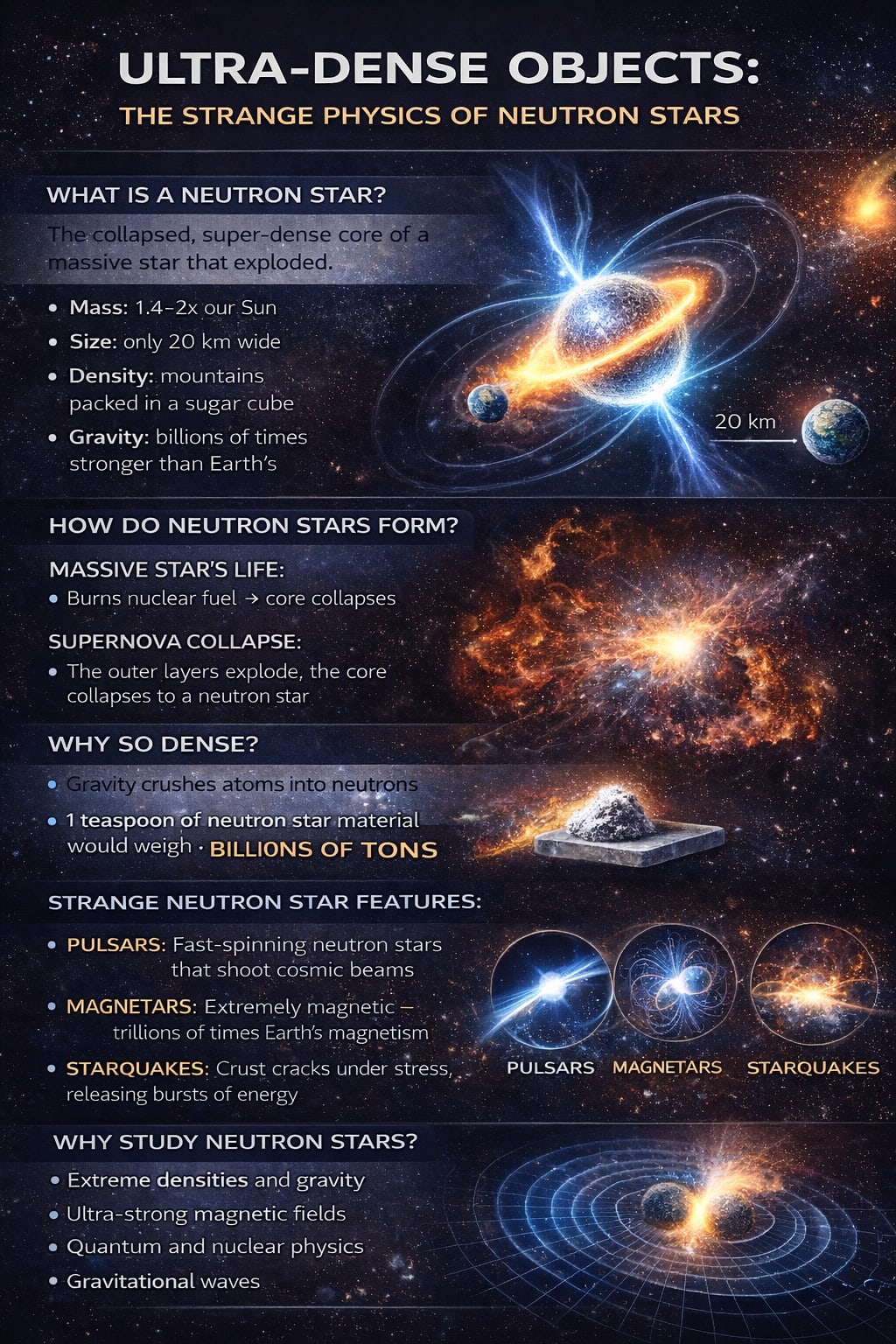
What Is a Neutron Star?
A neutron star is the collapsed core of a massive star that exploded in a supernova.
Basic Facts
• Mass: about 1.4–2 times the mass of the Sun
• Diameter: roughly 20–25 kilometers
• Density: billions of tons per teaspoon
• Gravity: billions of times stronger than Earth’s
Neutron stars are second only to black holes in terms of density.
________________________________________
How Do Neutron Stars Form?
The Life of a Massive Star
• A massive star burns nuclear fuel in its core
• Fusion creates outward pressure balancing gravity
• When fuel runs out, gravity wins
Supernova Collapse
• The core collapses in seconds
• Protons and electrons combine into neutrons
• A shockwave blasts outer layers into space
What remains is a neutron star — a compact object held up by quantum forces.
________________________________________
Why Are Neutron Stars So Dense?
The density of a neutron star is almost unimaginable.
Extreme Compression
• Atoms are crushed completely
• Electrons merge with protons
• Matter becomes a sea of neutrons
To understand the scale:
One teaspoon of neutron star material would weigh billions of tons on Earth.
This density creates conditions never replicated in laboratories.
________________________________________
The Role of Quantum Physics
Neutron stars are supported by quantum mechanical pressure, not ordinary forces.
Neutron Degeneracy Pressure
• Neutrons obey the Pauli exclusion principle
• They cannot occupy the same quantum state
• This creates pressure resisting further collapse
This pressure prevents the star from becoming a black hole — unless it exceeds a critical mass.
________________________________________
The Limit of Neutron Stars
There is an upper mass limit called the Tolman–Oppenheimer–Volkoff limit.
• Above this limit, neutron degeneracy pressure fails
• Gravity overwhelms all resistance
• The object collapses into a black hole
This limit is estimated to be around 2–3 solar masses.
________________________________________
Gravity on a Neutron Star
Gravity on a neutron star is extreme.
Mind-Bending Effects
• Escape velocity is about half the speed of light
• Time runs slower near the surface
• Space is strongly curved
If you stood on a neutron star:
• A fall of one meter would release enormous energy
• Your body would be instantly crushed
________________________________________
Neutron Star Structure: Layers of Extremes
Neutron stars are not uniform; they have layers.
1. Outer Crust
• Composed of heavy atomic nuclei
• Electrons move freely
• Crystalline structure
2. Inner Crust
• Exotic nuclear shapes (“nuclear pasta”)
• Neutrons begin to leak out of nuclei
3. Core
• Ultra-dense neutron fluid
• Possible exotic states of matter
The core remains one of the greatest mysteries in physics.
________________________________________
Exotic Matter Inside Neutron Stars
Scientists believe neutron star cores may contain:
• Superfluid neutrons
• Superconducting protons
• Hyperons (particles containing strange quarks)
• Quark matter (free quarks)
If confirmed, neutron stars would be the only known places where such matter exists naturally.
________________________________________
Neutron Stars as Cosmic Spinners
Neutron stars rotate incredibly fast.
Why They Spin So Fast
• Conservation of angular momentum
• Core collapse dramatically shrinks size
• Rotation speeds increase enormously
Some neutron stars rotate:
• Hundreds of times per second
• Faster than a kitchen blender
________________________________________
Pulsars: Cosmic Lighthouses
A pulsar is a rotating neutron star that emits beams of radiation.
How Pulsars Work
• Strong magnetic fields channel radiation
• Beams sweep across space as the star spins
• Earth detects regular pulses
Pulsars are so precise that some rival atomic clocks.
________________________________________
Magnetic Fields Beyond Imagination
Neutron stars have the strongest magnetic fields known.
Magnetars
• A special type of neutron star
• Magnetic fields trillions of times stronger than Earth’s
• Can crack their own crust
A magnetar near Earth could damage electronics from thousands of kilometers away.
________________________________________
Starquakes: When Neutron Stars Crack
Neutron star crusts can fracture due to stress.
What Happens
• Sudden crust adjustment
• Release of enormous energy
• Powerful gamma-ray bursts
These starquakes are among the most energetic events in the galaxy.
________________________________________
Neutron Star Collisions
When two neutron stars collide, the results are spectacular.
What We Observe
• Gravitational waves
• Gamma-ray bursts
• Creation of heavy elements like gold and platinum
These events help explain the cosmic origin of many elements on Earth.
________________________________________
Gravitational Waves and Neutron Stars
Neutron star mergers produce ripples in spacetime.
Why This Matters
• Confirms Einstein’s general relativity
• Allows direct measurement of neutron star properties
• Opens a new window into the universe
Neutron stars are key players in multi-messenger astronomy.
________________________________________
Neutron Stars vs Black Holes
Feature Neutron Star Black Hole
Surface Yes No
Density Extremely high Infinite (theoretically)
Escape Possible (with energy) Impossible
Quantum Pressure Supports structure Overwhelmed
Neutron stars are the last stable form of matter before total collapse.
________________________________________
Why Neutron Stars Matter to Science
Neutron stars help scientists:
• Test theories of gravity
• Study ultra-dense matter
• Understand nuclear forces
• Explore quantum physics at cosmic scales
They combine multiple branches of physics into one object.
________________________________________
Unanswered Questions
Despite decades of study, many mysteries remain:
• What exactly is inside the core?
• Do quark stars exist?
• What sets the maximum mass?
• How do magnetic fields grow so strong?
Future telescopes and detectors may provide answers.
________________________________________
Neutron Stars and the Limits of Physics
Neutron stars push physics to its limits.
They exist at:
• Extreme density
• Extreme gravity
• Extreme magnetism
• Extreme quantum behavior
Any theory that explains neutron stars must be fundamentally correct.
________________________________________
Conclusion: Nature’s Most Extreme Objects
Neutron stars are cosmic marvels — ultra-dense remnants of stellar explosions that compress matter into its most extreme form without becoming black holes. Inside them, atoms dissolve, gravity bends spacetime, and quantum laws rule on a massive scale.
They are not just stars; they are windows into the deepest laws of nature.
By studying neutron stars, we learn not only about the universe — but about the fundamental structure of reality itself.
About the Creator
Keep reading
More stories from shahkar jalal and writers in Education and other communities.
5 AI Side Hustles You Can Start in 2026 to Make Money Online
Artificial intelligence isn’t just a buzzword—it’s a goldmine for anyone looking to start a side hustle or make extra income online. In 2026, AI tools are more accessible than ever, allowing individuals to automate tasks, create digital products, and provide services that were previously time-consuming or expensive.
By Majus Jasulaitis3 days ago in Education
Top Basketball Drills to Build Leadership and Court IQ
Basketball is often described as a game of speed, skill, and teamwork. While athletic ability is important, the players who truly stand out are those with strong leadership qualities and advanced court intelligence. Court IQ refers to a player's ability to read the game, make smart decisions, and anticipate teammates' and opponents' actions. Leadership involves communication, confidence, and the ability to guide teammates during intense moments of competition.
By Jeb Kratziga day ago in Education
Top tipple tricks
Been thinking a lot about drinking, lately. Not least because of a recent episode of over-indulgence and the inevitable after effects. Some readers may recall the earlier articles I wrote about beating the booze. Here I set out an experiment in techniques for cutting down on my alcohol intake. The experiment was successful, the techniques worked, and I have armed myself with an arsenal of weapons in the war against the demon drink. I have yet to fire the first round however. It's all a question of timing (perhaps procrastination).
By Raymond G. Taylor3 days ago in Psyche



Comments
There are no comments for this story
Be the first to respond and start the conversation.