
Two Things I Never Did as a Teacher
Two things I was against doing and one thing I did that students loved.

I was a teacher in the classroom for over 60 years, teaching hundreds of high school, college, and seminary students. Unlike many other teachers, there are two things I never did.
Learn what those two things I never did. Also, learn the reasons I never did those things, even though they are common among many other teachers.
1. Grading on the Curve
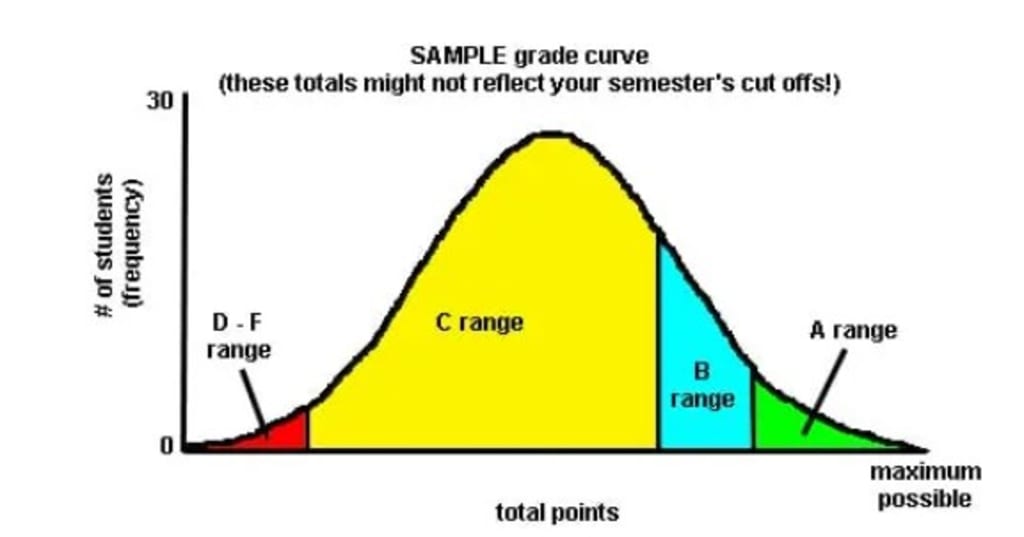
Some educators use a technique known as “grading on a curve” to adjust students' grades for assignments and tests. The “curve” means the curve of a bell that is used in statistics to show the normal distribution of any set of data. Therefore, “grading on the curve” usually means that students are assigned grades based on the highest score of anyone in the class.
Since I vehemently oppose that methodology, I never graded on the curve. Grading on the curve means adjusting everyone's grade based on the highest score in the class. For example, the curve relies on the highest of the lowest if all twelve pupils in a class received low grades. Anything below 60 would be considered failing on a typical grading scale. If the teacher used the curve to grade, the highest possible score of 60 percent would be an "A." Consequently, passing scores would be those that fall below that threshold.
When the grading-on-the-curve method is used, a teacher modifies each student's grade to raise the average.
When students suggested that I grade their assignments on the curve, I explained to them that life is not graded on the curve. We pay our actual household bills, not based on our neighbors' bills. Our bills are not based on a curve.
If students get in the habit of being graded on the curve, they might not strive for their full potential in life after they leave school. I never contributed to my students believing that grading on the curve was a good idea.
2. Throwing Out the Lowest Test Score

I never promised my students that I would throw out their lowest grade. I abide by that rule for a similar reason that I do not grade on the curve. Our creditors don't expect us to throw out our lowest bill. All of them want to be paid for the services they have rendered.
Therefore, I never threw out a test score to get the average of all the scores.
My Grading Method That Students Appreciated
While I never graded on the curve or threw out a student's lowest test score, there is one thing I did do that students loved.
I would give it careful thought if a student was just one point away from receiving the next-highest grade. To feel comfortable awarding the student an extra point so they can advance to a higher grade, I would consider a few factors:
- regular class attendance
- being on time for class
- assignments completed on time
- class participation
- good behavior in class
Students really appreciated this method. In the long run, it was much better than grading on the curve or throwing out a low test score.
My Grading Scale
- 90 to 100 = A
- 80 to 89 = B
- 70 to 79 = C
- 60 to 69 = D
- Below 60 = F
Teachers' Announcement
Teachers should inform students at the beginning of the semester what to expect concerning grades. That way, there will be no surprises for students when it comes to the grading scale, grading on the curve, and throwing out the lowest test score.
Students will be more inclined to do their best throughout the school year when they know what to expect and what not to expect.
Life Outside the Classroom
Students are better prepared for life outside the classroom when they do their best in the classroom without taking the easy way out. Therefore, they should get in the habit of striving for the highest possible grades instead of relying on someone else's grade as the standard.
About the Creator
Margaret Minnicks
Margaret Minnicks has a bachelor's degree in English. She is an ordained minister with two master's degrees in theology and Christian education. She has been an online writer for over 15 years. Thanks for reading and sending TIPS her way.
Keep reading
More stories from Margaret Minnicks and writers in Education and other communities.
A Formula for Writing, Public Speaking, Teaching, and Preaching
Many people have a fear of writing and public speaking. However, there is a proven formula I use in writing, speaking, teaching, and preaching. I wish I could get others to use the formula because I have been using the formula for over seven decades, and it has always been helpful. When I share the formula, people can't believe it works because it is so simple.
By Margaret Minnicks3 months ago in Education
Developing Strong Leadership Foundations for Sustainable Leadership Success
Strong leadership foundations help individuals guide teams, solve problems, and achieve shared goals. Leadership is not only about authority or position. It is about influence, responsibility, and the ability to support others. When people focus on building strong leadership foundations, they develop the skills needed to lead with confidence and purpose.
By Alfonso Kennard3 days ago in Education



Comments
There are no comments for this story
Be the first to respond and start the conversation.