
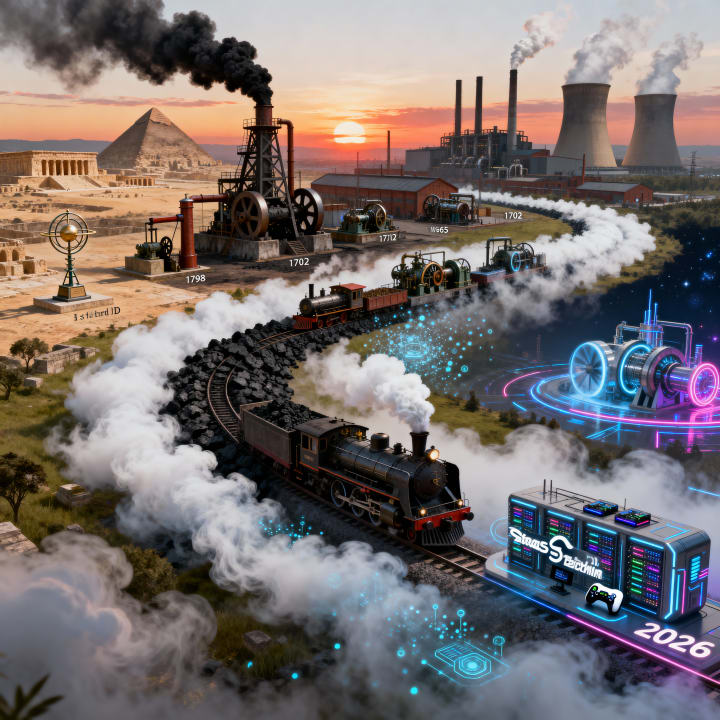
Twin Revolutions: From Steam Engines to Steam Machines
Two innovations, separated by centuries yet united by transformative ambition, have reshaped how we work and play. The steam engine powered humanity's leap into the Industrial Age, while Valve Corporation's Steam hardware aims to revolutionize modern PC gaming. This is their intertwined story of power, progress, and persistence.


Part I: The Birth of Mechanical Power
Breaking Free from Nature's Constraints
Before the steam engine, humanity's productive capacity remained shackled to unpredictable natural forces. Factories clustered along rivers that could freeze in winter or run dry in summer. Windmills stood idle on calm days. Animal and human muscle provided the only reliable power, limiting what civilization could achieve.
The steam engine shattered these limitations, offering consistent, portable power that could operate anywhere, anytime. This single invention would trigger the Industrial Revolution and fundamentally alter human society.
Pioneers of Atmospheric Power
The journey toward practical steam power began with Hero of Alexandria's Aeolipile in the first century AD—more toy than tool. Real progress waited until the 17th century, when scientists like Evangelista Torricelli and Otto von Guericke unlocked the secrets of atmospheric pressure.
In 1698, Thomas Savery patented his "miner's friend," a steam-powered pump that created vacuums to draw water from mines. Though innovative, it proved limited in practical application.
The breakthrough came in 1712 with Thomas Newcomen's atmospheric engine. This massive machine—featuring cylinders up to 70 inches in diameter—used alternating steam and condensation to power mine pumps. Despite consuming enormous quantities of coal (with early models achieving a duty of only 2-3 million pounds of water raised one foot per bushel), it proved invaluable for draining flooded mines across Britain.
Watt's Engineering Revolution
James Watt transformed the steam engine from industrial workhorse to efficient powerhouse around 1765. While repairing a Newcomen model, this instrument maker identified its fatal flaw: wasting energy by repeatedly heating and cooling the same cylinder.
His solution—the separate condenser (patented 1765)—kept the main cylinder hot while condensing steam elsewhere, dramatically improving efficiency. Partnering with industrialist Matthew Boulton, Watt secured a monopoly on this technology until 1800, charging customers one-third of their coal savings as royalty.
Watt's innovations multiplied:
Double-acting engines that pushed and pulled with equal force
Parallel motion linkages for smooth power transmission
Sun-and-planet gears converting linear to rotary motion
Pendulum governors maintaining consistent speed
The term "horsepower" for measuring engine output (745.7 Watts equals one horsepower)

By 1800, Watt engines consumed just 8.8 kg of coal per horsepower-hour—nearly half Newcomen's 14.5 kg requirement from 1725.
Cornwall's High-Pressure Revolution
While Watt cautiously limited pressures to 3 psig, Richard Trevithick boldly pushed boundaries with high-pressure steam. His Cornish Boilers, operating at 50 psig, produced engines four times more powerful than Watt's designs. This power-to-weight breakthrough enabled the world's first steam locomotive in 1802.
After Watt's patent expired in 1800, the Cornish Engine Era flourished. These machines combined high-pressure steam with condensers, achieving remarkable efficiency. Competition drove innovation—by 1840, average coal consumption dropped to 3.1 pounds per horsepower-hour. William West's engine achieved an astounding duty of 125 million in 1834.
Steam's Modern Legacy
Though internal combustion engines displaced steam in transportation, steam turbines generate 80% of global electricity today. Nuclear plants, coal facilities, and many renewable systems rely on steam power. Beyond electricity, steam enables:
Hospital sterilization
Concrete curing in cold climates
Manufacturing of textiles, pharmaceuticals, and advanced materials
Production processes for everything from Formula 1 components to spacecraft
Part II: Valve's Digital Revolution
The Failed Promise of Steam Machines (2015)
Valve Corporation's first attempt to bridge PC gaming and living room convenience launched in November 2015 with catastrophic results. The original Steam Machines—14 different models from 14 manufacturers, ranging from $1,500 to an absurd $50,000—confused consumers with their fragmented ecosystem.
Running SteamOS (Linux-based), these machines struggled with fundamental problems:
Game compatibility disaster: Most PC games required Windows; Linux ports were rare
No clear value proposition: Enthusiasts built better PCs for less money
Poor timing and positioning: Valve's own Steam Link streaming device offered similar functionality at a fraction of the cost
Within seven months, fewer than 500,000 units had sold. By 2018, Valve quietly removed Steam Machines from their storefront.
Redemption Through the Steam Deck (2022)
Learning from failure, Valve returned in February 2022 with the Steam Deck—a unified, handheld gaming PC built entirely in-house. This device succeeded where Steam Machines failed by solving the critical compatibility problem.
Proton, Valve's compatibility layer, enabled Windows games to run seamlessly on Linux without modification. Combined with custom AMD hardware (Zen 2/RDNA 2 "Aerith" APU in LCD models, refined "Sephiroth" chip in OLED versions), the Steam Deck delivered genuine PC gaming portability.
Key innovations included:
SteamOS 3 based on Arch Linux for rolling updates
Game verification system clarifying compatibility
Open design supporting alternative operating systems
OLED model improvements: 7.4-inch display, enhanced cooling, extended battery life
The Steam Deck sparked an entire category of handheld gaming PCs, validating Valve's vision.
The Second Coming: Steam Machine 2.0 (2026)
Armed with proven technology and hard-won experience, Valve announced their reimagined Steam Machine in November 2025 for early 2026 release. This singular, fixed-specification mini-PC measures just 156mm × 152mm × 162mm but packs serious power.
Technical Specifications:
Processor: Custom AMD Zen 4 (6 cores/12 threads, 4.8GHz)
Graphics: Custom AMD RDNA 3 (28 compute units, 2.45GHz, 8GB GDDR6)
Memory: 16GB DDR5 (expandable)
Storage: 512GB or 2TB M.2 (expandable via additional slots and microSD)
Performance: Targets 4K/60fps using AMD FSR upscaling—six times Steam Deck power
A massive thermal management system occupies 70% of internal volume, ensuring silent operation in enclosed entertainment centers. Critics worry the 8GB VRAM limitation may bottleneck demanding titles, though Valve prioritized affordability.
The Evolution of Control
Accompanying the new machine, Valve's redesigned Steam Controller incorporates Steam Deck's successful layout while adding cutting-edge features:
TMR joysticks: Next-generation Hall Effect sensors for precision and longevity
Grip Sense: Automatic gyroscopic activation when held
Integrated charging: 2.4GHz wireless receiver doubles as charging dock.

Conclusion: The Power of Persistence
From Newcomen's inefficient atmospheric engines to Watt's revolutionary improvements, from Valve's scattered first Steam Machines to their focused Steam Deck success—both stories demonstrate how transformative technologies emerge through iteration, learning, and determination. The steam engine freed humanity from nature's constraints; Valve's Steam platform aims to free gaming from proprietary limitations. Both revolutions remind us that true innovation requires not just vision, but the persistence to refine that vision until it changes the world.
#punitkochaliyan
About the Creator
Punit kumar
PUNIT KUMAR - My Voice Rises 🗣️, My Stories Thrive ✨.
I write here to share, grow & earn 💰 - thanks to Vocal’s open platform 🌍. I explore what moves me. Monetize with Vocal+ 🎯 + fun Challenges 💸. turning my passion into purpose.
Keep reading
More stories from Punit kumar and writers in Education and other communities.
The Moon: Earth's Natural Satellite
The Moon: Earth's Natural Satellite The Moon, Earth's only natural satellite, has captivated humanity's imagination for centuries. Its presence in the night sky has inspired myths, legends, and scientific exploration. This celestial body, with its unique characteristics and history, has played a crucial role in shaping our understanding of the cosmos. This article delves into the Moon's many facets, from its formation to its exploration, and also discusses India's Chandrayaan-3 mission, a significant step in lunar exploration.
By Punit kumar2 years ago in Education
Learn Fast, Play Smart
Modern trends demand a total recalibration of how people acquire new abilities. Information arrives in bursts, requiring a strategy that favors speed and precision over the slow methods of the past. Because of that, traditional education often feels heavy and static, while the digital era is fluid and relentless.
By Angela Ash4 days ago in Education
Slope-Ready Strategies: How to Plan a Stress-Free Ski Vacation
A ski vacation promises adventure, breathtaking views, and unforgettable memories—but only if you plan it well. Without the proper preparation, your dream winter escape can turn into a logistical nightmare. From lift tickets to lodging, ski gear to safety, planning a seamless trip to the slopes requires attention to detail and a clear strategy.
By Neil Druker6 days ago in Education


Comments
There are no comments for this story
Be the first to respond and start the conversation.