
Tutankhamun’s Tomb
The Curse of Tutankhamun Explained

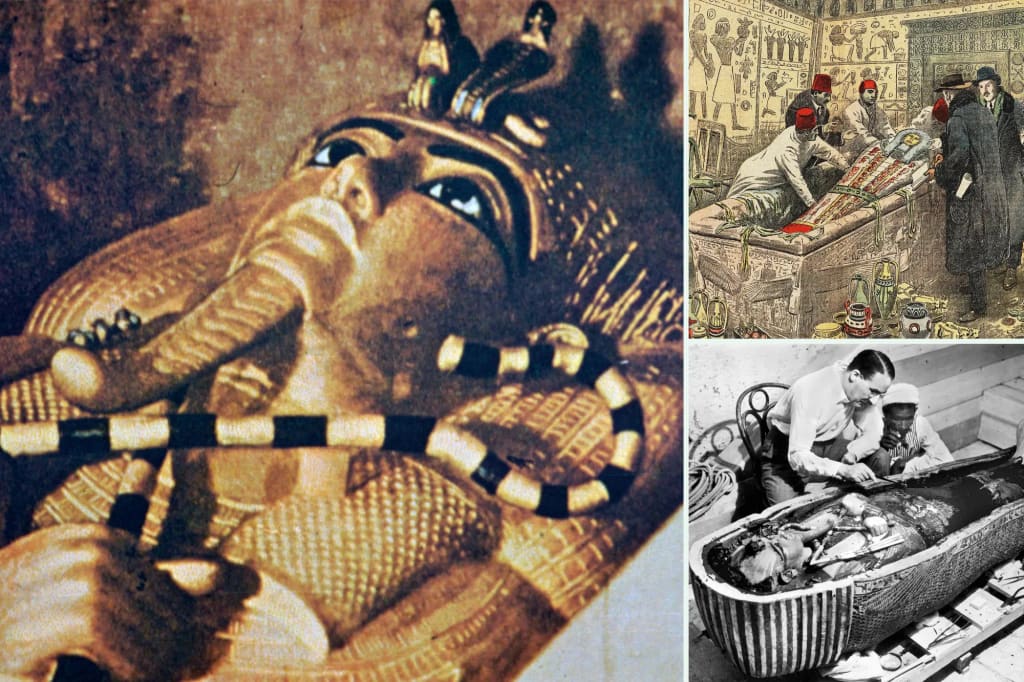
In November 1922, Howard Carter discovered the final resting place of a little-known Egyptian pharaoh named Tutankhamun. Upon carefully removing the outer door and stepping over the threshold, Carter became the first human being to do so in over 3,000 years. At that moment, Carter didn't know that Tutankhamun's tomb would become one of the greatest archaeological finds in history, comparable to the Terracotta Army, the remains of Pompeii, and the Rosetta Stone. News of the incredible discovery hit the headlines, drawing the world's media attention to the Valley of the Kings in Egypt, near what was once Thebes. It was the crowning achievement of Carter's career, immortalizing him among archaeologists. But from the moment he first stepped inside the pharaoh's tomb, rumors began to spread that his actions had unleashed a terrible curse, a punishment from beyond the grave for disturbing the long-dead pharaoh. Many dismissed it as nonsense, including Carter himself, until people started dying.
The Backstory
A few months before this remarkable moment in the history of archaeology, Howard Carter found himself standing in Highclere Castle, the grand manor house home to the Fifth Earl of Carnarvon, his benefactor who had been financing Carter's archaeological expeditions in the Valley of the Kings for the previous seven years. During this time, Carter had turned up next to nothing of archaeological interest. Admittedly, the outbreak of the First World War had somewhat hampered his efforts, but that didn't change the fact that Carnarvon had invested a lot of time and money into the venture with little to show for it. Carter's years in Egypt had yielded a few odds and ends, mostly scraps of linen and shards of pottery. However, many of these items were inscribed with the name of an Egyptian pharaoh whose remains had never been located: Tutankhamun.
Lord Carnarvon had summoned Carter to Highclere Castle to tell him it was over and that he would no longer be financing digs in the Valley of the Kings. Carter was almost frantic, practically begging Carnarvon to give him more time. This show of passion paid off, and Carter came away with a deal: one more year. If he didn't uncover anything of note in that time, his funding would be cut, and all of his hard work over the years would have been for nothing. As it turned out, Carter wouldn't need anywhere close to a year. He resumed his search for Tutankhamun's tomb on November 1, 1922, and three days later, he found it.
The Discovery
The team was going over old ground near the previously discovered tomb of Ramesses VI when one of Carter's men stumbled over a large piece of rock. Unlike the rest of the loose rocks, this particular chunk was partially buried beneath sand and mud. It turned out to be the top of a very long staircase that disappeared beneath the ground, ending abruptly at the door of Tutankhamun's tomb. Carter called for Lord Carnarvon at once, and when the earl arrived, the two men got a front-row seat at the opening of what was basically the world's most exciting episode of Storage Wars. Unlike Storage Wars, Tutankhamun's tomb wasn't full of soiled mattresses and 80s pornography. No, it was packed almost to bursting with around 5,000 priceless artifacts, including a dismantled chariot, finely carved figurines, priceless jewelry, ancient weapons, and one standard-issue Egyptian mummy ensconced in no fewer than three nested sarcophagi, the last of which was made of solid gold.
Somewhat ironically, considering the almost immediate rock star status Tutankhamun enjoyed around the world after the rediscovery of his mummified body, he wasn't actually all that important in his own time, at least as far as pharaohs go. While he would become famous for unleashing a curse on the men who found him, it seems the boy king, who was only 19 when he died, may have suffered from a curse of his own: a cripplingly small gene pool. His parents were siblings, resulting in Tutankhamun being born with a wide range of physical and mental disabilities.
The Curse
The first life reportedly snuffed out by the curse of Tutankhamun, on the very day the tomb was discovered, was Howard Carter's canary. It was found dead, coiled in on itself inside its cage with a cobra hanging from its mouth. This was seen as an ominous sign, especially since the statues guarding the entrance to the still-sealed chamber within the tomb wore crowns adorned with a uraeus, the ancient Egyptian symbol of divine authority, shaped like a cobra. Despite this creepy event, Carter and his men, made of stern stuff, dismissed the idea of a curse.
However, things took a darker turn when Lord Carnarvon died a few months later from a mosquito bite that became infected after he nicked it while shaving. He died of blood poisoning within two weeks, a little more than four months after becoming one of the very first people to step foot inside Tutankhamun's tomb. This event, combined with a lesion found on Tutankhamun's cheek during an autopsy six months later, fed the growing rumors of a curse.
Subsequent deaths of individuals connected to the excavation, including financier George J. Gould from a fever and Arthur Mace from arsenic poisoning, further fueled the legend. Carter's secretary died a year later, smothered in his sleep by an unknown assailant. These deaths, along with the media frenzy, led to widespread belief in the curse.
The Reality
Despite the eerie coincidences and the sensationalist press coverage, the reality was far less mystical. Many of the reported deaths were either natural or coincidental. Of the 58 people known to have been present when the tomb was first opened, only eight died within the following 12 years. Howard Carter himself died 16 years after the discovery, living to the age of 64.
The notion of a curse was perpetuated by newspapers, which made up the story to sell more copies. Lord Carnarvon's death, while tragic, was due to his compromised immune system from a previous car accident. The mysterious lesion on Tutankhamun's cheek was likely a coincidence.
Conclusion
In the end, the so-called curse of Tutankhamun was more a creation of media hype and confirmation bias than any supernatural phenomenon. While the story captivated the public's imagination, the deaths associated with the tomb were largely explainable through natural causes. The legend of the curse remains a fascinating chapter in the history of archaeology, a testament to the power of storytelling and the allure of the mysterious pas
About the Creator
Horace Wasland
Research analyst, writer & mystical healer. Exploring the edge where science meets mystery. From mystery/the mystical, to facts, news & psychology. Follow for weekly insights on all four and please leave a tip if you like what you read :)
Keep reading
More stories from Horace Wasland and writers in Education and other communities.
Are We Alone?
Hey, Horace here! Are we alone in the universe? It's a question humanity has been asking ever since we first realized that those twinkling points of light in the night sky are stars, some of which might be very similar to our own sun. You'd be forgiven for thinking this is simply one of life's great unanswerables. Who could possibly know whether or not we're alone in the endless reaches of space?
By Horace Waslandabout a year ago in Education


Comments (1)
Interesting piece