
Trump’s University Restrictions Create Global Shift in Student Choices
As U.S. closes its doors, countries like China and the UK see new opportunities to attract international talent
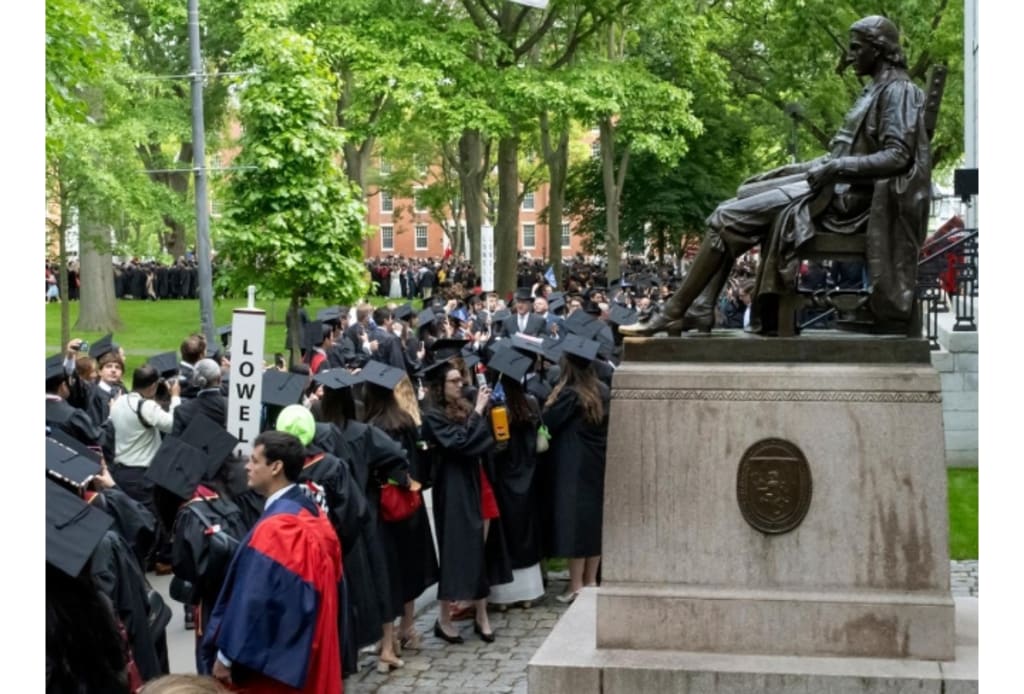
Trump’s Restrictions on Universities Open Doors for Other Countries
After Trump's actions, competition among several countries has intensified, as China has already announced it will welcome students who are unable to gain admission to the United States.
Last year, at the National Schools Regatta — a rowing competition for young people — the longest queue was outside the stalls of American universities.
This event takes place on the waters of Dorney Lake at Eton College and primarily includes students from private schools. It also draws large crowds of parents, grandparents, relatives, and friends. Striped blazers and school logos are visible everywhere.
The boat races are intense and exciting, but many in the audience seem more eager to get their children admitted to a top American university — whether through sports or some other avenue.
As Oxford and Cambridge have recently limited their intake from private schools, the attention of such families has shifted across the Atlantic towards the United States.
Nowadays, nearly every private school has at least one expert who knows which American university is best and how to navigate the admission process.
Exhibitions are also held where universities promote themselves, with representatives always available to impress parents.
This is why Donald Trump’s recent attack on American universities — even if only temporary — has left many surprised.
Earlier this week, the U.S. Department of Homeland Security moved to revoke Harvard University’s ability to admit foreign students — essentially halting their visa applications. Ostensibly, the goal is to purge universities of so-called “liberal” ideologies.
Trump also announced plans to further cut federal contracts with Harvard — the same university that recently witnessed major protests in support of Palestine.
At the very least, the President has signaled that chaos and uncertainty will likely dominate the future. At a time when affluent British families had found an alternative to Oxford and Cambridge in American universities, that path is now uncertain as well.
However, Trump’s crackdown also presents a golden opportunity for British higher education to fill the gap.
Due to the elitism of Britain’s private and a few select state schools, only a handful of universities — such as Durham, St Andrews, Edinburgh, and some in London — are considered worthy after Oxford and Cambridge. After that, parents, teachers, and unfortunately even students and employers give little attention to other universities.
Russell Group universities, which consider themselves second only to Oxford and Cambridge, are seen by many as merely second-tier. The rest of the universities may barely be acknowledged at all.
In 2023–24, the U.S. admitted 1.1 million international students, 10,000 of whom were from the UK. These students contributed $43.8 billion to the U.S. economy in tuition, accommodation, and other expenses. This isn’t just a financial loss for Britain — it’s also a loss of talent and intelligence that often never returns home.
For American universities, this has become a business — and a profitable one at that. This is Britain’s chance to make its education system appealing again, especially as foreign student numbers and their fee contributions decline.
Competition is now fierce, as China has already announced it will welcome students unable to gain admission to the U.S.
It’s also true that British universities themselves are partly to blame for this decline. In recent decades, they’ve expanded rapidly, and some institutions and courses don’t meet quality standards. However, we must not forget the bias that works against these institutions as well.
In this context, the UK government's move to impose funding cuts on universities is also damaging. The education sector is already under immense pressure, weakening morale and discouraging progress. If it is to seize the opportunity suddenly created by the U.S. president’s aggressive measures, the government must provide it with confidence and financial support.
This should be a joint effort — one that serves Britain's interests and encourages students to stay in the country for their education, as this would also benefit the economy. It would be in the national interest for students to remain, complete their education, and begin their careers locally.
While some may mourn and shed tears over this situation, the reality is: by closing one door, Trump has opened another.
About the Creator
Keep reading
More stories from Ikram Ullah and writers in Education and other communities.
Trapped in the Spotlight: The Digital Illusion Shaping Our Children’s Future
"The Glitter of TikTok and the Crumbling Future of Our Children" In today’s world, where a child’s hands should be holding a pen, they are instead gripping a smartphone—performing in front of a camera. Where there should be dreams of knowledge, insight, and service in their eyes, there is now an obsession with likes, views, and followers.
By Ikram Ullah8 months ago in Education
Why Great Content Beats Great Code in Modern Media Strategy
Content Is the Core of Every Media Strategy Modern media strategy often starts with tools, platforms, and automation. Many teams believe better code will solve engagement problems. This idea sounds logical, but it misses a key truth. Great content beats great code in media strategy because people respond to meaning, not mechanics.
By James Kaminsky7 days ago in Education
Wild Card Weekend Recap: What Happens Now?
I think I figured out why I love Wild Card Weekend so much. It's because it's the first playoff anything of the calendar year. The NFL season starts in the fall, and once upon a time, the champion was crowned either on or slightly before New Year's. The evolution of the NFL schedule has resulted in the playoffs starting just into the New Year, and currently, the final week of the season falls on the first weekend of the New Year, with Wild Card Weekend coming a week after that. So yes, chronologically, the NFL's Wild Card Weekend serves as the first playoff anything of the calendar year.
By Clyde E. Dawkins3 days ago in Unbalanced




Comments
There are no comments for this story
Be the first to respond and start the conversation.