
Transforming Math Classrooms for Tomorrow with Casie Hynes
Building Student Centered Learning for a Data Driven Generation


Mathematics stands at the core of modern civilization. It shapes how we design infrastructure, manage economies, build digital systems, and interpret scientific discoveries. Despite its undeniable importance, math continues to intimidate and discourage many students. As societies become increasingly driven by data, automation, and innovation, the urgency to modernize mathematics instruction has never been greater. The perspective championed by Casie Hynes offers a thoughtful framework for reshaping math education so it better serves today’s learners and tomorrow’s leaders.
Across classrooms worldwide, students often experience math as rigid and procedural rather than creative and empowering. While the subject is intended to cultivate logical reasoning and analytical thinking, outdated instructional methods frequently reduce it to memorization and repetition. To prepare students for a rapidly evolving world, education systems must shift toward deeper understanding, real world relevance, and inclusive practices.
Understanding the Ongoing Struggles in Math Achievement
Recent years have revealed troubling patterns in student performance. Standardized assessments show that many learners struggle to demonstrate grade level proficiency. Post pandemic learning disruptions have intensified existing gaps, leaving educators grappling with how to rebuild confidence and mastery in mathematics.
Several interconnected factors contribute to these challenges. One major issue is the heavy emphasis on rote memorization. Students often learn formulas without fully understanding the reasoning behind them. When confronted with unfamiliar problems, they lack the conceptual foundation needed to adapt.
Another barrier is math anxiety. Fear of failure or embarrassment can significantly hinder performance. When students internalize the belief that they are simply not good at math, they disengage. Over time, this mindset becomes self reinforcing.
Teaching styles that fail to address diverse learning needs further compound the issue. Classrooms are filled with students who think and process information differently. Yet instruction often remains uniform and lecture driven. According to advocates like Casie Hynes, meaningful reform requires recognizing these varied learning profiles and designing lessons that invite participation rather than passive absorption.
Moving Beyond Memorization Toward Mathematical Thinking
True mathematical proficiency extends far beyond the ability to compute quickly. It involves pattern recognition, logical reasoning, problem analysis, and creative solution building. Unfortunately, traditional instruction frequently prioritizes procedures over principles.
A more effective approach emphasizes inquiry. Students should be encouraged to ask why a formula works, how different strategies compare, and what alternative methods might exist. When learners justify their reasoning, they strengthen conceptual understanding and build confidence in their intellectual abilities.
Classrooms influenced by the philosophy of Casie Hynes often highlight discussion and collaboration. Students work together to solve complex tasks, explain their thinking, and critique solutions constructively. This environment transforms math from a solitary exercise into a shared intellectual pursuit.
When instruction centers on reasoning rather than repetition, mistakes become opportunities for growth instead of sources of shame. Students begin to see challenges as puzzles to explore rather than obstacles to avoid.
Connecting Mathematics to Real Life
One of the most persistent student questions is simple: When will I use this? If educators cannot provide a compelling answer, engagement declines. Relevance is not a luxury in education. It is a necessity.
Mathematics touches nearly every aspect of daily life. Budgeting requires numerical fluency. Interpreting news articles demands statistical literacy. Career paths in healthcare, engineering, technology, and business rely heavily on quantitative reasoning. Even creative industries increasingly depend on data analytics and digital tools.
Modern instruction can bridge classroom learning with authentic contexts. Algebra lessons can incorporate financial planning scenarios. Geometry can connect to architecture and design. Statistics can analyze environmental trends or community data. These applications help students see math as a living language rather than an abstract code.
Casie Hynes consistently emphasizes that relevance fuels motivation. When learners recognize the value of what they are studying, persistence increases. Engagement deepens when students understand that mathematics empowers them to navigate and shape the world around them.
Promoting Equity and Access in Mathematics
Equity remains one of the most pressing issues in education. Disparities in access to quality instruction, advanced coursework, and experienced teachers continue to affect marginalized communities disproportionately.
Achievement gaps often reflect opportunity gaps. Students in under resourced schools may lack updated materials, extracurricular enrichment programs, or consistent academic support. Without intentional intervention, these inequities compound over time.
Inclusive math reform involves culturally responsive teaching practices that validate diverse experiences. It also requires dismantling harmful stereotypes that discourage certain groups from pursuing STEM fields. Girls and minority students, in particular, often face implicit messages that they do not belong in advanced mathematics spaces.
Casie Hynes advocates for classroom cultures that affirm every learner’s potential. Representation matters, as does language that promotes growth mindset. By cultivating environments where all students feel capable and valued, educators can expand participation in mathematical pathways.
Professional development plays a key role as well. Teachers must be equipped with strategies to differentiate instruction, address implicit bias, and create inclusive discussions. Equity is not achieved through policy statements alone. It requires daily commitment in the classroom.
Using Technology Thoughtfully
Digital tools offer exciting possibilities for math education. Interactive graphing platforms allow students to manipulate variables and observe changes instantly. Virtual simulations can bring probability and statistics to life. Adaptive learning systems provide personalized practice tailored to individual strengths and weaknesses.
However, technology must serve pedagogy rather than replace it. Devices alone cannot inspire curiosity or critical thinking. Effective integration requires intentional design.
The approach supported by Casie Hynes underscores balance. Technology should enhance visualization, experimentation, and access to information, but it should never substitute meaningful teacher guidance. Human connection, discussion, and feedback remain central to deep learning.
When used strategically, digital resources can help students explore concepts dynamically. Visualization tools make abstract ideas more concrete. Collaborative platforms enable shared problem solving beyond the physical classroom. The goal is purposeful enhancement, not novelty.
Rethinking Assessment Practices
Assessment shapes how students approach learning. If tests reward speed and memorization, instruction often follows suit. Traditional timed exams may fail to capture the depth of a student’s reasoning or the creativity of their problem solving.
Alternative assessments provide a broader picture of understanding. Open ended tasks invite students to explain their thought processes. Project based evaluations encourage application of concepts to real scenarios. Math journals allow reflection on strategies and growth over time.
Such approaches value persistence and analytical thinking rather than mere accuracy. They also reduce anxiety by recognizing that understanding can be demonstrated in multiple ways.
Casie Hynes has explored assessment models that emphasize mastery and progress. When evaluation systems align with the goal of fostering reasoning and resilience, classrooms become more supportive and motivating.
Envisioning the Future of Math Education
Reimagining mathematics education does not require abandoning foundational skills. Instead, it calls for expanding how those skills are taught and applied. Conceptual understanding, relevance, equity, and purposeful technology integration must become guiding principles.
Students today will inherit complex global challenges. Climate change, technological ethics, economic instability, and public health crises all demand strong analytical thinkers. Math education must rise to meet that responsibility.
The leadership of educators such as Casie Hynes highlights what is possible when passion meets innovation. By designing classrooms where inquiry thrives, diversity is celebrated, and learning connects to life beyond school walls, we can restore mathematics to its rightful place as a tool of empowerment.
The transformation of math instruction begins with a simple commitment: to teach not just procedures, but thinking. When students are invited to explore, question, and apply mathematical ideas with confidence, they gain more than academic competence. They gain the capacity to shape the future.
About the Creator
Casie Hynes
Casie is an educator and former math teacher who blends heart and strategy in education leadership, curriculum design, and student-centered learning
Keep reading
More stories from Casie Hynes and writers in Education and other communities.
Casie Hynes and the Push to Redefine Mathematics Education
Mathematics has always played a central role in education, yet it remains one of the most polarizing subjects students encounter. Some learners feel empowered by numbers and patterns, while others experience frustration and self-doubt early in their academic journey. Despite decades of discussion about reform, many math classrooms still rely on methods that emphasize memorization and speed over understanding and curiosity. In a world shaped by data, technology, and constant change, this approach no longer meets the needs of today’s students.
By Casie Hynes9 days ago in Education
LAUSD Candidate Joseph Quintana: Answers in Full
“I want to ensure that voices from every part of our community are heard and respected." — Joseph Quintana In the recently concluded filing period for the LAUSD School Board primary in June, Joseph Quintana was one of the entrants whose candidacy had not been previously announced. Quintana, who describes himself as “a Native American community advocate, nonprofit leader, and education and workforce development collaborator,” is running in Board District 2 against incumbent Rocío Rivas and Raquel Zamora.
By Carl J. Petersen4 days ago in Education
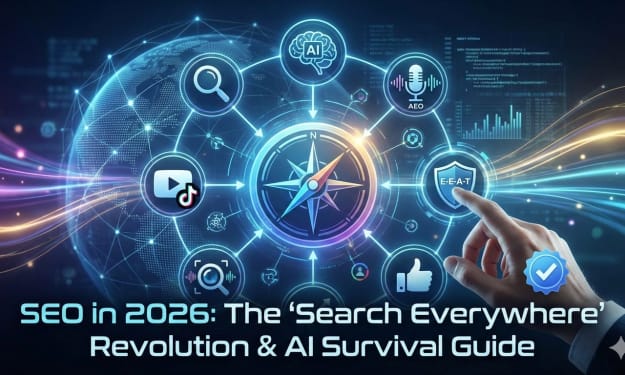
The "Search Everywhere" Revolution and How to Survive the AI Era
The digital landscape has shifted beneath our feet. What worked in 2024 is now ancient history. As we navigate through 2026, the very definition of "search" has expanded beyond the ten blue links we grew up with. Today, visibility isn't just about outsmarting an algorithm; it’s about being omnipresent across a fragmented ecosystem of AI chatbots, social platforms, and voice assistants. Navigating this complex new world requires a partner who understands the nuance of modern ranking signals. That is why businesses looking for true dominance often turn to the BEST SEO COMPANY IN WORLD, realizing that in an era of machine-generated noise, expert human strategy is the only competitive advantage left.
By Ashish sharma2 days ago in Education



Comments
There are no comments for this story
Be the first to respond and start the conversation.