
Top Skills You'll Gain from a Business Analyst Training Program
Essential Skills You Gain from Business Analyst Training


Business analytics is a growing field not just in India but across the globe. Companies are increasingly reliant on data, thus professionals with knowledge in this industry are in high demand. Companies increasingly rely on analytics to run their operations as technology and business processes alter. According to the Bureau of Labor Statistics, employment of management analysts (including business analysts) is predicted to grow by 11% from 2021 to 2031. Business analysts work across sectors, with banking, finance, and insurance at the top, followed by IT. As a result, there is also a high demand for business analytics degrees in India.
But whether one will shine bright as a business analyst depends not just on their degree but also their skills. There are a few skills that every professional in the field is expected to possess. This blog has been dedicated to exploring those skills that a business analyst training programme can impart.
Who is a Business Analyst?
A business analyst is a specialist who assists firms in identifying business requirements and challenges, as well as developing solutions to solve them through data collection and analysis. In other words, business analysts analyze data on company procedures, operations, and efficiency to find trends and patterns that may be used to guide decision-making and generate transformations in the business.
These individuals analyze corporate data to find gaps and roadblocks in company workflows and operations. They create and execute strategies for streamlining processes, boosting productivity, and optimizing the utilization of resources.
Top Skills Gained from a Business Training Programme
This section focuses on the most important skills that any business analyst must possess to succeed in the workplace. All of these skills can be acquired by participating in business analyst training programmes.
Before going into the detailed list, here is a tabular form of the skills that students can learn while pursuing their business analyst training programme(s).
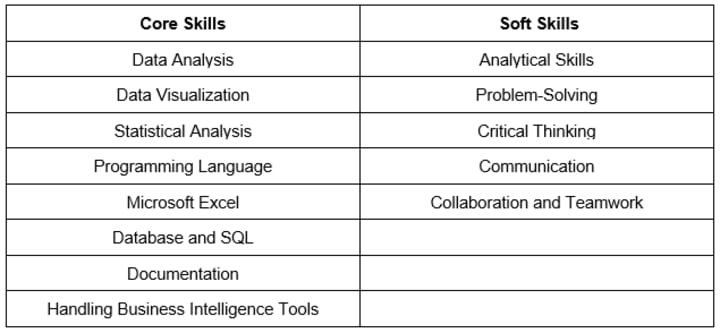
Core Skills
This section highlights the core skills that business analysts are required to have, with a focus on technical expertise.
Data Analysis
Business analysts employ data analysis to extract relevant information, allowing them to make educated and data-driven decisions, which requires the usage of several tools and software. Hence, when pursuing a training programme in this field, learners receive hands-on instruction on tools like SQL (Structured Query Language), SPSS (Statistical Package for the Social Sciences), SAS (Statistical Analysis System), and others. Along with data analysis, learners learn how to visualize data using tools such as Tableau, MS Excel, and Power BI, among others.
Data Visualization
Data analysis alone is insufficient; data must also be visualized. Data visualization is the graphical depiction of information and data. Professionals who deal with data visualization must be able to create charts, graphs, maps, and dashboards that express patterns and trends generated by analyzed data.
For data visualization, business analysts use tools such as Power BI, Tableau, and Qlik Sense.
Statistical Analysis
Statistical analysis is another skill that any business analyst must know and is taught during their training. This skill is utilized primarily for extracting information, spotting patterns, and making informed choices based on analyzed data. Here are some ways in which business analysts employ statistical analysis in their operations:
- Correlation analysis
- Description statistics
- Inferential statistics
- Regression analysis
- Chi-Square Test, etc.
Programming Language
Business analysts must be savvy in programming languages to undertake faster and more accurate data analysis. Nevertheless, these specialists do not need to be familiar with all language program software. That said, having a solid understanding of Python, R, and Oracle, among others, can be useful when dealing with large amounts of data.
Microsoft Excel
MS Excel is one of the oldest and most basic software taught in any business analytics programme. A solid understanding of Excel may aid with data calculation, representation, and visualization. MS Excel may also create pivot tables that summarize the data.
Database and SQL
Business analysts must be conversant with an organization's structured data. So, these people are trained to use relational databases such as Microsoft SQL Server, MySQL, Oracle DB, and NoSQL databases. A solid understanding of these databases enables business analysts to organize and handle large amounts of data. Additionally, they can access, recover, alter, and analyze data.
Documentation
- Documentation is essential for communicating the findings of data analysis to stakeholders. Hence, this is a skill that any professional working in data analysis must possess. Proper documentation allows business analysts to convey specifications, findings, and suggestions to stakeholders, ensuring that they have the insight required to make informed choices and promote the project's success.
- Handling Business Intelligence (BI) Tools
- BI tools may help extract meaningful insights from data, allowing companies to make more informed decisions. BI tools can be useful in the following areas.
- Data collection
- Data integration
- Data analysis & visualization
- Predictive analysis
- Data governance, etc.
Soft Skills
Apart from the core technical skills, to thrive as a successful business analyst, one must also possess a repertoire of soft skills. Business Schools offering different courses on business analytics often integrate these soft skills through diverse extracurricular activities, hands-on training, as well as classroom sessions.
Analytical Skills
As the name suggests, business analysts must have excellent analytical skills that allow them to analyze complicated data and deliver it in more understandable ways to stakeholders. They must also be ready to look at problems from several perspectives and think critically to find answers.
Problem-Solving
It goes without saying that problem-solving abilities are among the most vital for any professional. As a business analyst, you must be able to identify the fundamental cause of problems, think critically about them, and come up with appropriate solutions.
Critical Thinking
To analyze data, it is essential to think critically about it. Also, critical thinking is crucial when it comes to making strategic decisions about the company in collaboration with different stakeholders. It is this skill that enables business analysts to asses multiple options before choosing the most deserving one as the solution.
Communication
Since business analysts need to work in collaboration with other stakeholders, possessing strong communication skills is highly crucial. These professionals are not just required to have clear written communication skills, to document the results of analyzed data, but also to deliver high-quality presentations, which require strong verbal communication skills.
Collaboration and Teamwork
Finally, teamwork and a collaborative mentality are critical for achieving shared objectives and making choices based on assessed data patterns. Collaboration also increases productivity, promotes creativity, and fosters a positive work atmosphere. Thus, open and honest communication between business analysts and stakeholders is critical.
The Bottomline
To flourish in the role of business analyst, individuals must have a varied set of skills that include both technical and non-technical competencies. While this blog focuses on many essential skills usually taught in business analyst training programs, the scope goes much beyond these. Numerous additional skills can be acquired throughout such training programs. As a result, choosing a business analyst training course from a reputed university is critical for paving the route to a rewarding profession.
About the Creator
Globsyn Business School
Globsyn Business School, one of the best business schools in Kolkata, is India’s first ‘Corporate B-School’ offering AICTE-approved PGDM, PGDM – Business Analytics, and MBA (Global) with Malaysia University of Science & Technology.
Keep reading
More stories from Globsyn Business School and writers in Education and other communities.
Why Is Getting an MBA So Lucrative for a Bright Career Prospect?
MBA or Master of Business Administration, or more modern Global MBA courses, is a popular degree course across the globe, especially in developing nations like India where new businesses are coming up at a faster rate. Pursuing an MBA has long been considered a powerful stepping stone to a successful career. But the question that comes in more frequently is “why an MBA degree is considered to be so lucrative for a bright career prospect?”
By Globsyn Business Schoolabout a year ago in Education




Comments
There are no comments for this story
Be the first to respond and start the conversation.