
Top 10 basic programming concepts
tips coders

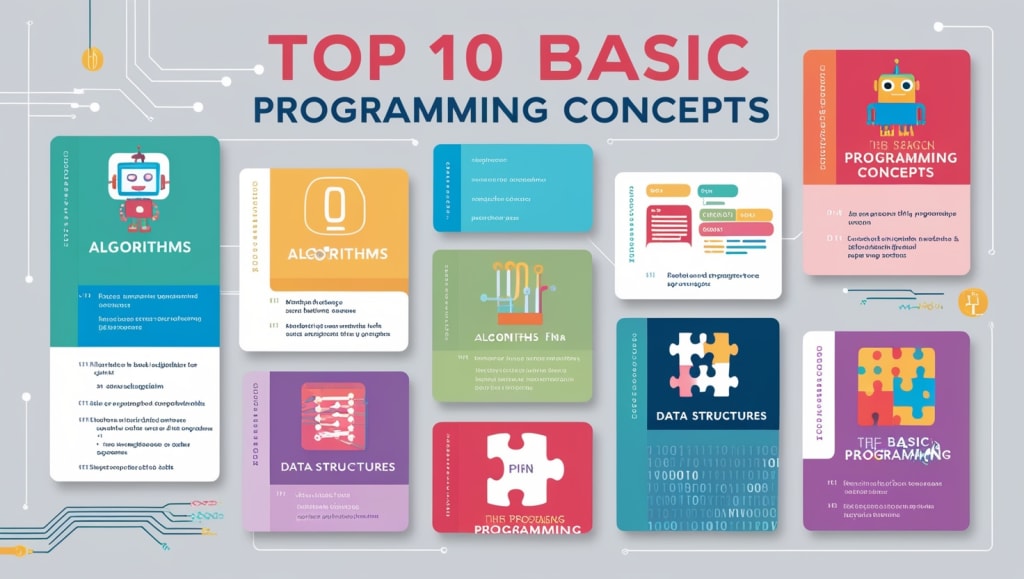
Top 10 basic programming concepts
1. Variables: Variables are used to store data in a program, such as numbers, text, or objects. They have a name and a value that can be changed during the program's execution.
2. Data Types: Data types define the type of data that can be stored in a variable, such as integers, floating-point numbers, strings, boolean values, and more. Different data types have different properties and operations associated with them.
3. Control Structures: Control structures are used to control the flow of a program's execution. Common control structures include if-else statements, loops (for, while, do-while), switch statements, and more.
4. Functions: Functions are blocks of code that perform a specific task. They can take input parameters, process them, and return a result. Functions help in organizing code, promoting reusability, and improving readability.
5. Conditional Statements: Conditional statements allow the program to make decisions based on certain conditions. The most common conditional statement is the if-else statement, which executes different blocks of code based on whether a condition is true or false.
6. Loops: Loops are used to repeat a block of code multiple times until a certain condition is met. Common types of loops include for loops, while loops, and do-while loops.
7. Arrays: Arrays are data structures that store a collection of elements of the same data type. Elements in an array can be accessed using an index, which represents their position in the array.
8. Classes and Objects: Object-oriented programming concepts involve classes and objects. A class is a blueprint for creating objects, which are instances of the class. Classes define attributes (variables) and behaviors (methods) that objects can exhibit.
9. Input and Output: Input and output operations allow a program to interact with the user or external devices. Common input/output operations include reading from and writing to files, displaying output to the console, and receiving input from the user.
10. Comments: Comments are used to add explanatory notes within the code that are ignored by the compiler or interpreter. They help in documenting code, explaining complex logic, and improving code readability for other developers.
🔟 𝘁𝗶𝗽𝘀 𝗳𝗼𝗿 𝗻𝗲𝘄 𝗰𝗼𝗱𝗲𝗿𝘀: 🔖
1. Learn Fundamentals: Use W3Schools, FreeCodeCamp, or MDN for solid basics.
2. Watch and Code Along: Follow YouTube tutorials to code in real-time.
3. Practice Regularly: Build small projects to sharpen your skills.
4. Join Coding Communities: Engage on platforms like X, Discord, and Reddit for support.
5. Use AI Tools Wisely: Leverage tools like ChatGPT responsibly to aid learning.
6. Master Git and Version Control: Learn to manage your code effectively.
7. Stay Updated: Follow tech blogs, newsletters, and podcasts.
8. Network: Attend meetups, hackathons, and online coding events.
9. Explore Open Source: Contribute to projects to gain experience.
10.Never Stop Learning: Technology evolves—keep exploring new languages and frameworks.
If you aspire to work in top product companies, here’s my advice:
👉 For SDE-1 or SWE positions, focus on:
✔️ Continuously upskilling and improving your abilities.
✔️ Developing strong problem-solving skills.
✔️Mastering DSA – trust me, you’ll be tested on it, so aim to excel.
Also, learn how to design scalable systems and understand how to build solutions that can handle growth in users and data.
👉 For higher-level roles (SDE-2 and SDE-3), focus on:
✔️ DSA + System Design (both LLD and HLD).
✔️ Building your leadership skills, as you’ll need to lead teams and projects.
🔸I know it’s challenging to do this while working full-time, but you’ll need to carve out time to consistently upskill yourself.
Remember, your learning plan should be sensible and well-organized.
The reason you're not feeling motivated is because you don't have a clear goal.
You do have a goal, but it's only that you want to make a lot of money. With just that, you'll only experience FOMO (fear of missing out), not money.
Hard work is your responsibility, but you need to set small and immediate goals. For example, if you're studying DSA, it's not something you can complete in one day. A goal for now should be to master one topic thoroughly until you can solve all medium-level questions, and slowly, you'll crack it.
This is crucial at every stage of life.
Motivation will come when you start achieving small things, and eventually, everything will fall into place one day. ♥️
🏆 – Java Developer
Stage 1 – Java Basics (Syntax, Data Types, Variables)
Stage 2 – Object-Oriented Programming (OOP)
Stage 3 – Exception Handling
Stage 4 – Java Collections Framework
Stage 5 – File I/O
Stage 6 – Multithreading and Concurrency
Stage 7 – Java Streams and Lambda Expressions
Stage 8 – JDBC
Stage 9 – Servlets and JSP
Stage 10 – Spring Framework Basics
Stage 11 – Spring Boot
Stage 12 – RESTful APIs with Spring
Stage 13 – Testing
Stage 14 – Deployment
Stage 15 – Build projects
Programming "Talent" is a Myth, Here's what you need to be a Good Programmer
1. Patience ✨
2. Perseverance
3. Abstract mindset (Creative solutions)
4. Problem-solving
5. Planning
6. Basic math skills ➕➖✖️➗
7. Tech Enthusiasm
It’s ok to make mistakes and create bugs, we learn !
About the Creator
Bahati Mulishi
Practical advice on remote work, IT careers, and professional skills to help you stay work-ready anywhere in the world.
Keep reading
More stories from Bahati Mulishi and writers in Education and other communities.




Comments
There are no comments for this story
Be the first to respond and start the conversation.