
Tips to Automate eLearning Process
The eLearning Automation Guide

The shift to automation is an integral part of the development of many industries, and the eLearning industry is keeping up with this trend. Automation helps to simplify routine processes and, at the same time, make them more efficient. This article will plunge into the world of automation, analyze what eLearning automation is, and give some tips for the correct implementation of automation.
What Learning Automation Is All About?
Automation in different industries takes different forms. However, in online learning, automation is all about algorithms and their application. Algorithms help to automate various routine tasks. For example, you can automate sending educational materials to different study groups or checking exams and tests. But that’s not the entire list of aspects you can automate:
- Authoring. Algorithms can change the course structure, adjust it to a particular student’s success, and provide different parts to students.
- Notifications and feedback. Automatic notifications about various course events will help you to always be in touch with students.
- Learning experience. Algorithms can recommend additional material for study or review, automatically enroll in the next course upon completion of the previous one, and much more.
- Customer service and support. Optimization of the support consists of the implementation of various chatbots that answer students' questions in real-time.
- Reporting. Collecting information and packing it into detailed statistics can be done using a variety of advanced algorithms.
- CRM. If the CRM is linked to the LMS system, algorithms can automate sending emails to students to receive feedback and much more.
Why eLearning Automation Is Beneficial for Your eLearning Processes
Let’s discuss the main reasons why eLearning automation is vital for any online course. We’ll number significant benefits you’ll receive after implementing automation techniques in your process.
Benefit #1. Lowered Time to Develop an Online Course
The lengthy development of online courses is one of the main problems for eLearning. According to surveys, 29% of respondents spent more than 100 hours developing their online courses. And automation algorithms are designed to solve this problem. For example, by implementing automation algorithms, you can simplify the creation of control tasks and tests. You do not need to compose each test since this can be done by algorithms that will analyze the educational material and generate a simple test based on it.
Benefit #2. Unique Learning Experience for Every Student
A personalized approach to each student is a great way to increase engagement in the learning process. Based on the students’ existing knowledge, the algorithms can recommend additional materials for study or rearrange some course blocks to consolidate the material with which problems arise.
Benefit #3. Enhanced Motivation
Your course must be good at involving students in the learning process to master the material successfully. Automation algorithms are one way to improve student motivation and create seamless learning. This can be manifested in various reminders about upcoming events (reports, tests, tests, and so on). Among other tools for boosting a learner’s engagement are leaderboards, game elements, etc.
Benefit #4. Improved Feedback Reception
The key to good online learning is constructive feedback and pointing out ways to fill knowledge gaps. Algorithms can automate this process by creating various prompts in real-time and providing multiple teaching materials, focusing on students’ incorrect answers on tests. This helps students always understand what knowledge they confidently use correctly and which ones require additional consolidation.
Benefit #5. Automated Reports
Reports are an essential part of any educational process because they help understand the effectiveness of an online course and student success. If you create reports manually, it takes too much time, and the more students in the group, the longer this process takes. Algorithms can automate the reporting process providing reports displayed in the required format.
Main Tips to Implement eLearning Automation
Well, we found out what eLearning automation is and its primary benefits for the educational process. It's time to consider the main tips that will help you correctly implement automation algorithms in your training course.
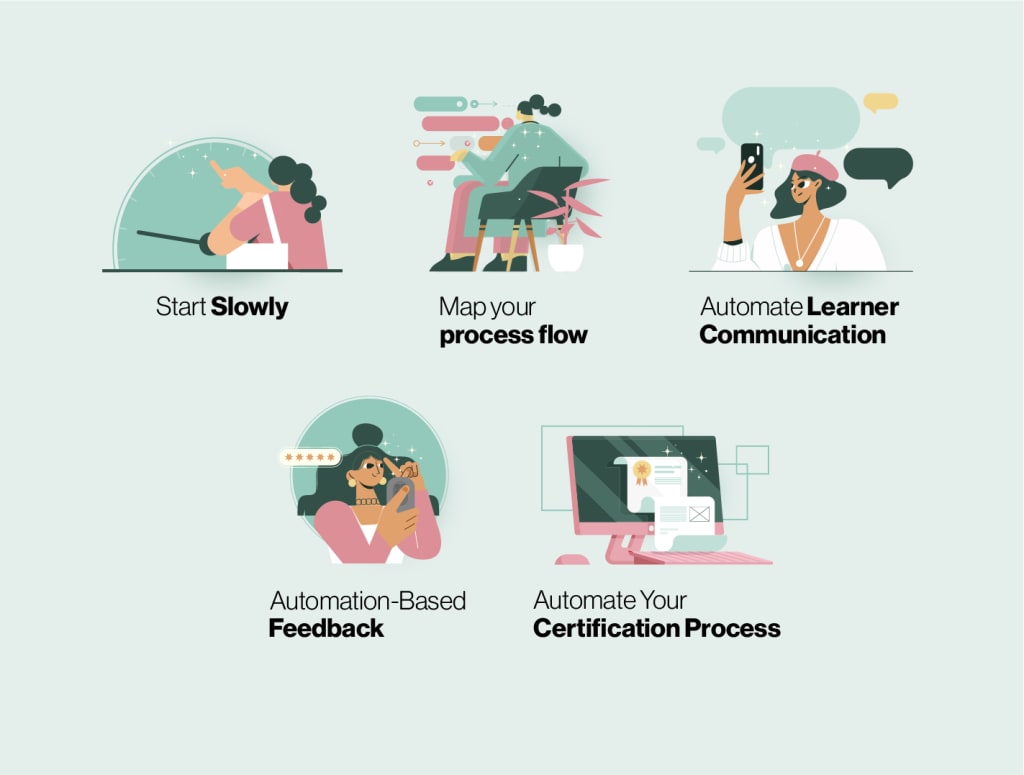
Tip #1. Slow Start and Rapid Growth
It’s a widespread mistake that course owners try to automate every aspect of online learning. However, this approach is erroneous because it becomes challenging to assess the effectiveness of automation. First, you should automate the most routine and time-consuming tasks. This will help you get two benefits at once: you will speed up one of your time-consuming processes and test various automatization possibilities. Further, it's just a matter of feedback and the subsequent automation of other tasks.
Tip #2. Slow Start and Rapid Growth
To successfully automate the process, you must thoroughly understand the principle of its operation and identify the weak points that slow it down. Close cooperation with the employees responsible for this process will help you in this. Collect accurate information about all the nuances of the process that you want to automate. This approach will help you chart the entire process and see which parts can be automated.
Tip #3. Back-end Processes Should Be Automated as Well
Back-end processes can be pretty routine and should be automated in the first place. For example, the beginning of the course is approaching, and there is a long settling of various formalities such as start time, duration, and much more. In addition, all this information should be sent out to both students and educators. An automatic mailing will help notify students of all the formalities of the upcoming course without distracting teachers from preparing for the course.
Tip #4. Automate Feedback
Automating feedback will help you get constructive feedback about your course faster and quickly apply the information you draw from it. In addition, this feedback can be formatted into detailed statistics that will help you understand the weaknesses of the course and improve the learning experience. Automation can include various digital quizzes and tests to get you a sample of data that will help smooth out the roughness of specific points in the course.
Tip #5. Certification Automation Is a Must
Certificates are direct evidence that the student has completed the course and gained new knowledge. In addition, the certificate is a document that can be applied to your resume and so on. Algorithms can fully automate the process of issuing certificates by filling in all the required fields of the certificate (student personal data, course name, completion date, and so on).
Wrapping Up
As you can see, automating online learning is a great way to improve the learning experience and free teachers from many of the mundane tasks that take up valuable time. However, progress does not stand still, and every year, the possibilities of eLearning automation are growing. Who knows what other innovations in eLearning automation will we see in 5-10 years. However, we’re confident that these innovations will bring even more convenience to the already established learning processes.
About the Creator
Keep reading
More stories from writers in Education and other communities.
How AI Is Impacting the Jobs of Website Designers and Developers
Artificial Intelligence (AI) is transforming industries across the globe, and the world of website design and development is no exception. From streamlining workflows and enhancing creativity to automating repetitive tasks and reshaping professional roles, AI’s influence is broad and deep. In this article, we explore how AI is impacting website designers and developers — the opportunities it presents, the challenges it introduces, and how professionals can adapt to thrive in an AI-augmented landscape.
By Rajiv Menon6 days ago in Education
Kiranmala: The tale of Princess Who conquered Magic Mountain
Long ago, in a land far away, the queen was panicked, her grasp on reality seemingly slipping. She had given birth to two boys and one girl. But to her horror, before even meeting their father, each child vanished, something else taking their place. She faced accusations of witchcraft and demon sorcery. And though the king loved her, he was easily swayed. He soon grew doubtful and banished his wife, who left the kingdom in anguish. Little did they know, the queen’s jealous sisters were the ones to replace the newborns
By Munesh Yadava day ago in Education




Comments
There are no comments for this story
Be the first to respond and start the conversation.