
They Found an Ancient Monoplane in a Pyramid in Egypt
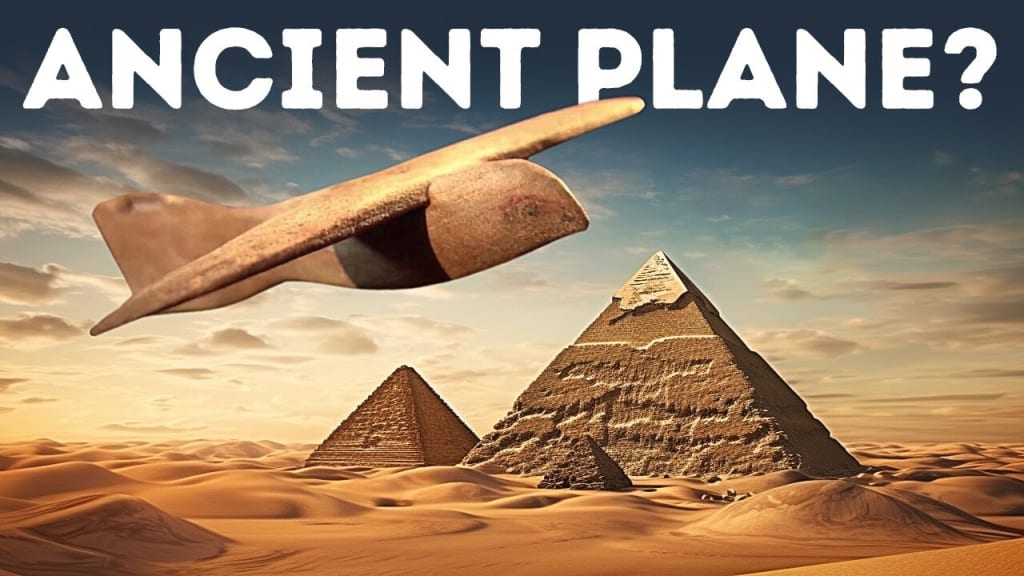
Transport yourself to the year 1898, where you find yourself immersed in excavations near Cairo, specifically in Sakara. This region, adorned with ancient tombs and pyramids, sparks your inner Indiana Jones as you hope to unearth something extraordinary—a gold manuscript, a treasure map, or perhaps the mummies of renowned pharaohs. However, your excitement takes a hit when you stumble upon what appears to be a mundane wooden bird, a relic from over 2,000 years ago.
Dubbed the Sakara bird, this artifact, carved from sycamore wood, boasts a modest wingspan of seven inches and a weight of approximately 40 grams. Despite its plain appearance, lacking intricate carvings or feathered details, the bird features a beak and eyes reminiscent of the hawk, symbolizing the deity Horus. Its tail, notably squared and oddly upright, hints at a missing piece, creating a mystery for eager investigators.
Numerous theories have emerged to explain the purpose of this enigmatic bird. Some propose it was a ceremonial object, while others suggest it served as a child's toy in an affluent family, possibly even functioning as a boomerang—a popular concept in ancient Egypt. The notion of the bird as a weathervane was debunked due to the absence of holes or markings, except for those added at the Museum in Cairo for exhibit support.
Nearly a century after its discovery, Egyptologist Dr. Khalil Masiha presented a groundbreaking theory. He proposed that the Sakara bird could be a model of an ancient monoplane, missing only a horizontal tailplane. Dr. Masiha argued that the bird's wings, set at a right angle, resembled the aerodynamic design of modern planes, potentially capable of generating the lift needed for flight. Furthermore, he suggested that placing miniature models of technological inventions in tombs was a common practice during that era.
To test this theory, glider designer Martin Gregory constructed a balsa wood model resembling the Sakara bird, even with the missing tailplane. However, the results of its flight were underwhelming, casting doubt on the monoplane hypothesis. Yet, the History Channel wasn't convinced, leading them to invite an aerodynamics expert who built another replica. Tested in conditions similar to those in Egypt, this model impressed observers with its flight capabilities.
If the Sakara bird indeed represents an ancient prototype of a plane from 200 BCE, it would be a remarkable example of an out-of-place artifact (OOPArt), defying the technological norms of its historical context. The Sakara bird joins a list of such anomalies, including the Antikythera mechanism—a 2,000-year-old analog computer retrieved from a shipwreck near the Greek island of Antikythera. This intricate device, dated around 100 BCE, could calculate the positions of celestial bodies, eclipses, and lunar phases with remarkable precision.
Other examples of ancient ingenuity include the first flushing toilets developed by the Minoans and the Indus Valley Civilization around 4,000 years ago. Their plumbing and sanitation systems surpassed innovations seen until 2,000 years later. Similarly, automated doors, often considered a modern invention from 1931, trace their origins back to Heron of Alexandria in the 1st century CE, who employed a hydraulic system for temple doors.
Even the concept of a battery seems to predate its conventional understanding, with a clay jar found in Baghdad dating back 2,000 years potentially serving as an early electroplating device or a vessel for sacred scrolls. Leonardo da Vinci's visionary design for contact lenses in 1508, although impractical, laid the groundwork for later innovations in improving vision.
Lastly, the marvel of instantaneous communication via transatlantic telegraph cables revolutionized long-distance messaging in 1858, reducing delivery times from days to mere hours. Queen Victoria herself sent the inaugural message through this undersea cable. Although the cable initially faltered, subsequent efforts revived this groundbreaking technology.
In conclusion, the Sakara bird, with its mysterious origins and contested theories, adds to the rich tapestry of ancient marvels that challenge our understanding of history and technological progress. These out-of-place artifacts continue to captivate our imagination, reminding us of the potential for innovation in unexpected times and places.
About the Creator
Soft Skills Training Strengthening Workforce Performance and Professional Growth
Soft skills training has become a critical component of professional development in today’s dynamic work environment. As organizations place increasing emphasis on collaboration, leadership, adaptability, and effective communication, soft skills are now viewed as equally important as technical expertise. These skills help employees navigate complex workplace interactions, adapt to change, and contribute more effectively to organizational goals.
By Bobby Yadav6 days ago in Education
Learn to Be Alone...
We often find that people are told to stop making 'X, Y and Z' their personality. Well, this only arose in the social media age as especially women's interests: reading, dramas, art etc. was heavily criticised as being 'useless'. It is historically well-documented that though many men require the work of women, whether it be through unpaid labour or entertainment, they also refuse to acknowledge it is important. This is why since it has been something of recognition, they have been complaining of a 'loneliness epidemic' now that women are withholding access.
By Annie Kapur6 days ago in Psyche




Comments (1)
This is a great work you can join my friends and read what i have just prepared for you.