
The World’s Biggest Money
When a Quintillion-Dollar Bill Taught Humanity the True Value of Wealth


The World’s Biggest Money
It stood taller than any skyscraper, wider than a football field, and heavier than a mountain. People called it The Giga Bill — the world’s biggest piece of money, built not printed, and visible from space.
No one knew exactly who had made it. Some said it was a tech billionaire trying to outdo Elon Musk. Others believed it was a government experiment gone wrong, or right, depending on who you asked. One theory claimed a rogue AI designed it to test the limits of human greed.

But one thing was certain: it existed.
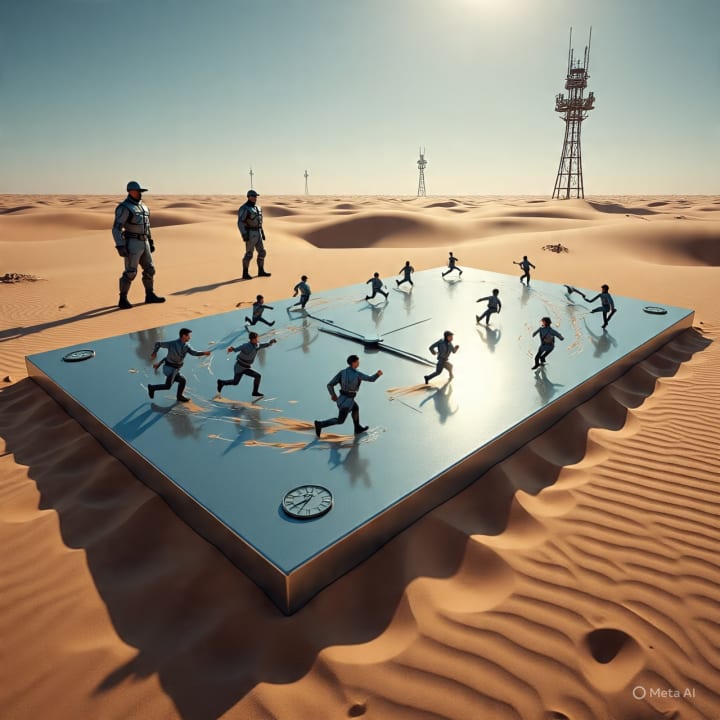
The Giga Bill was constructed in the Nevada desert, surrounded by armed guards and satellite surveillance. Made of an alloy of gold, graphene, and diamond dust, it shimmered in the sunlight like a god’s credit card. The number printed on it? One Quintillion Dollars — that’s a 1 followed by 18 zeroes.
It bore no president’s face. Instead, it showed the image of a clock with no hands, surrounded by a circle of people chasing each other endlessly — a symbol that would come to mean more than anyone first realized.
The world took notice. Fast.
Nations demanded a share. Banks fought legal wars over who had the right to store it. Economists panicked. Protesters marched in cities, chanting “Burn the Bill!” and “Money for the Many, Not the Machine!” The United Nations held emergency meetings, but no one could agree what to do with it.
Should it be destroyed? Spent? Split?
But here was the catch: The Giga Bill was unspendable.
No country on Earth had a bank big enough to accept it. It was worth more than the global economy itself. If someone tried to deposit it, it would collapse entire currencies. Even breaking it into smaller chunks would cause financial chaos. It wasn’t just money. It was a paradox. A monument to wealth so extreme, it was useless.
Still, people tried.

A billionaire offered to trade the Mona Lisa, four islands, and a private space shuttle for a 1% share in the bill. Denied. A warlord attempted to seize it with tanks — his army vanished without a trace. One hacker claimed he’d upload the bill into the blockchain. The servers exploded two minutes later.

Meanwhile, tourists began visiting the edge of the desert just to glimpse it. Hotels and restaurants boomed. A town called Billtown formed nearby, thriving on money worship. People wore shirts that said “I Saw the Bill” and “In Money We Trust.” Conspiracy theories spread like wildfire: that touching the bill would grant immortality, that it was cursed, that it was the first step toward a new world order.
Years passed. The Giga Bill remained untouched.
Then one day, an 11-year-old girl named Amira, a student from a small village in Sudan, asked a simple question in a viral video:
“If it can’t help anyone, is it really money?”

The world stopped. Her words echoed in headlines, classrooms, and parliaments. Economists debated the philosophy. Artists painted murals. Activists picked up her quote like a weapon.
And for the first time, something shifted.
People began to focus less on the bill and more on what it represented: greed, power, control — and the hollowness of wealth without purpose. Some countries erased national debt with new cooperative economic systems. A new global movement called “True Worth” began, valuing skills, kindness, and time instead of dollars and digits.
Amira was invited to speak at the UN. She stood before presidents, CEOs, and royalty and said:

“You made the biggest money, but forgot the biggest meaning.”
It was the final blow.
In a unanimous vote, the world agreed to dismantle the Giga Bill. Piece by piece, it was broken down and repurposed — not into currency, but into satellites to connect the world, clean energy panels, and water systems for drought-stricken regions. Its materials gave life, not just luxury.
Billtown became Worthville, a city dedicated to education and innovation. The desert bloomed with solar farms and gardens. And on the spot where the Giga Bill once stood, they built a monument: not of a bill, but of a globe — wrapped in the words:
“Value is what we give, not what we take.”
About the Creator
Keep reading
More stories from MoneyOrbit and writers in Education and other communities.
When Healing Leads the Way: How Outcome-Driven Healthcare Reshapes Systems, Costs, and Trust
Healthcare is at a crossroads. Rising costs, overwhelmed providers, and frustrated patients have exposed deep flaws in systems that prioritize financial performance over human well-being. For decades, success in healthcare was often measured by revenue, service volume, and utilization rates. While economic sustainability is essential, problems arise when profit becomes the primary goal rather than a byproduct of adequate care. Shifting the focus from profits to outcomes fundamentally changes how healthcare operates, who it serves, and how success is defined.
By Evan Weiss St Louisa day ago in Education
Lean Management Principles in Healthcare: A Practical Guide to Better Patient Care
Lean management principles in healthcare focus on improving patient outcomes by reducing waste, streamlining workflows, and strengthening team collaboration. Originally developed in manufacturing, Lean has become a powerful approach for hospitals, clinics, and medical practices that want to deliver higher-quality care with fewer delays and less frustration.
By Brady Beitlicha day ago in Education



Comments
There are no comments for this story
Be the first to respond and start the conversation.