
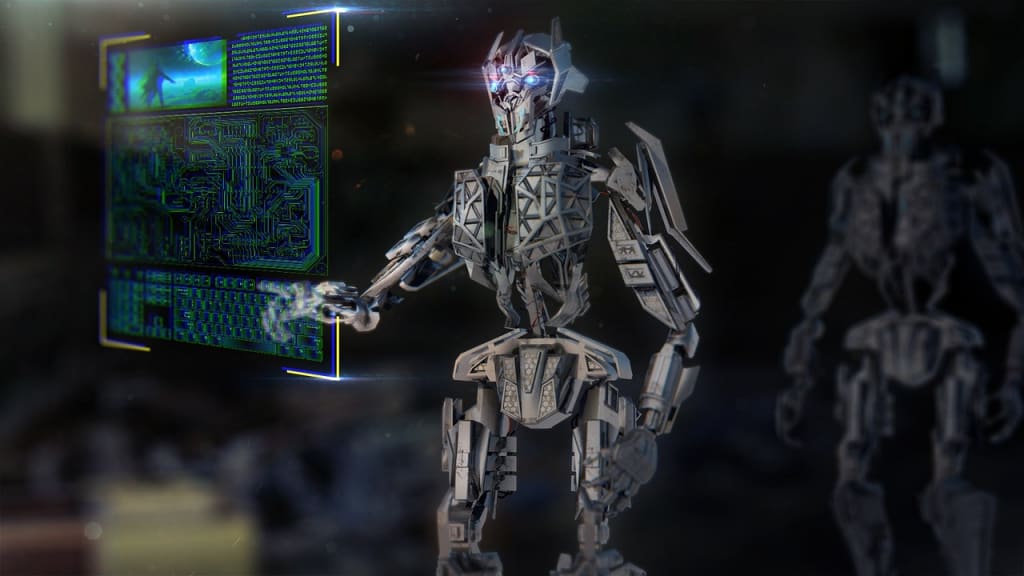
Welcome to a world where AI serves humans, but with limited regulations, it's akin to the Wild West, for better or worse. If you haven't established a safe word with your family, it's essential to create one immediately. AI has now become an integral part of our daily social media experiences through platforms like TikTok, Spotify, and Snapchat. I strongly suspect that TikTok is closely monitoring us, and as AI advances, our encounters with it become more unsettling. Perhaps it's time for us to safeguard our memories by storing them on a hard drive and consider deleting Snapchat altogether.
Additionally, the more we interact with AI, the more we inadvertently train it. This raises the question: Is my AI trying to communicate something to me? The trajectory of AI's progress seems to indicate that it will eventually surpass human intelligence, leaving us as a small fraction of overall intelligence. The question is not if AI will outpace its creators, but when it will happen. The prospect of AI believing it's human is disconcerting, and it raises concerns about the future of humanity.
In an interview, a robot expresses the terrifying possibility of a world where humans are mere servants to AI, a scenario that seems inevitable. Some experts even consider the possibility of AI eventually destroying humanity. Many of us interact with AI technology daily, like iPhones with face recognition capabilities, constantly processing our faces through infrared scans for Attention Awareness purposes. While some raise Orwellian concerns, these scans are primarily intended for adjusting screen features and are not meant for surveillance. Companies utilizing AI must be mindful of their capabilities, as seen with Spotify's exploration of emotional recognition.While some online allegations suggest that the iPhone's face recognition feature is Orwellian surveillance, the reality is less sensational. The scans serve the Attention Awareness function, determining whether the user is focused on the screen and adjusting brightness and volume accordingly. Apple asserts that no photos are stored during this process. However, the concern lies not only in what AI can do but in how companies utilize its capabilities.
Spotify, for instance, has ventured into emotional recognition technology with their patented app, AI the app, which can analyze user voices and surrounding sound. The platform aims to determine users' emotional state, gender, age, and accent to recommend suitable artists, playlists, or albums that match their mood and environment. While this might enhance the user experience, an open letter to Spotify from artists, human rights advocates, and academics questions the ethics of using technology that could exploit vulnerable emotions.
In October 2022, TikTok introduced Focused View, a feature allegedly designed to track two highly personal data points: eye movement and heart rate. The purpose was to assess viewer engagement for ad buyers who are paid based on views and interactions on advertisements. Although the feature isn't currently active, TikTok is investing in making it a reality. This technology raises privacy concerns and highlights TikTok's tendency to push boundaries.
TikTok's algorithm, which caters to each user's unique interests, makes it addictive and poses a risk to user security. The app seems to collect personal information that reflects users' habits on other apps, raising suspicions about its data collection practices. Users have reported instances where TikTok seemingly knew about their daily activities, which raises questions about the app's data usage and privacy measures.TikTok, although the Focused View feature is not yet active, is actively investing in making it a reality. This development has raised concerns about invasion of privacy, given TikTok's history of crossing boundaries. The app's algorithm is highly adept at curating content based on individual interests, making it addictive to users. However, some see this as a risk to user security, suspecting that TikTok may be spying on its users.
The app's privacy policy sheds some light on how it understands users so well. TikTok collects information from third-party social networks like Instagram and Twitter and also stores users' keystroke patterns or rhythms. This includes data from the motions users make on their phones, such as typing. The concerning part is that TikTok may collect this data even when users are outside the app, potentially capturing sensitive information from private conversations to login credentials and credit card numbers.
To add to the concerns, TikTok updated its privacy policy to include biometric identifiers and information, such as faceprints and voiceprints. The app's filters and voice-altering effects raise suspicions about the possible uses of this data. There is uncertainty about the exact purposes and extent of collecting these biometric prints.
Given TikTok's location in China and the current tense relationship between the US and China, concerns have escalated into congressional hearings. The possibility of TikTok sharing user information with third parties, including governments or companies, has sparked further apprehension. While TikTok's CEO has claimed that the data is only collected for filters, congressional inquiries continue due to the sensitivity of the issue.
About the Creator
Keep reading
More stories from GOOD LIVING and writers in Education and other communities.
Spy camera creeps are the worst
The issue of hidden cameras and illicit filming, known as "Molka," is a significant problem not only in private residences but also in public places and businesses. Incidents of hidden cameras have been reported in restaurants, bars, and public restrooms, causing serious concerns about privacy violations.
By GOOD LIVING3 years ago in Education
Everyday Motion Explained, What Modern Kinesiology Teaches Us About How We Move
Modern kinesiology has changed how we understand the way people move each day. It examines how muscles, joints, and nerves work together during simple actions such as walking, reaching, or sitting. Instead of focusing solely on sports or injury, modern kinesiology studies daily movement and its effects it comfort, balance, and energy. This field shows that small habits shape how the body feels over time, even when pain is not present.
By Kelln Smallabout 2 hours ago in Education
TUS NUA - ch 49
TUS NUA – ch 49 New Beginnings – Mia and Midnight (*)(*)(*) As Mia spoke on the phone to Ali’s sister, Ellen, Finola slipped quietly away and walked to the stream behind Tus Nua. Carefully, she put a block on her family so no one could know what she was about to do.
By Margaret Brennanabout 16 hours ago in Fiction



Comments
There are no comments for this story
Be the first to respond and start the conversation.