
The Wise Farmer
A Tale of Prudence and Life's True Earnings

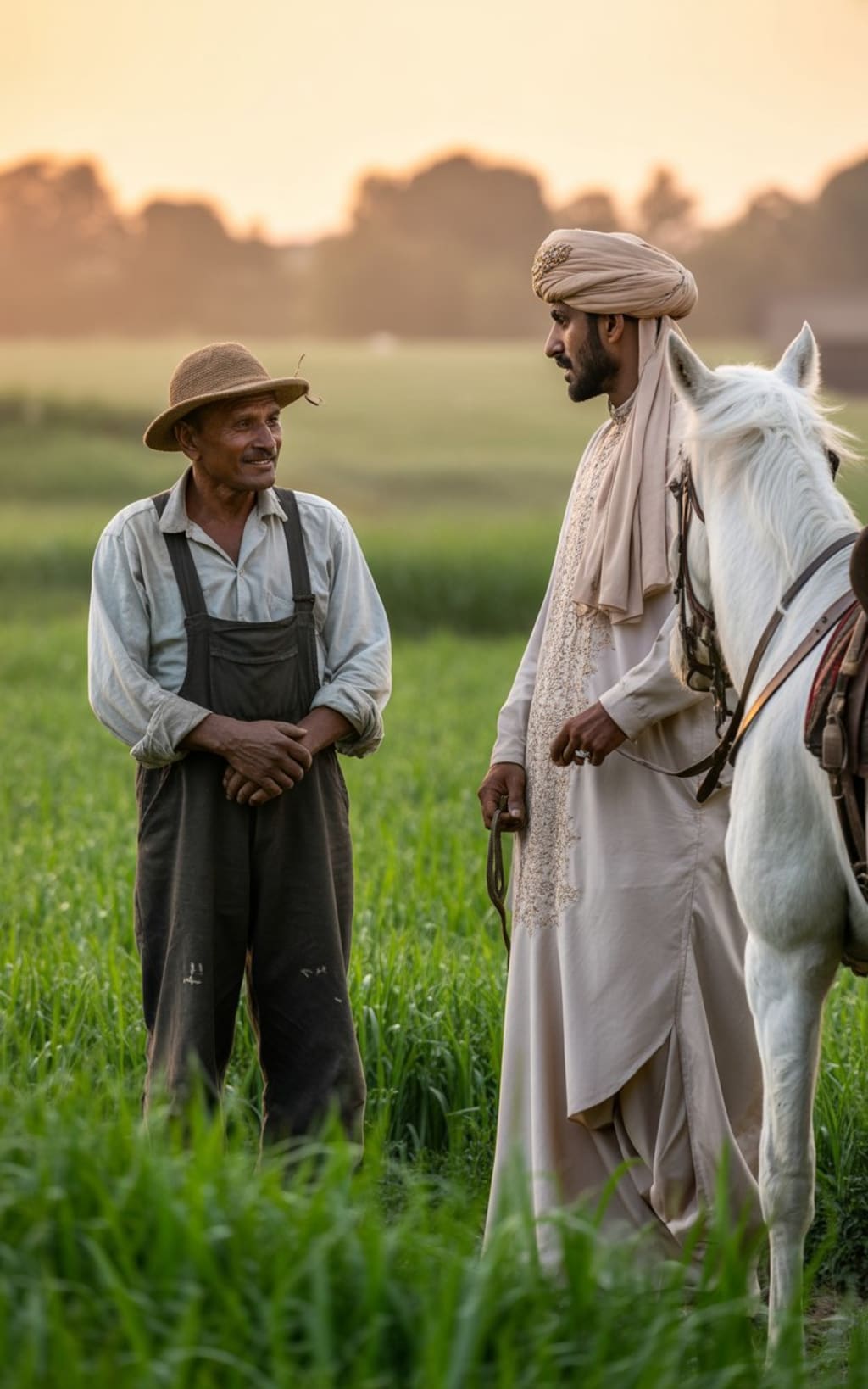
In Garhi Kumarti, a beautiful village situated a few miles from Hyderabad, Deccan, there lived a wise farmer. Like every morning, the local Nawab had set out for his routine ride. The sun had not yet fully ascended, but its soft, golden rays were already spreading across the fields, and the fresh, earthy scent of the soil filled the air. The Nawab, riding his swift horse, was enjoying the natural scenery when his gaze fell upon a field where a farmer was diligently toiling in the early hours. His body was drenched in sweat, and he was sowing his crop with complete concentration. The Nawab thought to himself, "How diligently and passionately this simple man is engaged in his work. I should get to know him and inquire about his well-being."
The Nawab reined in his horse, stopped it at the edge of the field, and dismounted. He walked towards the farmer, observing him closely. There was a mix of fatigue and contentment on the farmer's face from his hard work. The Nawab asked in a gentle tone, "Tell me, brother! You are working so hard in this field. Does anything remain after all this earning, or does all your effort go in vain?"
The farmer looked up. There was a hint of respect and some surprise in his eyes that the Nawab himself had come to him. He folded his hands and humbly submitted, "Sir! This is not just earning; it is the foundation of life. And as for what remains, that story is quite interesting too. After the main benefit, whatever remains, I divide it into four parts."
The Nawab's curiosity grew; he stepped closer to the farmer and said, "So, how do you spend these four parts? I am very interested to hear the details."
The farmer smiled and replied, "Sir! One of these four parts goes to the government as tax, which is the right of the state and my responsibility. This part is like me personally giving it to the government treasury and being relieved of my duty."
The Nawab nodded, saying, "That I understand, it is every citizen's duty. What do you do with the remaining three parts?"
"The second part, Sir, is spent on paying off debt," the farmer paused for a moment, deep thoughts clouding his face, then he continued, "This is my late father's debt, which he took from a moneylender. Since my father's passing, the interest on this debt has doubled, and it now rests on my shoulders. It's a cycle from which I cannot escape. I pay something with every harvest, but it never seems to end. It is both my inheritance and my duty."
The Nawab's brow furrowed; he thought about how a chain of debt could extend through generations. He asked with even more surprise, "And this third part, which you give to the old ones, who are these old people? Do you give it to an orphanage or a charity?"
A sparkle appeared in the farmer's eyes, and he bowed his head respectfully, saying, "Sir! These old ones are none other than my own two sons. They are my hope for the future. I spend on their education, their upbringing, and their future. I know that what I am investing in them today will become my support in old age tomorrow. They are the true fruit of my labor."
The Nawab took a deep breath; the farmer's logic forced him to ponder further. He then asked, "And this fourth part, which you simply give away? What kind of payment is this?"
A slight smile spread across the farmer's face, and he said, "Sir! This part is for my only daughter. As you know, these days, a good marriage is difficult without a dowry. Social pressure and customs have made it essential. I consider it a wasteful expenditure, because it benefits no one, it's merely a tradition, but it has to be paid so that my daughter can have a home. In my view, this money is wasted, but for my daughter's happiness, it is my responsibility."
Listening to the farmer's words, the Nawab's astonishment and reverence only grew. This simple farmer's philosophical discourse had touched his heart. He understood that the farmer not only calculated the land but also deeply understood every aspect of life. His words carried lessons of wisdom, responsibility, and foresight. The Nawab felt that this humble farmer had taught him a profound lesson about life.
The Nawab mounted his horse again, sincerely commending the farmer. He took out a purse of gold from his pocket and offered it to the farmer, saying, "Your wisdom and your hard work are both commendable. This is a small reward from me for you, so that you may feel ease in your daughter's marriage, and your children's future may be even brighter."
The farmer looked at the Nawab with grateful eyes; there was a hint of tears in them as he folded his hands and said, "Nawab Sahib! Thank you for your generosity."
The Nawab smiled and spurred his horse. After meeting the farmer, he had learned a great deal that day. This man, living his daily life in the fields, was not just a farmer, but a treasure trove of wisdom and understanding. The Nawab returned to his palace with new insights, a deep respect for the farmer in his heart.
About the Creator
AngelFace
✨ “I share mysteries 🔍, stories 📖, and the wonders of the modern world 🌍 — all in a way that keeps you hooked!”
Can Training Farmers End Hunger?
What if one of the most powerful solutions to global hunger is not food aid, but knowledge? Around the world, millions of smallholder farmers grow the food that feeds their communities. Yet many of them struggle with low crop yields, unpredictable weather, poor soil quality, and limited market access. If farmers are at the center of food production, could empowering them with better skills be the key to ending hunger?
By Convoy of Hope4 days ago in Education
How to Install Floodlight Cameras: Step-by-Step Guide
Floodlight cameras give strong security for homes and businesses. They mix bright lights with video recording to scare away intruders and catch clear footage. When you pick the best floodlight camera, you get reliable protection that works day and night. This guide takes you through the installation process in clear steps.
By Bilal Ahmad5 days ago in Education




Comments
There are no comments for this story
Be the first to respond and start the conversation.