
The "Wind" in Feng Shui
Understanding Wind in Feng Shui: From Classical Concepts to Practical Applications

Key Points of Today’s Article:
Why Houses Should Not Be Built on Exposed Mountain Peaks
Understanding "Knife Slashing Sha"
Avoiding "Wind Blowing Through the House"
Today, I’ll introduce some Feng Shui concepts related to "wind."
As I’ve mentioned before, The Book of Burial states: "Obtaining water is the top priority, storing wind is second." This highlights that in Feng Shui, the importance of "storing wind" is second only to "obtaining water."
In this context, the term "storing" in Chinese refers to preventing Qi (vital energy) from dissipating, while "wind" symbolizes vital energy itself.
What is vital energy? It is the dynamic balance of Yin and Yang energies (we’ll explore Yin and Yang in detail another time). How can vital energy be preserved? Only a stable energy field can retain it. In Feng Shui, an environment with a stable energy field is regarded as having good Feng Shui.
In modern terms, a stable energy field refers to maintaining a home's comfort by ensuring proper temperature, humidity, ventilation, and lighting. These factors are keys to achieving "storing wind," which focuses on creating vital energy stability and balance.
When Does the Energy Field Become Unstable?
Generally, this occurs in two situations:
1. External Environment:
In the Feng Shui classic Snow Heart Ode, there is a phrase: "Eight doors missing, eight winds blowing." This means that when wind flows into a home from all eight directions, Qi disperses, destabilizing the energy field. Even a wealthy family in such a home would experience a decline.
For this reason, houses exposed to wind from all sides are considered unfavorable in Feng Shui. A typical example is a house built on a mountain peak, where it is constantly surrounded by wind and unable to form a stable vital energy field. In contrast, traditional Chinese dwellings are often built on hillsides rather than at the summit.
In urban settings, when a building directly faces a gap between two tall buildings, the wind channeled through this gap can be described as being as sharp as a knife—this phenomenon is referred to as "Knife Slashing Sha" in Feng Shui. Such strong, concentrated wind currents are highly unfavorable. Therefore, avoid homes that directly face gaps between tall buildings to prevent the Knife Slashing Sha effect.
By the way, the terms "Eight Door"() and "Eight Winds" (八风) are rooted in Chinese 术数 (shushu) culture, an academic category in traditional Chinese thought. While "术数" has no exact English equivalent, it can be loosely translated as "metaphysics." The former originates from Qimen Dunjia (奇门遁甲), and the latter is used in traditional Chinese medicine. Feng Shui, predictive techniques, and traditional Chinese medicine share interconnected theories, which is why some terminology overlaps across these fields.
The concepts of "Eight s" and "Eight Winds" are used to describe open spaces on all sides, resulting in strong wind speeds and an unstable energy field. In Feng Shui, the eight directions are commonly used for spatial descriptions. However, for professional Feng Shui practitioners, we often rely on 24 directions for more precise energy field analysis. This system is professionally referred to as the "24 Mountain Directions" (二十四山向).
2. Internal Environment:
In Feng Shui, for external environments, straight and fast-moving energy flows are considered unfavorable, especially strong flows like the Knife Slashing Sha mentioned above. Similarly, within a home, wind—like water—should flow gently and in a meandering manner.
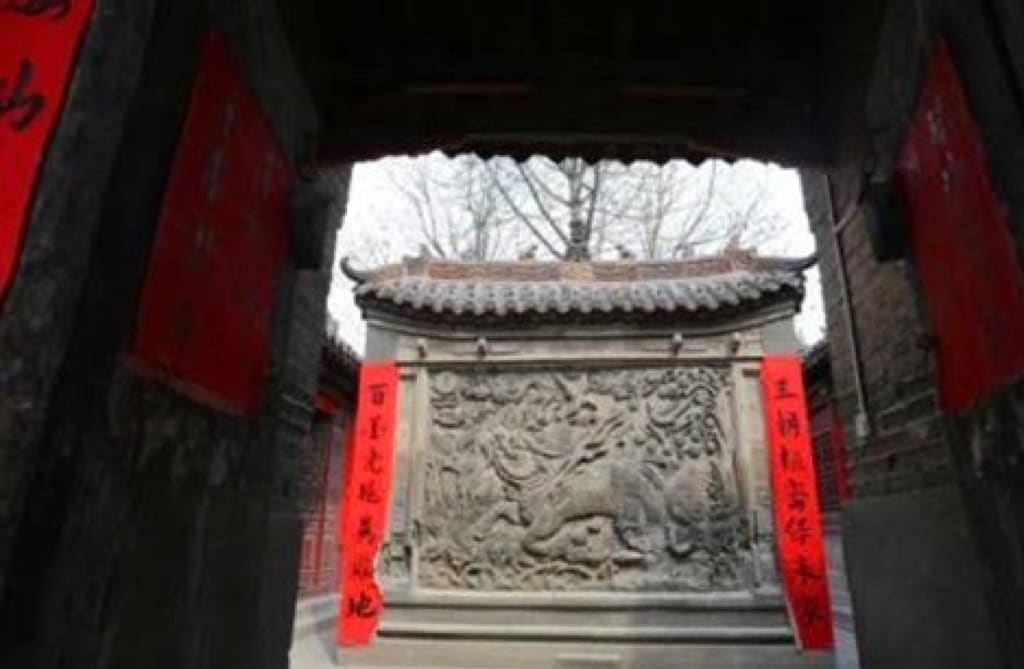
Feng Shui favors curved and indirect pathways over straight and direct ones. For example, traditional Chinese homes, such as courtyards (siheyuan), often feature a screen wall called a shadow wall (yingbi) placed in front of the main entrance (Figure 1). This wall slows the flow of wind entering the house, allowing it to circulate gently around the wall before entering the interior.
I once visited a client’s house with a spacious front hall. The main entrance directly faced the living room, which, in the original design, had no doors. However, the living room in this house had a door installed. The homeowner explained that the previous owner had consulted a Chinese Feng Shui master who recommended adding the door. This was a wise suggestion, as the door helped stabilize the living room’s energy field and prevented airflow from the front door from rushing directly into the space.
This is a practical example of the "storing wind" concept in Feng Shui.
About the Creator
Lidong Yu
I am a Chinese Feng Shui consultant and educator, raised and trained in China. My work draws on classical Feng Shui traditions to help people better understand the relationship between themselves, their environments, and time through Qi.
When the Shelter Closes
Across the street from my house, a man slept under a tree, his dog by his side. My first, naive thought: he must be traveling through. But he kept coming back, often sleeping there during the day. Then it hit me—that person might not have a home.
By Bride of Sound3 days ago in Humans


Comments
There are no comments for this story
Be the first to respond and start the conversation.