
The Wealthiest City In History
Beginning and downfall of the great Babylon

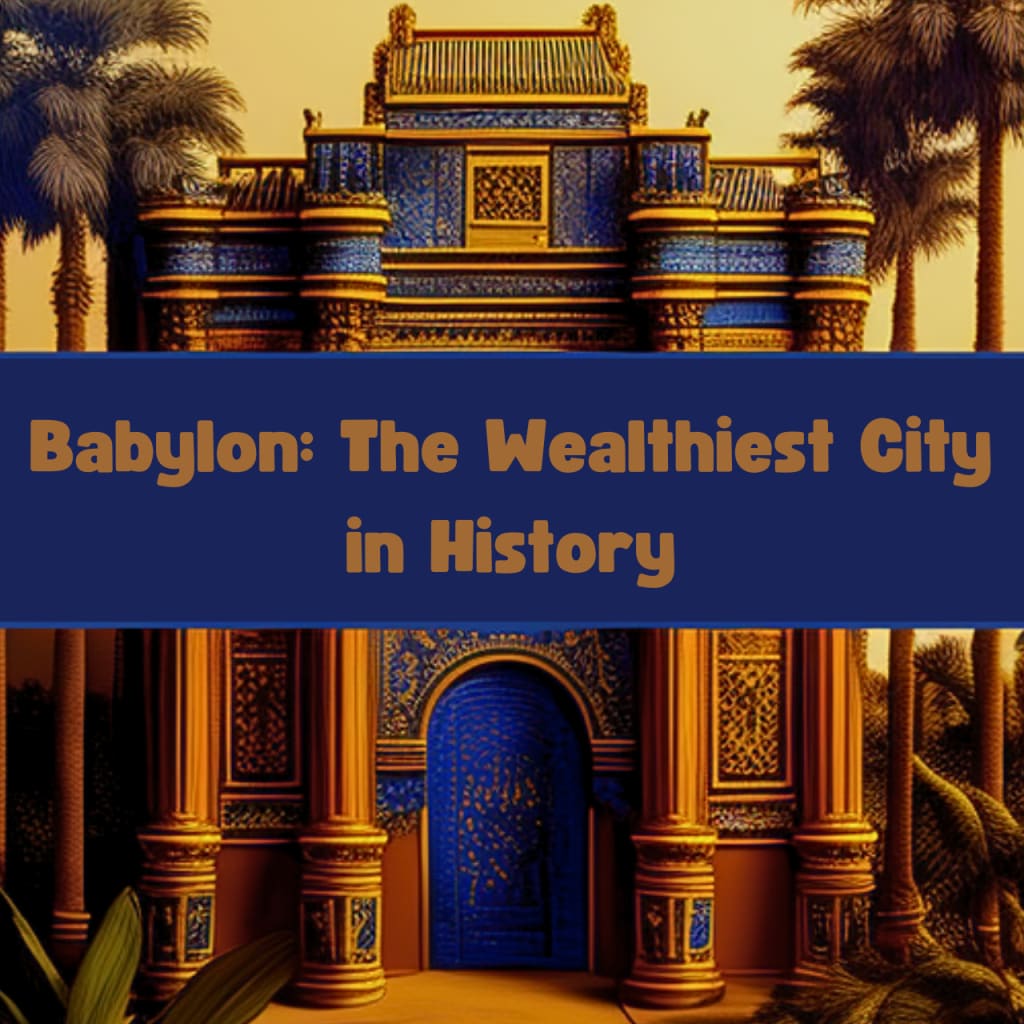
In the annals of human civilization, few cities have captured the imagination quite like Babylon. Located in modern-day Iraq, Babylon was the capital of the Babylonian Empire, which dominated the ancient Near East from the 18th to the 6th century BC. During its heyday, Babylon was one of the wealthiest and most powerful cities in the world, a center of trade, culture, and innovation that left an indelible mark on history.
The Rise of Babylon
The story of Babylon begins around 1894 BC, when it was founded as a small town on the banks of the Euphrates River. Over the centuries, the town grew in size and influence, eventually becoming the seat of power for the Babylonian Empire under the rule of Hammurabi in the 18th century BC. Hammurabi is perhaps best known for his code of laws, which established a uniform legal system across the empire and influenced the development of subsequent legal codes around the world.
Under the Babylonians, Babylon grew into a thriving metropolis, with a population that may have exceeded 200,000 at its peak. The city was known for its monumental architecture, including the famous ziggurat known as the Tower of Babel, which was believed to have reached a height of over 90 meters. Babylon was also a center of trade, with merchants from across the ancient world converging on its markets to buy and sell goods. The city was particularly renowned for its textiles, which were produced using advanced techniques such as dyeing and weaving.
One of the key factors driving Babylon’s wealth was its strategic location on the Euphrates River. The river provided the city with a steady supply of water, which was used for irrigation and agriculture. Babylon was also located at the crossroads of several major trade routes, which made it a natural hub for commerce. As a result, the city became a magnet for merchants, craftsmen, and artisans, who flocked to Babylon in search of opportunity.
The Splendor of Babylon
Perhaps the most famous aspect of Babylon was its wealth and luxury. The city was home to a glittering array of palaces, temples, and other grand buildings, many of which were decorated with precious metals and gems. The Hanging Gardens of Babylon, one of the Seven Wonders of the Ancient World, were a marvel of engineering, with a series of tiered gardens that cascaded down the side of a massive stone structure. The gardens were said to have been built by King Nebuchadnezzar II as a gift to his queen, who missed the lush greenery of her homeland.
Babylon was also known for its extravagant feasts and festivals, which were attended by the city’s elite. These events were a showcase of Babylon’s wealth and opulence, with exotic foods, music, and entertainment on display. The city’s famous Ishtar Gate, a massive structure adorned with glazed bricks depicting lions, bulls, and dragons, was a testament to the grandeur of Babylonian art and architecture.
The Decline of Babylon
The city's wealth also attracted the attention of the Persian Empire, who eventually conquered Babylon in 539 BCE under the rule of Cyrus the Great. The city remained a significant cultural and economic center under Persian rule, with the construction of numerous palaces, temples, and public works. One notable feature was the construction of the famous Hanging Gardens of Babylon, which were one of the Seven Wonders of the Ancient World.
Despite its great wealth and power, Babylon eventually fell into decline. It was sacked by the Seleucid Empire in 275 BCE and later by the Parthians in 141 BCE. By the time of the Roman Empire, Babylon was no longer a significant city and its ruins were largely abandoned. The site of the ancient city was eventually buried under layers of sand and debris, and it was not until the 19th century that archaeological excavations began to uncover the remains of the once-great city.
Today, the ruins of Babylon are located in modern-day Iraq, and efforts have been made to preserve and restore the site. In 1983, the United Nations Educational, Scientific and Cultural Organization (UNESCO) designated the ancient city of Babylon a World Heritage Site, recognizing its historical significance and cultural value.
In conclusion, Babylon was truly one of the richest and most magnificent cities in history, with its wealth and power influencing not only the ancient world, but also modern civilizations. Its cultural and architectural achievements continue to inspire and awe people around the world today, and its legacy remains an important part of human history.
About the Creator
Keep reading
More stories from Factual Frenzy and writers in Education and other communities.
Why is the Mona Lisa so famous?
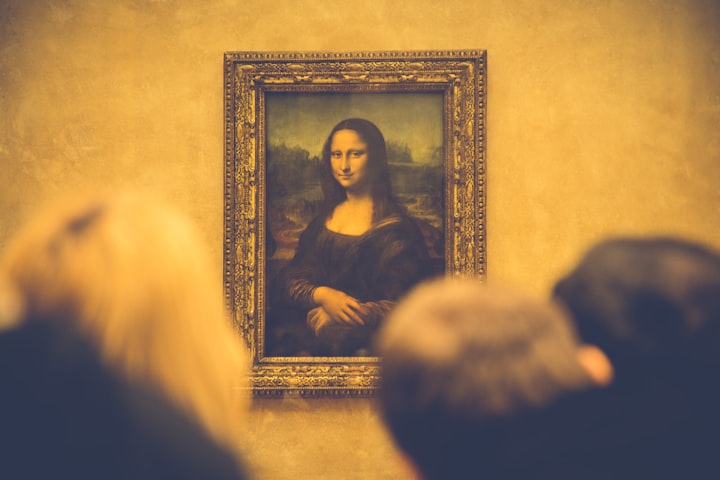
Vincenzo Peruggia took a painting off the wall and slid down the back stairs of the Louvre on August 21, 1911, as dawn broke over Paris. He was just a few steps away from freedom when he ran into a two-pronged issue: There were approaching footsteps as the door was locked. The "Mona Lisa" by Leonardo da Vinci was tucked under Peruggia's arm. It is currently regarded as the most famous painting in the world. But how did it get to where it is today? The portrait is said to have been started by Leonardo in 1503, when a Florentine businessman asked for a portrait of his wife, Lisa Gherardini. Leonardo worked on the painting for more than a decade, but when he died, it was not finished. Leonardo da Vinci was a pioneer in a number of artistic techniques thanks to his ground-breaking research on human optics over the course of his lifetime. The "Mona Lisa" depicts some of them. Utilizing "air point of view," he made pictures at more noteworthy distances hazier, creating the deception of significant profundity. Additionally, he used the technique known as "sfumato" to create subtle color gradations that softened the edges of the forms he depicted. Although all of this is striking, is it sufficient to make the "Mona Lisa" the most well-known painting in the world? It is regarded as an exceptional Renaissance portrait by many academics, but it is only one of many. Additionally, great artwork can be found throughout history. In point of fact, most of the factors that contributed to the "Mona Lisa's" rise to worldwide fame were outside of the canvas. After Leonardo's death, King François the First of France purchased the painting and began displaying it. After that, in 1550, the well-known biography of Italian Renaissance artists, including Leonardo, was written by the Italian scholar Giorgio Vasari. The book, which was translated and sold a lot, described the "Mona Lisa" as if it were a dreamlike representation of life. The "Mona Lisa" evolved into one of the French Royal Collection's most coveted pieces over time. It was initially displayed for the general public in the Louvre Museum before hanging in Napoleon's bedroom. The once-private treasures of the deposed aristocracy were a popular attraction for tourists there. A number of European academics in the 1800s increased the "Mona Lisa"'s popularity by focusing heavily on its allure. Alfred Dumesnil stated in 1854 that the smile on the Mona Lisa evoked a "treacherous attraction." After a year, Théophile Gautier composed of her "taunting lips" and "look encouraging obscure delights." In addition, Walter Pater described the Mona Lisa in 1869 as the epitome of timeless femininity. The portrait was a well-known piece in one of the world's most famous museums by the 20th century. However, the "Mona Lisa" was not yet well-known. It was Peruggia's 1911 heist that assisted it with soaring to uncommon distinction. It wasn't entirely out of the question that Peruggia would be imprisoned inside the Louvre because he had been contracted to create protective cases for the museum. Additionally, Peruggia was fortunate in that a worker who saw him in the stairwell simply assisted Peruggia in opening the door and allowed him to leave for the day. The theft made news around the world. The empty space where the "Mona Lisa" used to be displayed drew a crowd of people. Because Peruggia had worked at the Louvre, the police interviewed him, but they never considered him a suspect. In the meantime, they questioned Pablo Picasso regarding his connection to a previous robbery at the Louvre, but in the end, they let him go. After smuggling the "Mona Lisa" to Italy and making arrangements to sell it to a Florentine art dealer, Peruggia kept the painting in a false bottom suitcase for two years. Peruggia viewed himself as an Italian patriot who was returning the work of an old master. However, he was immediately detained, not celebrated as such. The "Mona Lisa" was put back on display in front of large crowds after the mystery was solved, and newspapers celebrated the success of the story. In the next many years, reasonable craftsman Marcel Duchamp derided it; It was pursued by Nazi art thieves; About it, Nat King Cole sang; and it was attacked by museum visitors with teacups, paint, stones, and paintbrushes. Over 500 years after its creation — eyebrows and eyelashes since a long time ago blurred — the "Mona Lisa" is safeguarded by an impenetrable, tremor safe case. It now stands as a reminder of how we create and maintain celebrity, rather than as an outstanding Renaissance portrait.
By Factual Frenzy3 years ago in Education
The Confidence Advantage: How Transparent Communication Builds Lasting Investor Trust
Investor relationships thrive on more than financial returns. While performance attracts attention, trust sustains commitment over time. In an environment shaped by rapid information flow and shifting market conditions, transparency has become one of the most powerful tools for building and maintaining investor confidence. When organizations communicate clearly and consistently, they strengthen relationships that endure well beyond short-term results.
By Michael Christopher Venturino3 days ago in Education
Golf Handicap Reduction Without a Swing Overhaul: Smarter Ways to Play Better Golf
Lowering your handicap does not always require technical changes or hours on the range; it requires rebuilding your swing. Many golfers overlook the fact that scoring improvement often comes from strategic thinking, mental discipline, and better preparation. By focusing on how you play rather than how you swing, you can unlock consistent progress and enjoy the game more. This article explores practical, on-course methods that help you shoot lower scores while keeping your swing exactly as it is.
By Ian Schenkel Haliburton3 days ago in Education


Comments
There are no comments for this story
Be the first to respond and start the conversation.