
The Unwound Hour
Some clocks show you where you've been; this one showed him where it all began.
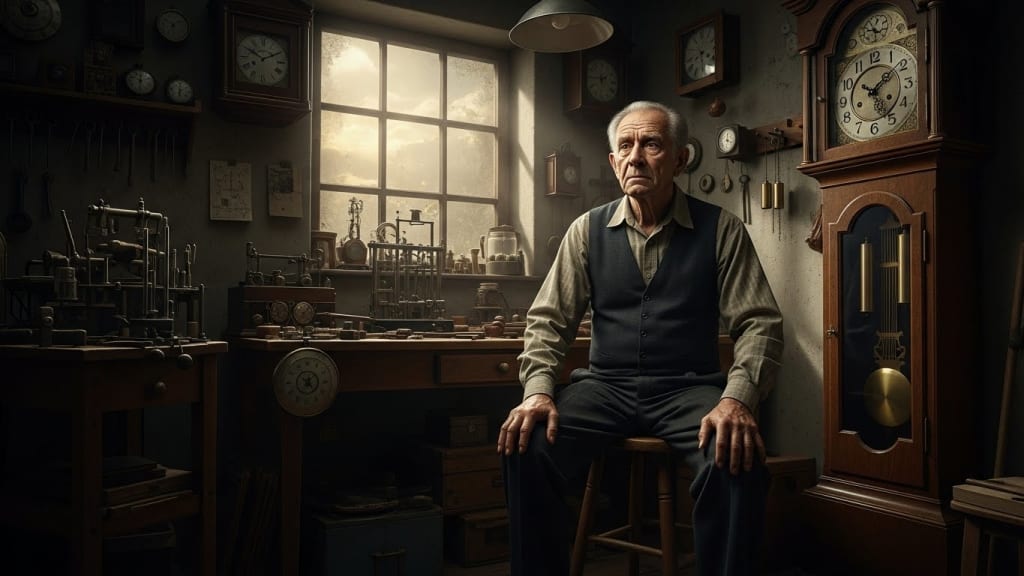
Silas worked in a quiet dust. The air in his shop, "Silas's Timepiece Repair," hung thick with the ghosts of forgotten minutes, of brass and polished wood, of faint clock oil and the mildew that clung to everything old. He ran a calloused thumb over the face of a pocket watch, a broken thing, its hands frozen at a quarter past three, like a startled bird. He’d seen a thousand of these. Each one a tiny, complex history. He breathed out, a puff of dust motes dancing in the single shaft of sun slicing through the grime-streaked window.
His own life felt much the same sometimes, a mechanism wound down, gears stuck. He was fifty-eight, a widower, his son a continent away, a life of his own, a different kind of time running through him. Silas just fixed things. The predictable, forward march of seconds, minutes, hours. That was his trade. That was his comfort, mostly.
Then the old man brought in the grandfather clock. Not even a proper customer, just a shuffle of worn leather shoes, a mumbled "moving house, needs to go." It was tall, dark oak, plain, no fancy carvings or gilded trim. Just a sturdy, silent sentinel. Silas barely glanced up from a spring he was coaxing into submission. "Leave it in the corner. I'll get to it when I get to it." The old man nodded, dropped a twenty on the counter, and vanished as quietly as he'd appeared.
Weeks passed. Other jobs, more urgent, louder, demanded attention. The grandfather clock stood, a dark pillar in the periphery, ticking not at all. Silas finally got around to it one Tuesday. He rolled his stool over, wiping grease on his apron. The case creaked open, smelling of aged wood and something else, something metallic and sharp, like old blood, or just old iron. He pulled out his tools, a worn set, each one an extension of his own gnarled fingers.
The mechanism inside was peculiar. Not entirely unfamiliar, but a variant, a deviation from the common designs. Gears meshed in ways that seemed almost... counter-intuitive. He spent an hour just cleaning, clearing decades of grit and hardened oil, brushing away spider silk that webbed between the brass. He oiled the pivot points, tested the spring, then reassembled a few loose cogs. He wound it up. A hesitant tick... tock. Then silence.
He wound it again, more firmly this time. Tick... tock... tick... tock. It sounded right. He watched the hands. The minute hand lurched. Then, it didn't move forward. It retracted. One minute. Two. Three. It was moving backward. He blinked. "What in god's name?" He leaned closer, squinting. The second hand was also doing it, a steady, relentless march against the flow.
"Damn thing's broken," he muttered, reaching for a tiny screwdriver. He knew his clocks. This wasn't just a misaligned gear. This was fundamental. He took it apart, piece by piece, spreading the brass and steel components across his workbench. He checked the escapement, the balance wheel, every single cog. Everything seemed in perfect order. Reassembled, he wound it up again. The hands, with an almost defiant elegance, began their slow, graceful retreat. Backward.
Silas sat on his stool, arms crossed, staring. He watched the minute hand sweep from, say, twenty past to nineteen past, then eighteen. It was like watching a movie in reverse, frame by frame, only it was real time, un-making itself. The quiet tick-tock was regular, precise. It wasn't broken. It was just... built that way. A clock designed to unwind the hours.
Days turned into weeks. Silas kept the clock. He set it to the actual time, then watched it steadily, calmly, move away from it. He’d find himself staring, not just at the hands, but through them, at the faint, hazy reflection of his cluttered shop. Sometimes, if he stared long enough, the dust motes in the reflection seemed to dance backward into the air, or a smudge on the glass would ever so subtly un-smudge itself. Or maybe that was just his tired eyes playing tricks.
It started subtly, the education. He was working on another clock, a lady’s gold watch, intricate. He stripped a screw. Annoying, stupid mistake. But then, as his eyes drifted to the oak clock in the corner, he saw it. Not with his eyes, but in his mind. The screw, perfect, then the undoing of his hand, the slip, the stripping of the thread, the anger rising. He saw the sequence in reverse. The consequence first, then the action that created it. Not memory, not regret, but a raw, dispassionate analysis of the un-making.
Later, much later, over a lukewarm cup of instant coffee, he thought of his son, Mark. That last fight, before Mark left for London. A stupid argument about money, about expectations. Silas had said some things. Mark had said some things back, harsh words, his face red. He'd slammed the door. Now, watching the oak clock, Silas closed his eyes. He saw the door softly opening on its own, the slam un-slamming. Mark's angry words receding, softening, becoming unsaid. The hurt draining from his face, replaced by... what? By the words Silas hadn't said. The things he should have held back. The unsaid apologies.
It wasn't a rewind button for life. It was a lens. A harsh, unflinching lens that showed him the origins of things. The slow, creeping decay of his marriage. The tiny, almost imperceptible moments of neglect that, when played in reverse, coalesced into a chasm. He saw the first crack appear in the plaster, then the force that created it, the tremor, the settling. He wasn't reliving. He was unliving, observing the unraveling of events, the quiet retreat from the present moment back to its genesis.
The clock kept its silent, relentless retreat. Every tick-tock was a lesson in causality. What if he’d said this instead of that? What if he’d stayed home that night? What if he’d listened more, judged less? The backward movement didn't offer a chance to change anything, only to understand, with a chilling clarity, how everything came to be. It peeled back the layers, revealed the root system of his choices, tangled and deep.
He never showed the clock to anyone. What would he say? "Look, this timepiece shows you where you were before you were here, where you were coming from instead of where you're going"? They'd think he'd finally gone soft in the head, spending too much time with forgotten gears. But for Silas, it was like a private, unending lecture. A brutal, relentless course on the architecture of a life lived.
The clock didn't offer comfort. It offered stark, unvarnished truth. It forced him to confront the small, almost invisible decisions, the slight turns in the road that had, over years, led him exactly to this dusty shop, to this quiet life. He saw the young, hopeful Silas, full of plans, then watched those plans slowly retract, un-form, as life happened, as mistakes were made, as opportunities slipped away.
One afternoon, the chime mechanism finally fixed, it struck. Not midnight, then eleven, then ten. It struck three times, then four, then five. It was counting up to a past hour. The sound, a deep, resonant dong, was unsettling in its reverse logic. He closed his eyes, hearing the echoes of his own life unwinding.
He took out an old photograph, faded at the edges. Mark, probably eight or nine, grinning, gap-toothed, holding a toy airplane. Silas remembered the day. The sunshine. The grass. He remembered his own younger self, a faint shadow behind the lens. He looked at the clock, its hands now at some impossible, un-made time.
He picked up a polishing cloth, started wiping the glass on the clock's face. Slowly, carefully. "Alright, old friend," he murmured, "lesson understood."
About the Creator
HAADI
Dark Side Of Our Society
Why Stars Near the Horizon Look Distorted
The Role of Earth’s Atmosphere When starlight travels toward Earth, it moves through the vacuum of space without interference. However, once it enters Earth’s atmosphere, it must pass through layers of gases, dust, water vapor, and temperature variations.
By shahkar jalal6 days ago in Education
Review of 'Man on the Run'
My wife and I saw Man on the Run, a nearly 2-hour documentary on Amazon Prime, about Wings, Paul McCartney's group that flew around the world from shortly after The Beatles broke up in early 1970 to shortly after John Lennon was murdered at the end of 1980, making a Beatles reunion forever impossible.
By Paul Levinson4 days ago in Beat




Comments
There are no comments for this story
Be the first to respond and start the conversation.