
The Universe: A Grand Tapestry of Space, Time, and Existence
From the tiniest particles to the vastness of galaxies, the universe is an endless mystery waiting to be explored.

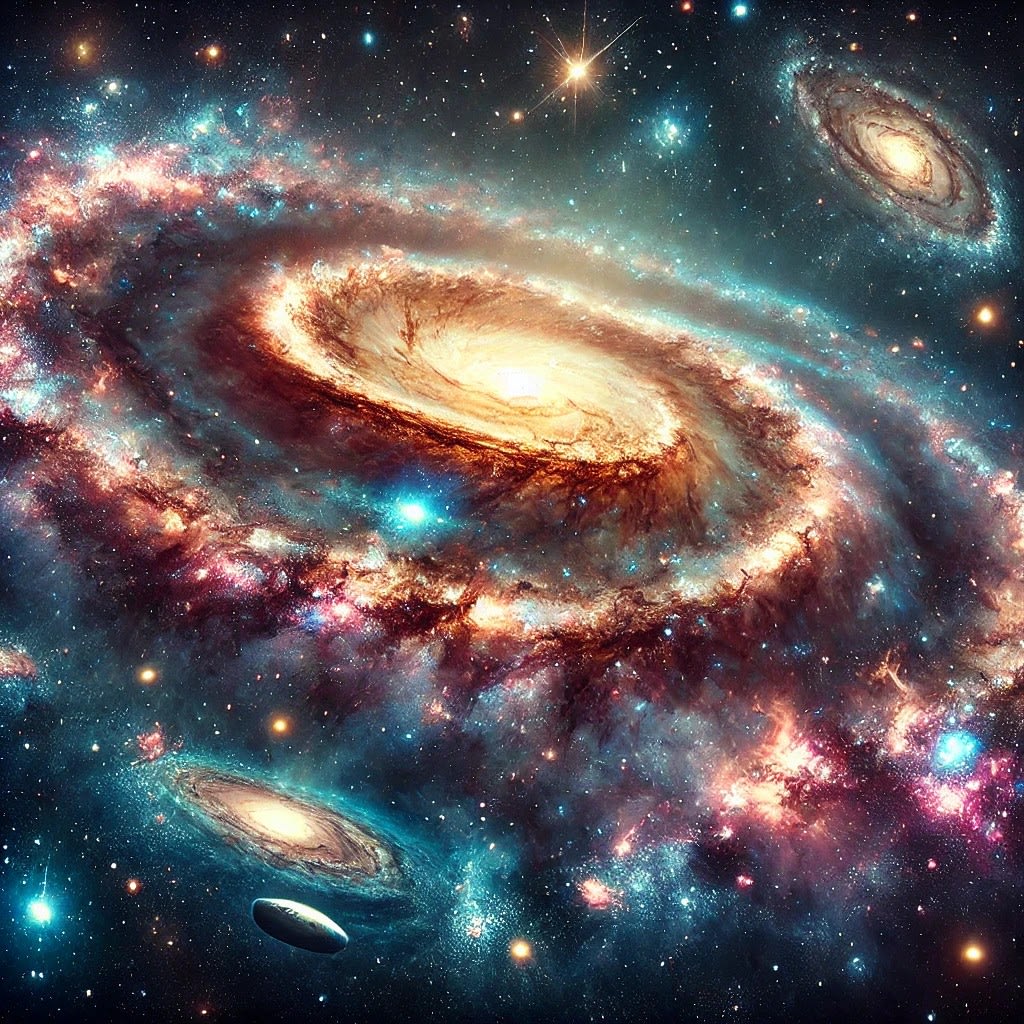
The universe is everything. It’s not just the stars twinkling in the night sky or the planets orbiting the Sun—it is all of space, time, matter, and energy combined. It includes the galaxies stretching across unfathomable distances, the black holes swallowing light, and the cosmic dust forming new worlds. Most astonishingly, it includes us, tiny specks of consciousness within an incomprehensible expanse.
A Home in the Cosmos
Earth, our home, is just a small part of this grand universe. It orbits the Sun, which itself is a single star among the hundreds of billions that make up the Milky Way galaxy. The Moon, ever-present in our sky, is our closest celestial neighbor. Alongside us, other planets—some rocky, others gas giants—share the cosmic dance around the Sun. Beyond our solar system, there are exoplanets orbiting distant stars, many of which might harbor conditions suitable for life.
The Milky Way and Beyond
Our galaxy, the Milky Way, is a vast, rotating collection of stars, dust, and dark matter spanning over 100,000 light-years across. Yet, it is just one of billions of galaxies that form the known universe. Each galaxy, whether a majestic spiral or an enormous elliptical cluster, harbors billions of stars, some with their own planetary systems. At the heart of nearly every galaxy, including ours, lies a supermassive black hole—a gravitational powerhouse that shapes the motion of stars and gas around it.
The Cosmic Web: A Universe Without Bounds
Galaxies are not isolated; they form clusters, and these clusters connect into superclusters, woven together by an unseen structure known as the cosmic web. This vast network of galaxies and dark matter spans the observable universe, which itself is estimated to be 93 billion light-years in diameter. Yet, this is only what we can see—the actual universe could be infinitely larger.
The Mysteries of Dark Matter and Dark Energy
For all we know about the universe, much remains a mystery. Scientists estimate that only about 5% of the universe consists of ordinary matter—the atoms that make up stars, planets, and people. The rest is made up of dark matter, an invisible substance that holds galaxies together, and dark energy, a mysterious force driving the universe’s accelerated expansion. These enigmatic components challenge our understanding of physics and push us toward new discoveries.
The Passage of Time: A Cosmic Perspective
Time itself is a fundamental part of the universe. The Big Bang, occurring approximately 13.8 billion years ago, marks the beginning of time as we know it. Since then, the universe has been expanding, evolving, and birthing galaxies, stars, and planets. Our own existence is a brief moment in this vast timeline, yet we are intricately connected to the cosmos. The atoms in our bodies were forged in the hearts of ancient stars, making us literal stardust come to life.
The Search for Life Beyond Earth
One of the greatest questions we face is whether life exists elsewhere in the universe. With billions of galaxies, each containing billions of stars and even more planets, the odds of life existing beyond Earth seem high. Scientists search for biosignatures—chemical traces that could indicate life—on exoplanets and in the atmospheres of distant worlds. The discovery of even the simplest extraterrestrial life would forever change our perspective on our place in the cosmos.
The Universe Within Us
As vast as the universe is, we are an inseparable part of it. The same physical laws governing galaxies apply to the tiniest particles in our bodies. The forces shaping the stars also influence the chemistry of life. In understanding the universe, we gain insight into ourselves—our origins, our future, and our deep connection to everything that exists.
Looking Ahead: The Future of Cosmic Exploration
Our curiosity about the universe has driven us to explore the unknown. Telescopes peer deeper into space, revealing galaxies from the dawn of time. Robotic explorers traverse Mars, seeking signs of past life. Future missions may carry humanity beyond Earth, perhaps to Mars or even the moons of distant planets. The universe, vast and full of mysteries, beckons us to keep searching, keep wondering, and keep reaching for the stars.
The universe is everything—and within it, we find both our past and our future, written in the light of the cosmos.
About the Creator
Aurora Lark
I write at the crossroads of science fields that constantly challenge our perceptions and expand our horizons. I decode the intricate narratives of our modern world, transforming technical details into clear, thought-provoking stories.
Keep reading
More stories from Aurora Lark and writers in Education and other communities.
Lost World Beneath Antarctica: A Hidden Ecosystem Frozen in Time for 14 Million Years
For centuries, Antarctica has captivated explorers, scientists, and adventurers alike. Beneath its vast, frozen landscape lies a world largely unexplored, holding secrets of Earth’s past. Recently, scientists have uncovered something astonishing—a lost world, miles beneath the Antarctic ice, untouched for over 14 million years. This extraordinary discovery opens new doors to understanding ancient ecosystems, climate change, and the potential for life in extreme environments.
By Aurora Lark11 months ago in Education
UMPCO Inc: My Insider View on an Unsung Aerospace Fastener Maker
When I first learned about UMPCO Inc, I had no idea how deep its influence ran through aviation and aerospace hardware. Today, I want to take you behind the scenes of this fastener and hardware solutions manufacturer — a company that quietly supports every aircraft clip, clamp, and bracket that helps keep our skies safe.
By Beckett Dowhan4 days ago in Education
Getting Started with Still Fishing: A Beginner’s Guide
A Beginner’s Guide to Still Fishing So, you’ve decided to take up fishing, and after a quick search online, still fishing catches your eye. The name alone probably makes it sound easy, right? Just sit back, relax, and wait for the fish to bite.
By Irimia Rares2 days ago in Education




Comments
There are no comments for this story
Be the first to respond and start the conversation.