
The Truth The Truth Behind a Famous Quote: Did Aristotle Really Say It
How Will Durant’s Paraphrase of Aristotle’s Philosophy Became One of the Most Misattributed Quotes in History

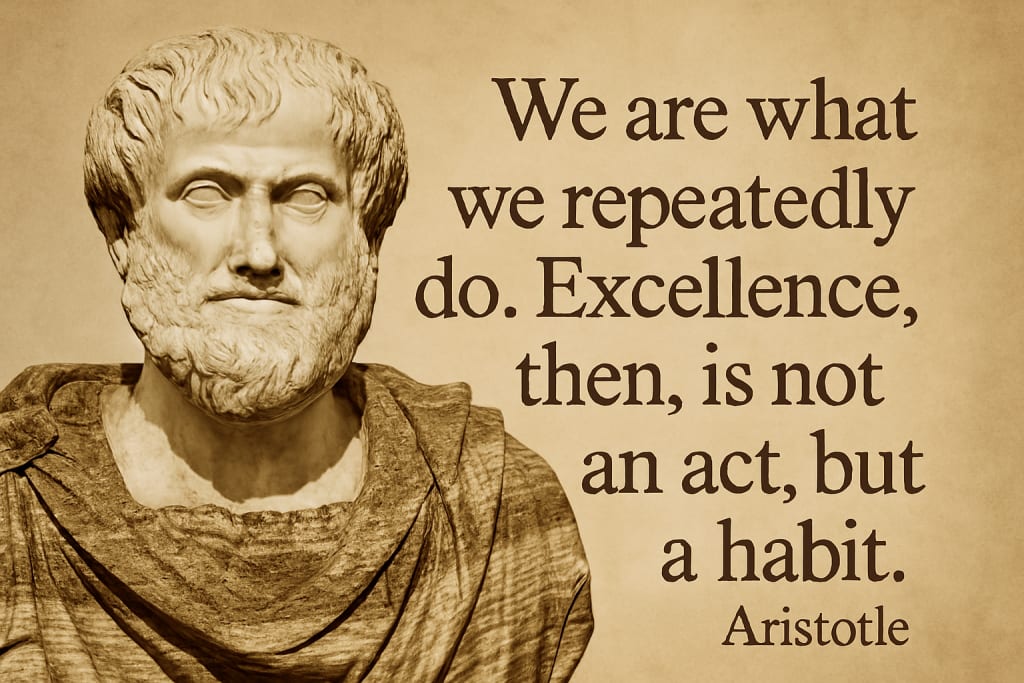
The famous quote often attributed to Aristotle, "We are what we repeatedly do. Excellence, then, is not an act, but a habit, is widely known as a guiding principle for personal growth and success. However, the origins of this quote are often misunderstood. It was not Aristotle himself who stated it directly, but rather historian and philosopher Will Durant, who paraphrased Aristotle’s ideas in his book The Story of Philosophy while summarizing the Greek philosopher’s thoughts on habit and virtue.
Understanding the origins of this quote requires a closer look at Aristotle’s philosophy. Aristotle, one of the greatest thinkers of ancient Greece, explored the concept of virtue and moral excellence in his work Nicomachean Ethics. In this text, he emphasized the importance of habit in shaping character. Aristotle believed that virtues are not innate qualities but rather traits developed through practice and repetition. He argued that people become virtuous by repeatedly performing virtuous actions, just as a skilled musician becomes proficient through continuous practice.
Will Durant, in The Story of Philosophy, sought to summarize Aristotle’s teachings in a way that made them accessible to modern readers. While discussing Aristotle’s views on virtue, Durant wrote, “We are what we repeatedly do. Excellence, then, is not an act, but a habit. This paraphrased version of Aristotle’s philosophy gained widespread popularity and was frequently cited as if Aristotle himself had said it.
Despite the misattribution, the essence of the quote remains aligned with Aristotle’s philosophy. The idea that excellence and virtue are cultivated through consistent action is a fundamental aspect of his ethical framework. Aristotle argued that individuals achieve eudaimonia, or a flourishing life, by developing good habits and engaging in ethical behavior. He maintained that moral excellence is not achieved through occasional grand gestures but through a commitment to virtuous living in everyday actions.
This principle has significant implications in various aspects of life, including personal development, education, sports, and business. The notion that repeated actions shape one’s character and determine success has been embraced by motivational speakers, educators, and leaders across different fields. It highlights the importance of discipline and consistency in achieving excellence.
For instance, in the world of athletics, top-performing athletes follow rigorous training routines, practicing their skills repeatedly until they become second nature. A basketball player does not become great by making one incredible shot but by shooting thousands of baskets during practice. Similarly, in academics, students who develop effective study habits through repetition are more likely to excel in their studies. The same principle applies to entrepreneurship and professional growth those who consistently work on their skills and improve their craft are more likely to succeed.
The misattribution of the quote to Aristotle also sheds light on how historical figures’ ideas are often simplified or reinterpreted over time. In an effort to make complex philosophical ideas more digestible, writers and historians sometimes condense concepts into concise statements. While this can help popularize important ideas, it can also lead to inaccuracies regarding their original sources.
The popularity of this particular paraphrase demonstrates how powerful and influential Aristotle’s ideas remain today. Even though the exact wording was Durant’s interpretation, the underlying philosophy is deeply rooted in Aristotle’s ethical teachings. It serves as a reminder that success and personal growth are not the result of isolated efforts but of consistent and deliberate practice.
In contemporary discussions on self-improvement, the concept of habit formation is widely studied. Books such as Atomic Habits by James Clear and The Power of Habit by Charles Duhigg explore how small, repeated actions lead to lasting change. These modern perspectives align with Aristotle’s notion that habits shape our character and ultimately define who we are. The scientific study of habits supports the idea that behaviors repeated over time become ingrained, influencing our success and well-being.
Understanding the true origin of this quote also encourages critical thinking when it comes to widely accepted statements. Many famous quotes attributed to historical figures are often altered or paraphrased, leading to misconceptions about their original context. Recognizing the contributions of historians like Will Durant in making philosophical ideas more accessible allows for a deeper appreciation of the thinkers who influenced them.
While Aristotle did not explicitly state the famous quote, his philosophy undeniably supports the idea that excellence is achieved through habitual actions. His teachings continue to inspire individuals seeking to improve themselves and attain a higher standard of living through consistent effort. By acknowledging both Aristotle’s original ideas and Will Durant’s role in summarizing them, we gain a more accurate understanding of the timeless wisdom behind the phrase.
The key takeaway from this discussion is that our daily habits and actions define us. Whether in personal development, professional growth, or ethical conduct, what we repeatedly do shapes our character and our destiny. By embracing this philosophy, individuals can cultivate a life of excellence through conscious effort and discipline, staying true to the spirit of Aristotle’s teachings.
About the Creator
Nora Ariana
Empowering through stories and sound igniting purpose, sparking growth, and awakening the power within.
Keep reading
More stories from Nora Ariana and writers in Education and other communities.
A goal is a dream with a deadline
A goal is a dream with a deadline. This powerful quote reminds us that without action, dreams remain just that wishes floating in our imagination. But when we set a timeline and commit to achieving them, they evolve into goals, bringing clarity, direction, and purpose. Many people go through life holding on to dreams, hoping they will come true someday. But someday is not a day on the calendar. Dreams without structure often fade with time or get buried under the weight of daily responsibilities. Turning a dream into a goal is what separates those who achieve from those who continue to wish.
By Nora ArianaExclusive • 11 months ago
Ferrara Enterprises Inc: A Trusted Manufacturer of NSN Components for Aviation and Industrial Systems
In the aerospace and defense supply chain, reliable component manufacturers play a crucial role in maintaining aircraft systems and industrial equipment. One such manufacturer is Ferrara Enterprises Inc, a company associated with producing components that appear in various National Stock Number (NSN) catalogs used across aviation, defense, and industrial sectors.
By Beckett Dowhan3 days ago in Education
The Power of Fellowship: Strengthening Faith Through Shared Moments and Unity
The Power of Fellowship in Everyday Faith The power of fellowship plays an important role in many faith communities. It brings people together through shared beliefs, prayer, and support. Fellowship is not only about gathering in one place. It is about building meaningful relationships that help people grow in faith.
By World Olivet Assembly4 days ago in Education
A Transparent Look at Vocal Challenges and Top Stories
Almost three years ago, we shared a resource article that served as a place for people to suggest new challenge prompts. We thought it would be a good idea to refresh that thread, and take the opportunity to answer a few common questions about top stories, how challenges are judged and how submissions are reviewed.
By Vocal Curation Team4 days ago in Resources


Comments
There are no comments for this story
Be the first to respond and start the conversation.