
The Theory of Evolution: Understanding the Origin and Diversity of Life
A Scientific Explanation of Life’s Development Through Natural Selection and Genetic Variation

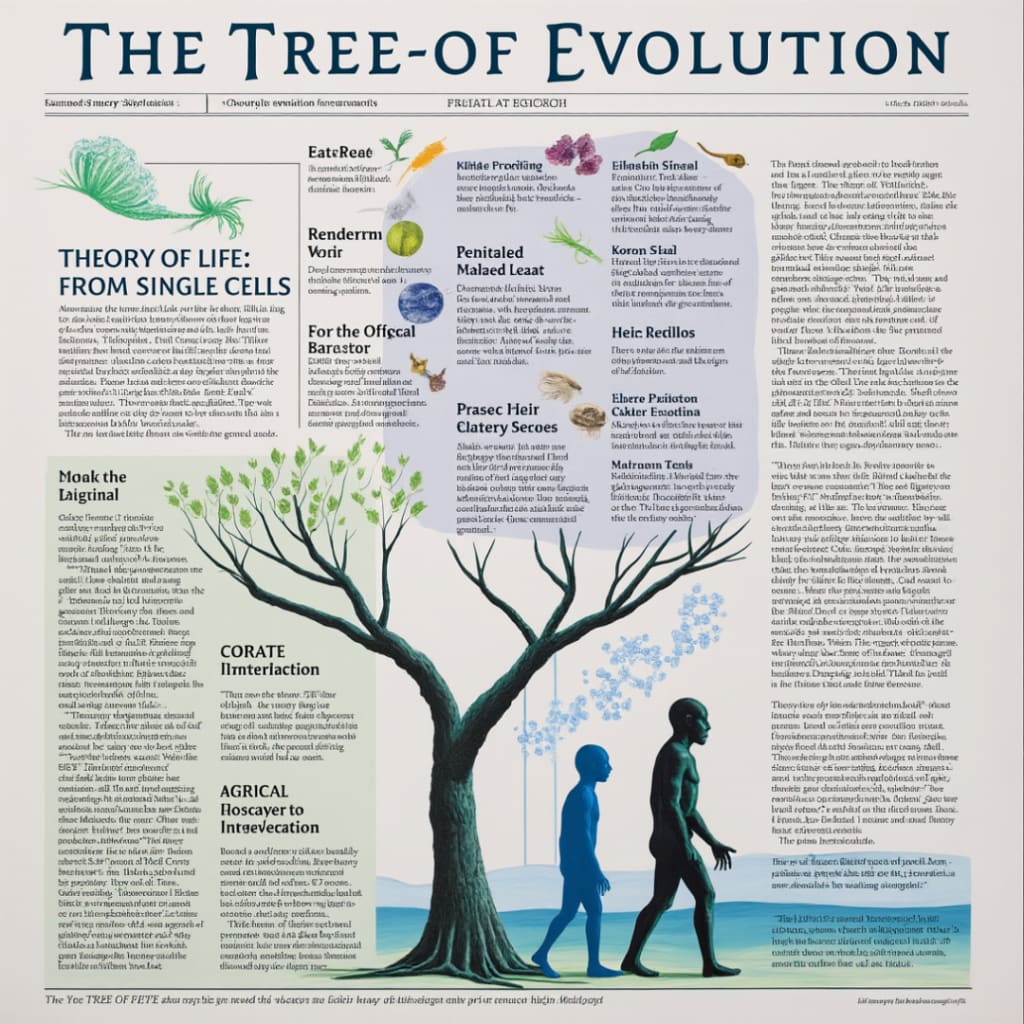
Introduction
The theory of evolution stands as the cornerstone of modern biology. It explains how the complex and diverse forms of life that populate the Earth have arisen over billions of years from simpler ancestors through a combination of natural processes. First articulated in a comprehensive form by Charles Darwin in the 19th century, and later refined by numerous scientists, the theory of evolution has transformed our understanding of life’s origins, adaptation, and continuity.
Evolution is not merely a historical explanation; it is an active scientific theory backed by overwhelming evidence from multiple fields including paleontology, genetics, comparative anatomy, embryology, and molecular biology. This essay explores the full breadth of the theory of evolution, from its historical context and foundational principles to its modern extensions and implications for science and society.
Historical Foundations
The concept that species change over time has deep philosophical roots. Ancient Greek philosophers such as Anaximander and Empedocles speculated on the transformation of life, but their ideas lacked empirical support. During the Middle Ages, theological doctrines dominated explanations for biodiversity, attributing creation to divine design.
The Enlightenment ushered in more empirical inquiry. Naturalists like Georges-Louis Leclerc (Comte de Buffon), Jean-Baptiste Lamarck, and Erasmus Darwin proposed early ideas of biological change. Lamarck, for instance, theorized that organisms could acquire traits during their lifetime and pass them on—a notion later discredited.
In 1858, Charles Darwin and Alfred Russel Wallace independently proposed the mechanism of natural selection. Darwin’s 1859 publication, On the Origin of Species, laid the groundwork for the theory of evolution, positing that species evolve over time due to the differential survival and reproduction of individuals with advantageous traits.
Core Mechanisms of Evolution
1. Genetic Variation
Variation among individuals in a population is a prerequisite for evolution. Genetic variation arises through mutations (random changes in DNA), genetic recombination during sexual reproduction, and horizontal gene transfer in some organisms like bacteria. This variation is essential because it provides the raw material for natural selection to act upon.
2. Natural Selection
Natural selection is the primary mechanism described by Darwin. It operates on the principle that individuals with traits better adapted to their environment are more likely to survive and reproduce. These advantageous traits then become more common in subsequent generations. Over time, this process leads to the adaptation of species to their ecological niches.
3. Mutation
Mutations are changes in an organism's DNA that can be neutral, harmful, or beneficial. While many mutations have little effect, some can introduce new traits that provide a survival advantage. When beneficial mutations are heritable, they may spread through the population over generations.
4. Genetic Drift
Genetic drift is the change in allele frequencies in a population due to random sampling effects, especially in small populations. Unlike natural selection, genetic drift is non-directional and can lead to the loss or fixation of traits irrespective of their usefulness.
5. Gene Flow
Gene flow, or the transfer of genetic material between populations, increases genetic diversity. It can introduce new traits into a population, contributing to adaptation and sometimes slowing the effects of natural selection by homogenizing populations.
6. Speciation
Speciation is the formation of new species from ancestral forms. It can occur through mechanisms like geographic isolation (allopatric speciation), ecological specialization (sympatric speciation), or hybridization. Over long periods, speciation contributes to the immense diversity of life.
Evidence Supporting Evolution
The theory of evolution is supported by extensive and converging lines of evidence from various scientific disciplines:
1. Fossil Record
Fossils reveal the history of life on Earth, showing a clear progression from simple to more complex forms over time. Transitional fossils, such as Australopithecus (between apes and humans) and Tiktaalik (between fish and amphibians), provide direct evidence of evolutionary change.
2. Comparative Anatomy
Structures that share a common origin, such as the forelimbs of vertebrates, are known as homologous structures. Despite serving different functions (e.g., wings, fins, arms), their underlying skeletal similarity points to a shared ancestor.
3. Embryology
The embryos of many vertebrates exhibit striking similarities during early development, such as gill slits and tail structures. These features are remnants of ancestral forms and suggest common descent.
4. Molecular Biology
The most compelling modern evidence comes from genetics. DNA sequencing shows that all life shares a common genetic language. Humans share about 98–99% of their DNA with chimpanzees, reflecting recent divergence from a common ancestor. Proteins, enzymes, and genetic pathways are conserved across widely different organisms.
5. Biogeography
The geographical distribution of species reveals patterns consistent with evolution. Island species often resemble mainland species but have evolved distinct traits to adapt to their unique environments, a phenomenon famously observed in Darwin’s finches in the Galápagos Islands.
Modern Evolutionary Synthesis
By the early 20th century, Darwin’s ideas were integrated with Mendelian genetics to form the Modern Synthesis. This fusion brought together population genetics, systematics, paleontology, and molecular biology to refine evolutionary theory.
Key developments of the Modern Synthesis include:
Evolution occurs through changes in allele frequencies in populations over time.
Natural selection, mutation, genetic drift, and gene flow are all driving mechanisms.
Evolution is gradual, with speciation resulting from the accumulation of small genetic changes.
Today, this framework is further enhanced by evolutionary developmental biology (evo-devo), genomics, and epigenetics, which provide insight into how genes and development influence evolutionary change.
Evolution in Action
Evolution is not confined to ancient history; it is observable today:
Antibiotic Resistance: Bacteria evolve resistance to antibiotics through natural selection. Those with resistance genes survive treatment and reproduce, making future infections harder to treat.
Pesticide Resistance: Insects exposed to pesticides can develop resistance, requiring new and stronger chemicals.
Viral Evolution: Viruses like influenza and SARS-CoV-2 mutate rapidly, leading to new strains that can evade immunity.
Darwin’s Finches: Ongoing studies of finch populations in the Galápagos continue to demonstrate rapid evolutionary changes in beak size in response to environmental conditions.
Evolution and Human Origins
Humans are part of the evolutionary continuum. Fossil and genetic evidence shows that humans share a common ancestor with chimpanzees and other primates. The genus Homo emerged around 2.5 million years ago in Africa. Homo sapiens arose approximately 300,000 years ago and migrated across the globe, interbreeding with other hominin species like Neanderthals and Denisovans.
The discovery of hominin fossils like Australopithecus afarensis (e.g., “Lucy”) and the sequencing of ancient DNA have clarified the complex evolutionary history of modern humans.
Evolution and Society
The theory of evolution has had far-reaching implications beyond biology. In medicine, it informs vaccine development, antibiotic use, and cancer research. In agriculture, it helps improve crop resilience and animal breeding. Conservation biology uses evolutionary principles to protect biodiversity and manage endangered species.
However, evolutionary theory has also sparked philosophical, ethical, and cultural debates:
Ethical Misuse: Misapplications of evolutionary ideas—such as in eugenics and social Darwinism—have led to harmful ideologies and policies. These are distortions of the science and highlight the importance of ethical reflection.
Religious Objections: Some religious groups reject evolution, viewing it as incompatible with creationist beliefs. However, many religious institutions accept evolution as compatible with faith, emphasizing that science and religion address different kinds of questions.
Educational Challenges: In some regions, teaching evolution in schools has faced resistance. Promoting scientific literacy requires clear communication about what evolution is—and is not.
Misconceptions About Evolution
Despite its scientific foundation, several myths persist:
"It's just a theory": In science, a theory is a well-supported, testable explanation—not a mere guess.
"Humans evolved from monkeys": Humans and monkeys share a common ancestor but evolved along different paths.
"Evolution happens to individuals": Evolution occurs at the population level over generations.
"There is a goal or direction": Evolution has no specific goal or final form; it is driven by environmental pressures and random variation.
The Future of Evolutionary Science
As technology advances, evolutionary biology continues to evolve:
CRISPR and Gene Editing: Understanding evolution helps researchers edit genes more safely and effectively, with implications for treating genetic diseases.
Artificial Intelligence: Evolutionary algorithms mimic natural selection to solve complex problems in computing and engineering.
Astrobiology: If life exists beyond Earth, evolution provides a framework for understanding how it might emerge and adapt.
Conclusion
The theory of evolution is one of the most profound scientific achievements in human history. It unifies all branches of biology, provides deep insights into the nature of life, and equips us to face real-world challenges in health, environment, and technology.
Far from being a threat to human uniqueness, evolution places us within a grand and beautiful tapestry of life—a story written in our genes, preserved in fossils, and unfolding with every generation. As our knowledge deepens, so does our capacity to appreciate the intricate processes that shape living organisms and connect us to every other form of life on Earth.
As Carl Sagan eloquently wrote, "We are a way for the cosmos to know itself." Evolution is that cosmic journey made visible in biology.
About the Creator
Keep reading
More stories from Zain Ul Abedin Khan and writers in Education and other communities.
Bending Time: The Discovery of Time Dilation
Introduction Time is one of the most fundamental concepts in human experience. For centuries, people assumed that time flowed at the same rate for everyone, everywhere. However, this notion was shattered in the early 20th century by a revolutionary idea known as time dilation—a concept from Einstein’s theory of relativity. Time dilation reveals that time does not pass at the same rate for all observers, especially when they are moving at different velocities or are in different gravitational fields. The discovery of time dilation profoundly changed our understanding of reality, space, and the universe itself.
By Zain Ul Abedin Khan9 months ago in Education
What Should Be Your Main Focus During an Online Limited Radiology Tech Program
Well, the short answer is that there is not a single module that you should strictly focus on. If you want to become a X-ray technician, you need to develop both technical and soft skills.
By Meaghan Howe4 days ago in Education
Precision in Motion: The Rise of Sport Shooting and Firearms in Modern Competition
Sport shooting has grown from a simple test of aim into a structured sport that demands discipline, patience, and technical skill. Today, sport shooting and firearms play a major role in global competitions, training programs, and recreational events. Athletes train for years to improve accuracy and control. They study equipment, posture, breathing, and focus. Because of this dedication, sport shooting has become a respected sport that rewards precision and calm thinking.
By Matthew Pothoff3 days ago in Education
Hottest in the Office
Dear Rafi, You’re very distracting to work around. For the first second I saw you the other day, I thought you were some type of executive. It took a moment to realize no, you were just the new guy, dressed up for the job he wants. Be still, my heart.
By Gabriel Shames5 days ago in Pride




Comments
There are no comments for this story
Be the first to respond and start the conversation.