
The Teacher Who Never Gave Up
One educator’s fight to keep the classroom alive during a crisis

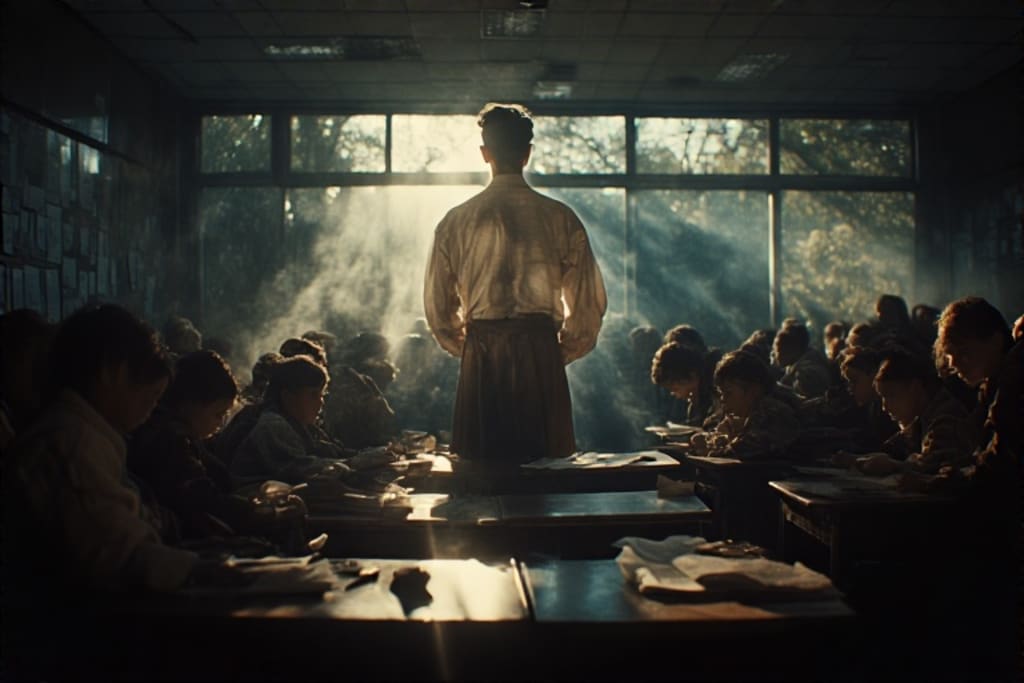
In the small mountain village of Chandpur, where clouds kissed the rooftops and goats outnumbered people, there lived a woman named Mrs. Fariha. She was the only teacher at the village’s only school—a faded stone building with three rooms, cracked windows, and a leaky roof.
Most days, the wind howled through the broken shutters, and the chairs wobbled like they were ready to give up. Sometimes there was chalk, sometimes not. But Mrs. Fariha always came. Rain or shine, she arrived at 6 a.m. sharp, her shawl fluttering and her arms full of books, like a soldier reporting for duty.
The village children were not easy to teach. Many had to work in the fields or tend to their younger siblings. Some arrived late. Some came hungry. Others didn’t come at all.
But still, she waited.
Each day she taught the ones who showed up—sometimes only three, sometimes seven. She told them stories of faraway places, taught them how to write their names, and drew diagrams in the dirt when the blackboard broke.
Some people whispered, “Why does she even try? These children won’t go far.”
But Mrs. Fariha believed otherwise.
One of her students, little Faizan, was a quiet boy who never spoke much. He sat in the back, avoided eye contact, and struggled to read even the simplest words. Other children teased him, calling him “the sleepy goat.” But Mrs. Fariha never let it slide.
She gave him extra time. She lent him books. She taught him how to sound out words, one syllable at a time. She even visited his family and helped his mother learn how to support his learning at home.
When Faizan finally read a full sentence without help, she clapped so loudly that even the birds flew off the roof.
In her heart, every small success was a celebration.
Then came a bad year. A landslide destroyed part of the village. Families were displaced. The school building was damaged beyond repair. Parents said they had no choice—education had to wait.
But Mrs. Fariha didn’t stop.
She turned the village’s abandoned shed into a classroom. She borrowed benches and mats. She wrote letters to organizations asking for supplies. She held classes outdoors when the weather allowed, and indoors when it didn’t. People watched her from their windows, amazed.
“She’s still going,” they’d whisper. “Still teaching.”
One day, a government officer visited the village for a survey. He stopped near the shed, curious about the group of children reading under a tree. When he asked who was in charge, every child pointed at the same person—Mrs. Fariha.
She welcomed him warmly and showed him their lesson plans, books, and student work—all hand-prepared. The officer was so impressed that he wrote an article about her for a national newspaper, calling her “The Teacher Who Never Gave Up.”
Weeks later, the article went viral. Donations poured in—books, uniforms, supplies, even funding for a new school building. A team of volunteers arrived to help rebuild the school, this time with solar panels and a small library. The children cheered as the walls went up, brighter and stronger than before.
And Mrs. Fariha? She didn’t change. She still came early, still wore her fluttering shawl, and still believed in every student—even those who didn’t yet believe in themselves.
Years passed. Faizan, once the shy, struggling boy, became the first student from Chandpur to attend college in the city. On his graduation day, when asked to give a speech, he said only one name:
“Mrs. Fariha—the woman who saw a spark in me when I didn’t even know I had one.”
Today, the school in Chandpur is known as the Fariha Learning Center, and on a sign just outside the entrance, painted in big blue letters, are the words:
“A good teacher doesn’t just teach lessons—they light the way, even when no one else is watching.”
Moral: One person’s belief can change the life of many. Even when everything seems broken, a heart full of hope and determination can rebuild a future—one child, one lesson, one day at a time.
Ask ChatGPT
About the Creator
Keep reading
More stories from Najeeb Scholer and writers in Education and other communities.
A Backpack Full of Hope
In a dusty border town called Rahimgarh, where the sun painted everything gold and brown, lived a boy named Sameer. Life in Rahimgarh was simple, but hard. The streets were noisy with vendors and donkeys, the air thick with the scent of spices and dry earth, and the hearts of its people—though weary—still beat with courage.
By Najeeb Scholer7 months ago in Education
Education Finance Software Market to Reach USD 12.04 Billion by 2035
Education Finance Software Market The Global Education Finance Software Market is projected to reach approximately USD 12.04 billion by 2035, rising from USD 5.63 billion in 2025, and registering a CAGR of 7.9% during the forecast period from 2025 to 2035. This growth reflects increasing digital transformation across educational institutions, particularly in financial administration and compliance management. Schools, universities, and training institutions are modernizing budgeting, accounting, payroll, and procurement systems to improve transparency and operational efficiency.
By Roberto Crum5 days ago in Education
Generational Wealth Blueprint: Proven Investment Strategies for Family Legacies
Generational Wealth is the dream of many families across the country. It means building assets that last beyond one lifetime. It means creating safety, freedom, and choice for children and grandchildren. Many people believe only the very rich can achieve this goal. That belief is not true. With focus and steady effort, almost any family can build Generational Wealth over time. The key is using smart investment strategies for family legacies. These strategies help turn earned income into long-term assets. They protect money from loss and grow it incrementally. Generational Wealth is not built overnight. It grows through discipline, patience, and clear planning. Families who understand this process create a strong path for the future. Each wise decision today shapes the financial life of the next generation.
By Winston Feng5 days ago in Education




Comments
There are no comments for this story
Be the first to respond and start the conversation.