


There was a weaver who had a very pampered son. Whatever the boy wanted, he wouldn't stop until he got it.
One day, the son of a wealthy man was passing by their house, riding a horse. Seeing him, the weaver’s son called out to his father,
“Father, why don’t I have a horse? Get me a horse!”
The weaver replied, “I’m a poor man, son. How can I afford a horse? A horse costs a lot of money.”
But the boy insisted, “That won’t do. You must get me a horse.”
Then he started crying—first dancing and wailing, then rolling on the ground, then he smashed his father’s hookah pipe. Still not getting the horse, he finally stopped eating altogether.
The weaver was now in deep trouble. Seeing his son refuse food, he thought, “Now there’s no choice. I must get him a horse. Let me see if I have any money at all.”
After searching everywhere, he managed to gather a few coins. He tied the money in a cloth and set off to the market to buy a horse.
At the market, he asked a horse trader, “Hey there, how much for your horse?”
The trader said, “Fifty rupees.”
But the weaver had only five rupees wrapped in his cloth. Where would he get fifty? Disheartened, he started walking back home.
Just then, he saw two men arguing. One of them said, “You’re in big trouble now!”
The other replied, “Horse eggs will be laid.”
Of course, horses don’t lay eggs, so this is just a saying meaning “nothing will happen.” But the weaver didn’t know that. As soon as he heard “horse eggs,” he got excited and asked,
“Brother, where can I find these horse eggs?”
A particularly mischievous man nearby heard him and said,
“Come with me—I have a horse egg at home!”
This man had an old gourd at home. He brought the weaver there and handed him the gourd, saying,
“Here you go—a horse egg. See how it’s already cracked? The foal will hatch any moment. Just be careful it doesn’t run off!”
The weaver was overjoyed.
“How much does it cost?” he asked.
“Five rupees,” said the man. The weaver immediately handed over the money and left with the gourd, convinced that a baby horse was inside.
The gourd was cracked and red inside. The weaver thought,
“Oh no, if it tries to escape, I’ll just grab it quickly. I’ll wrap it in a scarf and bring it home. Even if it kicks and jumps, I won’t let go!”
Thinking such things, he reached a riverside and suddenly felt very thirsty. He left the gourd on the bank and went to drink water. But what he didn’t see was a fox sneaking up. While he drank, the fox gnawed on the gourd and ran off.
When the weaver turned around, he saw the fox with the gourd.
“Oh no! My horse has hatched and is escaping!” he shouted and gave chase.
But catching a fox? That wasn’t something the poor weaver could manage. The fox led him through fields, woods, and who knows where else. Eventually, the weaver was exhausted. On his way back, he realized he was lost.
By then it was night, and he had no way to return home. After searching a while, he found a hut belonging to an old woman and asked if he could sleep there for the night.
The old woman only had two rooms. One she shared with her granddaughter; the other stored belongings. She let the weaver sleep in that room.
Now, every night, a tiger would sit behind the old woman’s house. She knew this, so neither she nor her granddaughter ever stepped out after dark.
But the granddaughter had overheard the weaver talking about a horse egg and was curious to hear more. She wanted to visit him. The old woman warned her,
“No, no! Don’t go! The tiger or something worse—the tag—will get you!”
Now “Baghe-Taghe” (“by tiger or tag”) is a common Bengali expression. There’s no such animal as a tag. But the tiger didn’t know that. Listening from behind the house, he became terribly nervous.
“Tag? What is that?” he thought.
“If it’s worse than a tiger, I’m doomed!”
Just then, the weaver stepped outside to check if it was morning yet—and spotted the tiger!
“Oh look!” he thought, “My baby horse is sitting here!”
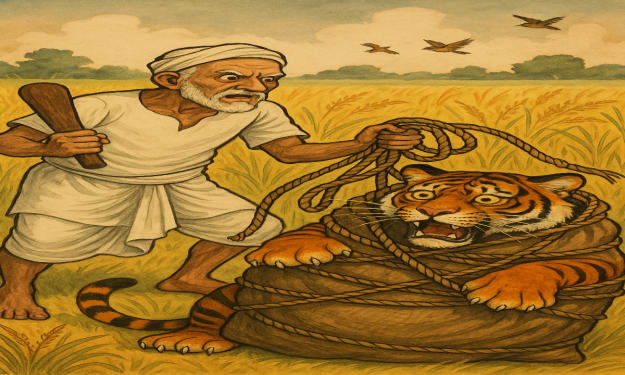
He rushed over, threw his scarf around the tiger’s face and jumped on its back!
The tiger was completely startled.
“Oh no! It’s the Tag! It’s got me!” he thought in horror.
Terrified, the tiger began to run. But with the scarf covering its eyes, it couldn’t see properly.
The weaver held on, thinking,
“I’ll ride this foal till it gets bright, then I’ll figure out the way home.”
When morning came and he could see clearly, the weaver realized—
“Oh no! This isn’t a horse—it’s a tiger!”
Now he panicked.
“What should I do?” he thought.
The tiger, still thinking it was caught by a dreadful Tag, kept running and begging,
“Please, Tag-dada (Brother Tag), spare me! I’ll worship you!”
The weaver had no idea the tiger was calling him Tag. He was only thinking of how to escape.
As the tiger ran under a banyan tree with low-hanging branches, the weaver quickly grabbed one and climbed up.
“Phew! Saved!” the weaver sighed.
“Phew! Saved!” said the tiger, collapsing under the tree in exhaustion. Then he started calling other tigers for help.
Soon, four or five tigers gathered.
“What happened?” they asked. “Who tied your eyes like that?”
The tiger, still panting, replied,
“Brothers, today I was almost done for! The Tag caught me! I begged and pleaded, promised worship, and only then he let me go. But I’m tied—if I don’t worship him, he’ll come back!”
Hearing this, the other tigers started a grand worship of the Tag under the tree. They brought buffaloes and deer as offerings. More and more tigers joined. The weaver, sitting up in the tree, had never seen so many tigers before. He was trembling.
His shivering made the tree leaves rustle. The tigers looked up but couldn’t clearly see through the leaves.
“What’s that up in the tree?” one said.
“Look at its big tail!” said another.
It wasn’t a tail—it was the end of the weaver’s scarf hanging down. But not seeing properly, they thought it was part of a scary creature.
An old tiger declared,
“That must be the Tag itself!”
At once, all the tigers shouted,
“Run! Run! It’s the Tag!” and fled in terror.
Then the weaver climbed down and returned home.
His son asked,
“So, where’s the horse, Father?”
The weaver slapped him on the cheek and said,
“Here’s your horse!”
After that, the boy never asked for a horse again.
About the Creator
Alomgir Hossain
When I was a child, I used to listen to fairy tales from my mother. When I grew up, I was very fond of reading books, so I used to go to the library and read different types of books. Short stories and novels were my favorite books.
Keep reading
More stories from Alomgir Hossain and writers in Education and other communities.
Buddus`s Father
Once there was an old farmer named Buddhu's father. His paddy fields were ripe, and flocks of weaver birds came and feasted on his rice. To chase them away, Buddhu's father made a clapper (a kind of noise-making tool). But even the sound of the clapper didn’t scare the birds away.
By Alomgir Hossain9 months ago in Fiction
What is Affiliate Marketing: A Beginner's Step-by-Step Guide
Affiliate marketing is a performance-based online business model that generates over $12 billion annually in the U.S. alone and continues to grow as e-commerce expands. At its core, affiliate marketing allows individuals to earn commissions by promoting products or services created by other companies. Affiliates share unique tracking links through websites, blogs, social media, email lists, or videos, and earn a percentage of each sale or action completed through those links. Because affiliates don’t handle product creation, inventory, payment processing, or customer support, it’s one of the most accessible ways to monetize an online presence.
By Mohammad Sufyaana day ago in Education



Comments
There are no comments for this story
Be the first to respond and start the conversation.