
The Symmetry of Seven
He Didn't Kill for Pleasure. He Killed for Balance.
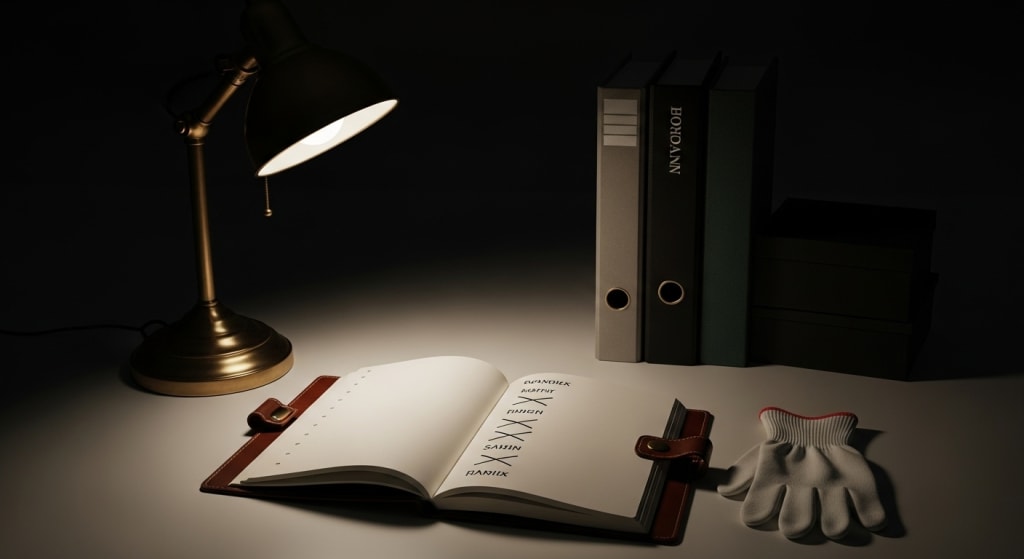
Detective Miles Kaito hated the word "senseless." Every murder, no matter how brutal, made a twisted kind of sense to the perpetrator. But the case landing on his desk on a rain-slicked Tuesday morning was testing his conviction. The victim, a celebrated cardiac surgeon named Dr. Alistair Finch, had been found in his greenhouse. He wasn't stabbed, shot, or bludgeoned. He had been meticulously, almost surgically, poisoned by a rare oleander toxin administered through a single prick on his thumb. The scene was spotless, devoid of struggle, of rage, of anything that felt… human.
“It’s like a ghost did it,” his partner, Eva Rostova, muttered, staring at the crime scene photos. “No forced entry, no prints, no DNA. He just let death walk right in.”
The only anomaly was a small, deliberate one. Placed squarely in the center of Dr. Finch’s workbench was a single, pristine white gardening glove. Its pair was never found.
Kaito’s instincts hummed with a low, persistent dread. This wasn't a crime of passion; it was a delivery. Two days later, the ghost wrote them a letter. Typed on heavy, watermark-free paper, it arrived at the precinct, addressed to Kaito.
“Detective Kaito,
Dr. Alistair Finch was the first. His hands, which saved one hundred and seventeen lives, were also responsible for ending seven. Through negligence disguised as arrogance, he caused seven preventable deaths. The public record knows of three. The hospital board hushed up the other four. I have balanced the scales.
There are six more.”
It was signed with a single, elegant glyph: a perfectly balanced scale.
Panic erupted. The press dubbed him "The Equilibrist." The department was scrambling, trying to find the link between seven hypothetical victims. But Kaito was frozen, the letter feeling like ice in his hand. The killer wasn't taunting them. He was informing them. He saw himself as a moral accountant, correcting the universe's ledger.
Their investigation was a frantic race against a clock only the killer could see. They uncovered a corrupt city official whose backroom deals had led to seven fatal fires in substandard housing. A CEO whose deliberate pollution of a town's water supply was linked to seven specific cancer clusters. Each name they uncovered was a person who had caused immense suffering and evaded any real justice.
And one by one, the Equilibrist found them.
The city official was found in his imported sports car, dead from carbon monoxide from a perfectly modified exhaust system. A single, white driving glove was on the passenger seat. The CEO was discovered in his private jet, the air system subtly tampered with. A single, white aviation glove lay on the co-pilot's chair.
The murders were flawless, quiet, and chillingly specific. The public sentiment began to curdle. This wasn't a monster they could easily vilify. He was killing monsters. Online forums buzzed with a perverse admiration. The Equilibrist was a dark hero, doing what the system could not.
Kaito, however, saw the terrifying truth. The killer wasn't driven by a desire for justice, but by an obsession with symmetry. The cold, mathematical precision of it all was more frightening than any act of rage. He was treating human lives like integers in an equation.
When the sixth victim—a philanthropist who had secretly been trafficking minors—was found, the pattern solidified. The killer was working from a fixed list. Seven names. Six were now crossed off. The press held its breath. The city waited for the final act.
The break came not from forensic science, but from psychology. Kaito, drowning in case files, realized the connection wasn't just the number seven. It was the method. Each punishment was a dark reflection of the crime. The doctor was poisoned. The arsonist was gassed. The polluter was asphyxiated. The killer wasn't just balancing numbers; he was crafting a brutal, poetic irony.
And then Kaito knew. He knew who the seventh name was, because he understood the killer's deepest, most symmetrical need. The final letter arrived.
“Detective Kaito,
You have been a worthy observer. The equation is nearly complete. The seventh name on the list is my own. For seven years, I watched the system I believed in fail the innocent. I stood by as the guilty walked free, their lives built on the graves of others. I became a judge, a jury, and an executioner. But a system without oversight is a tyranny. I have broken the universal law to uphold it. My crime is the greatest of all.
The scales must be balanced. The final judgment is mine to deliver.”
The address was a warehouse by the docks. Kaito and his team stormed the building, but they were too late. They found him in a bare, white room, seated calmly in a simple chair. He was a man Kaito had never seen before, a quiet, unassuming man who had lost his entire family to a drunk driver who had bribed his way to a suspended sentence. Seven years ago.
On the floor in front of him lay the seventh and final white glove. And in his lap, a single, empty vial.
He had completed his equation. The final murder was his own. The scales, in his mind, were now perfectly, terrifyingly, balanced. Detective Kaito looked down at the serene face of the killer and felt no victory, only a profound, chilling emptiness. The Equilibrist hadn't been stopped. He had simply finished his work.
About the Creator
HAADI
Dark Side Of Our Society



Comments
There are no comments for this story
Be the first to respond and start the conversation.