

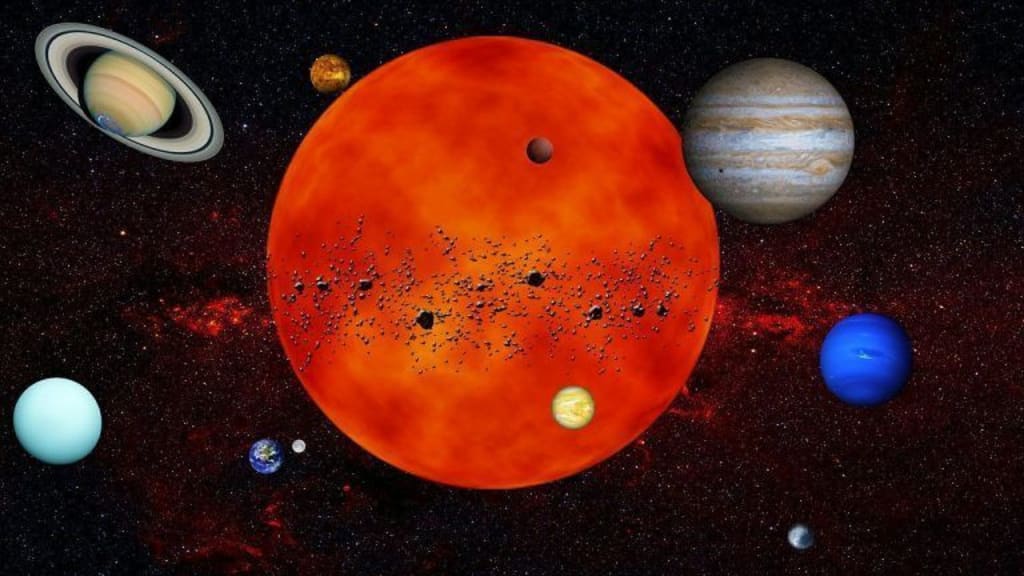
The solar system is a vast and complex system that is composed of the sun, eight planets, dwarf planets, moons, asteroids, comets, and other small bodies. It is a fascinating area of study that has intrigued scientists for centuries. In this essay, we will explore the solar system and its components in greater detail.
The sun is the most massive object in the solar system, accounting for more than 99% of its total mass. It is a star that is located at the center of the solar system and provides the energy that drives the planetary motions. The sun is a hot, glowing ball of gas that is composed mainly of hydrogen and helium. It emits energy in the form of light and heat, which sustains life on Earth.
The eight planets in the solar system are divided into two groups, the inner planets and the outer planets. The inner planets, Mercury, Venus, Earth, and Mars, are the closest to the sun and are rocky and small in size. They are also known as the terrestrial planets. The outer planets, Jupiter, Saturn, Uranus, and Neptune, are much larger in size and are composed mainly of gas. They are also known as the gas giants. Pluto, which was once considered a planet, is now classified as a dwarf planet.
The inner planets are characterized by their relatively short orbital periods and their rocky compositions. They have thin or no atmosphere and are subject to extreme temperature variations. Mercury is the smallest planet in the solar system and is closest to the sun. It has a heavily cratered surface and a thin atmosphere. Venus, the second planet from the sun, has a thick atmosphere that traps heat, making it the hottest planet in the solar system. Earth is the third planet from the sun and is the only known planet to support life. It has a complex atmosphere that shields it from harmful radiation and regulates its climate. Mars, the fourth planet from the sun, has a thin atmosphere and a heavily cratered surface. It is known for its large volcanoes and vast canyon systems.
The outer planets are characterized by their large size and their gaseous compositions. They have thick atmospheres that are composed mainly of hydrogen and helium, and they rotate much faster than the inner planets. Jupiter, the largest planet in the solar system, is known for its massive storms, including the Great Red Spot, which is a giant storm that has been raging for hundreds of years. Saturn, with its beautiful rings, is the most visually striking planet in the solar system. Uranus and Neptune are known as the ice giants because they are composed mainly of water, methane, and ammonia ices. They have a system of rings and moons and are still largely unexplored by spacecraft.
Apart from the planets, the solar system also contains several dwarf planets, such as Ceres, Haumea, Makemake, and Eris. These are small, icy bodies that are similar in size to some of the larger asteroids. The Kuiper Belt, which is a region beyond the orbit of Neptune, is home to many of these dwarf planets, along with countless comets and asteroids.
Comets and asteroids are small bodies that orbit the sun and are composed mainly of rock and ice. They are remnants from the early solar system and are believed to hold clues to the formation and evolution of the planets. Comets are characterized by their tails, which are formed as they approach the sun and are heated by its radiation. Asteroids, on the other hand, are small rocky bodies that range in size from a few meters to several kilometers.
In conclusion, the solar system is a vast and complex system that contains many fascinating objects. From the massive sun to the small asteroids, each component plays a vital role in the system's dynamics. Scientists continue to study and explore the solar
About the Creator
Brain Upgrader
If you're interested to learn & upgrade your brain, welcome to my page. Hope you'll find and learn something new from here. Enjoy :)
Keep reading
More stories from Brain Upgrader and writers in Education and other communities.
"The Art's & Crafts Movement"
The Arts and Crafts movement was a response to the mass-produced, machine-made goods that had flooded the market during the Industrial Revolution. The movement began in Britain in the 1880s and quickly spread to other parts of Europe and the United States. Its central tenet was the belief that the quality of an object was more important than its quantity, and that handmade goods were superior to those made by machines.
By Brain Upgrader 3 years ago in Education
What causes cavities
When a team of archaeologists recently came across some 15,000-year-old human remains, they made an interesting discovery. The teeth of those ancient humans were riddled with holes. Their cavities were caused by the same thing that still plagues us today: specific tiny microbes that live in our mouths.
By Munesh Yadav25 minutes ago in Education
Unlock Pinpoint Precision: How to Improve Golf Accuracy and Control With Expert Techniques
Golf is a game of small margins. A shot that veers just a few yards off course can cost you a stroke or even more. While power may seem impressive, accuracy and control are what truly separate average players from skilled ones. These qualities help you land the ball where you want it, avoid hazards, and play with more confidence.
By Daniel Ladner2 days ago in Education



Comments
There are no comments for this story
Be the first to respond and start the conversation.