
"The Silent Clock: A Story of Time and Truth"
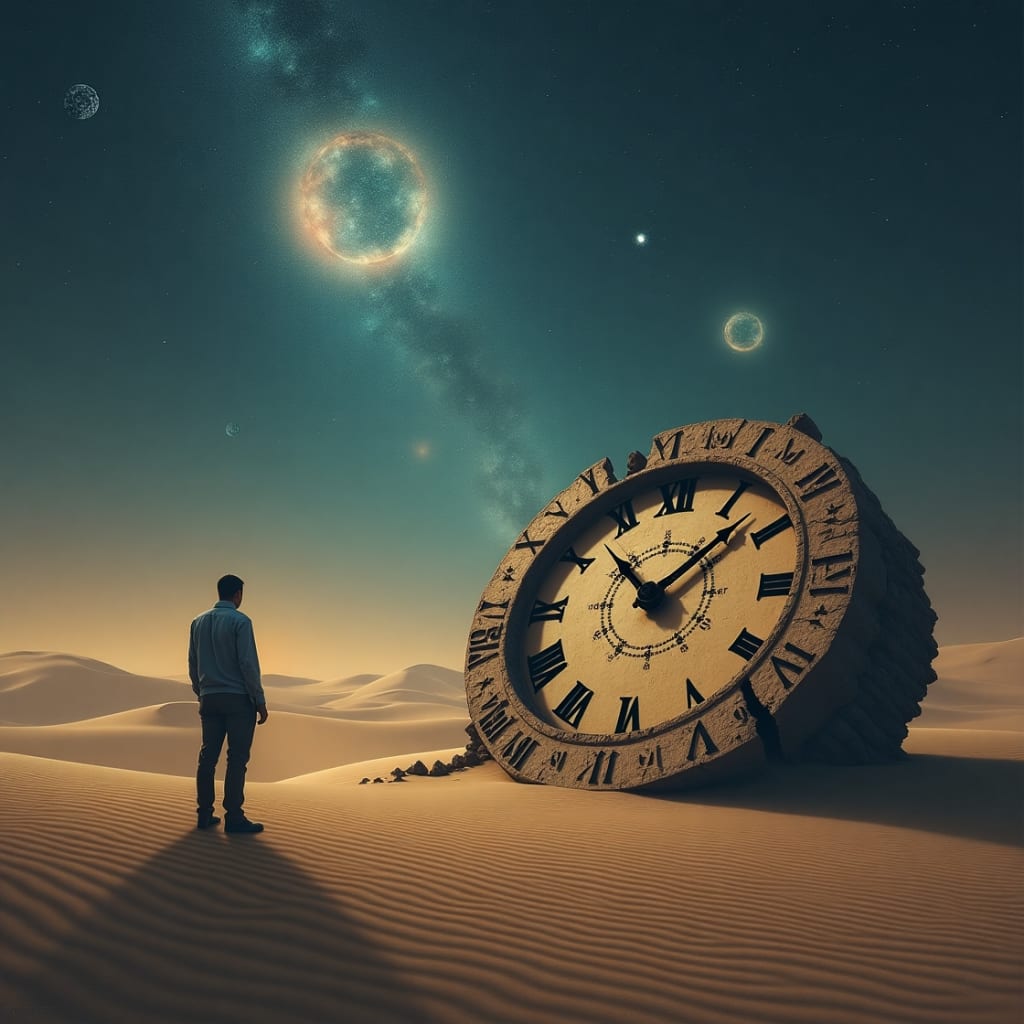
Time. It ticks, it flows, it waits for no one. But what is time, really? Is it just the ticking of a clock or the rising and setting of the sun? Or is it something deeper—a divine mystery, an ancient force, a test we are all placed in, whether we know it or not?

---
In the quiet town of Anrak, nestled between ancient hills and rivers older than memory, lived a man named William. He was neither wise nor foolish, neither young nor old. He was simply...aware. He questioned things people usually ignored. Most of all, he questioned time.
Each morning, he would rise with the call to prayer, not because of habit but because he believed those few moments before the sun kissed the earth held answers. One morning, he sat facing the eastern horizon, whispering, "What are you, Time?"

That day, he started his search.
---
Time in the Ancient World
William began with the oldest library in Anrak, where scrolls and dusty books preserved thoughts long forgotten. The first scroll he found was a copy of then ancient Hindu text. In it, Lord Krishna tells Arjuna:
> "I am Time, the great destroyer of worlds." (Bhagavad Gita 11:32)
William paused. Here, time was not a neutral observer. It was a force—a god, even. Something that consumes everything, even the strong and the wise. Time, in this vision, wasn’t something you manage. It was something that manages you.
He read further about the Yugas in Hindu belief: four massive ages that cycle over millions of years. We live in Kali Yuga, the age of darkness, where time accelerates and truth becomes harder to find. Could it be, William thought, that our very perception of time changes with the moral state of the world?
---
Time in Islam
Next, William turned to the Qur'an. He read:
> "Indeed, your Lord is Allah, who created the heavens and the earth in six days..." (Surah Al-A'raf 7:54)
Time had a beginning. And in a powerful hadith, the Prophet Muhammad (صلى الله عليه وسلم) quotes Allah:

> "Do not curse Time, for I am Time."
William pondered. The hadith wasn’t saying Allah is time, but that He controls time. In Islamic theology, time is a creation—just like matter, light, or space. It exists to give us a chance to grow, to be tested, and to return.
In this view, time is divine mercy and justice. Without it, we would not age, change, or learn. Time humbles kings, heals wounds, and buries both tyrants and saints.
---
Time in Ancient Greece
William moved on to Greek philosophy. In Plato's "Timaeus," he found:
> "Time came into being with the heavens. It is a moving image of eternity."
And Aristotle said:
> "Time is the number of motion according to before and after."
So to the Greeks, time was linked with motion and change. Without movement, there is no time.

A frozen world, even if it exists for years, has no "time" unless something happens.
He suddenly understood why the stars mattered to ancient civilizations. The sun, the moon, the seasons—they weren’t just beautiful; they were clocks.
---
Time in Modern Science
Then came the scientific truth, as mind-bending as any scripture.
Einstein’s Theory of Relativity showed that time is not absolute. Time moves slower near massive gravity or when traveling at speeds near light. That meant time can be bent, stretched, or warped.
William smiled. Science, too, admitted that time was not fixed.
In quantum physics, time becomes even stranger. Some scientists speculate that time could be made of tiny units—"chronons" —like atoms of time. Others suggest it may not exist fundamentally, only as a human illusion shaped by memory and consciousness.
Even the Big Bang, the origin of everything, marks the beginning of time. Before that, time did not exist, according to our best models.
So science, philosophy, and religion all seem to agree: Time is not eternal.
---
The Truth William Found
One evening, William returned to the hill where he had first asked the question.
The sun dipped below the horizon, casting long shadows. He whispered, "Now I know. Time is the stage where my soul learns. It is the silence between heartbeats, the fire beneath memory, the mercy between birth and death."
Time was not the enemy.
It was the teacher.
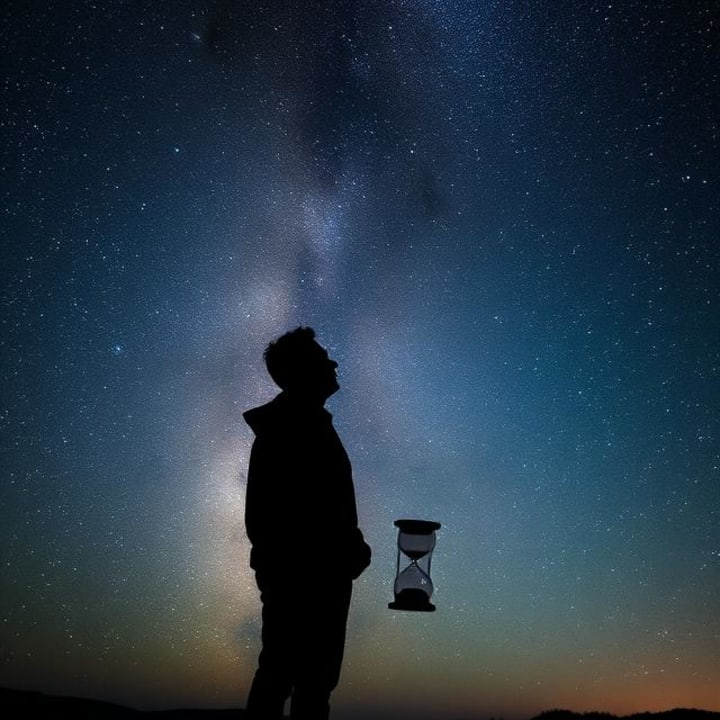
He watched as the stars appeared above, each blinking on in perfect rhythm. They were not distant fires, but old witnesses, watching our brief stories unfold one second at a time.
William stood, finally at peace. He didn’t control time. But he could honor it.
And that, he thought, was enough.
About the Creator
Keep reading
More stories from Junaid Khan and writers in Education and other communities.
From Mud Floors to Million-Dollar Suites: The Untold Origins of the Hotel Industry
When you walk into a hotel lobby today — glossy floors, scented air, smiling staff, and buffet breakfasts — it feels like magic. Like a pause from the chaos of the real world. But have you ever stopped to wonder...
By Junaid Khan9 months ago in History
A Beginner’s Guide to Microsoft Advertising
When people talk about online advertising, one platform usually gets most of the attention. For a long time, I assumed that was the only real option. Later, while researching search marketing tools, I discovered another system called Microsoft Advertising.
By supun fernando4 days ago in Education
What Raquel Zamora Says She’ll Bring to LAUSD Board District 2
“LAUSD has some of the strongest special education services in the nation." — Raquel Zamora In the 2022 election, Dr. Rocío Rivas won the race to fill the Board District 2 seat that was held by Monica García, who was forced from office due to term limits. In her first attempt at re‑election, Rivas will face Raquel Zamora. With only two candidates on the ballot, the June 2, 2026, primary will be a winner‑take‑all contest.
By Carl J. Petersen4 days ago in Education


Comments
There are no comments for this story
Be the first to respond and start the conversation.