
The Seed Renaissance: Inside France USD 1.91 Billion Agritech Surge
France Seeds Market
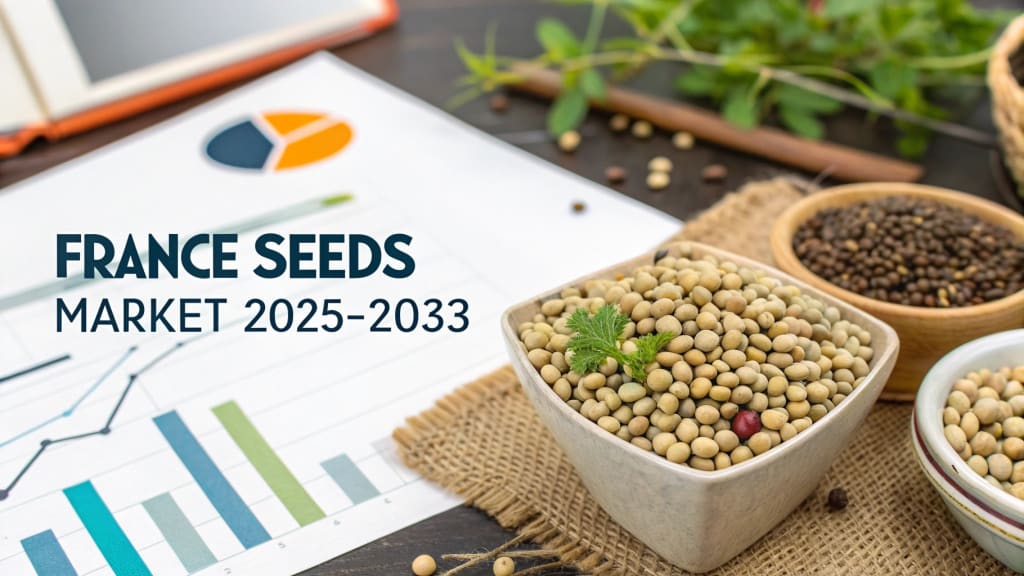
The era of “one-size-fits-all” crop solutions is officially over. Walking through the agricultural research centers of Île-de-France or browsing webinars on French agritech platforms in 2026, it becomes clear that the modern French farmer is now one of the most discerning in the world. I call them “Seed Strategists” growers who can evaluate genetic traits, sustainability metrics, and yield predictions with the precision of a biotech analyst, valuing data-backed results over tradition alone.
This evolution is driving a market projected to reach $1.91 billion by 2033, up from $1.47 billion in 2024, with a steady growth rate of 2.66% CAGR. To understand this trajectory, we need to examine the three “invisible forces” reshaping France seed industry the integration of biotechnology with traditional agronomy, the rise of precision agriculture, and the tightening regulatory and sustainability frameworks.
1. The Biotech-Enhanced Seed Revolution
At the heart of France’s growth story is the marriage of genetic science and classical agronomy. For decades, French farmers relied on tried-and-true varieties of wheat, maize, and sunflower, often imported from neighboring EU countries. Today, domestic seed developers are leveraging cutting-edge genomics, CRISPR techniques, and marker-assisted breeding to create seeds that are not only high-yielding but also disease-resistant and environmentally resilient.
Varieties such as tolerant wheat strains for Fusarium control or drought-resistant maize demonstrate the sophistication of modern French seed science. Companies like Limagrain, RAGT Semences, and Vilmorin & Cie are blending decades of traditional breeding knowledge with biotechnology to optimize traits for local climates, soil types, and pest pressures.
This approach represents a “best-of-both-worlds” strategy: the reassurance of local adaptation combined with the predictability of lab-tested genetic enhancements. By 2026, these biotech seeds are capturing increasing shares of the premium agricultural input market, often outpacing imported varieties in both adoption speed and farmer loyalty.
2. Precision Agriculture: Seeds Meet Smart Farming
The modern French farm is no longer a field of guesswork it’s a data-driven ecosystem. Precision agriculture tools, including drones, soil sensors, and satellite mapping, allow farmers to match specific seed varieties to exact microclimates and soil conditions.
Farmers start with detailed soil and moisture diagnostics, often fed into platforms that simulate crop growth under varying conditions. Based on this data, distributors offer customized seed recommendations for hybrid or treated seeds, tailored for both yield optimization and sustainability compliance.
This “digital twin” approach to farming transforms seeds from simple commodities into strategic inputs for farm-level optimization. It also enables a new class of high-value offerings, such as organic-certified or bio-treated seeds that meet strict EU sustainability standards. By 2030, this AI-assisted precision farming is expected to be a core driver behind the 2.66% CAGR, turning every hectare into a carefully managed investment in both profitability and ecological stewardship.
3. Sustainability and Diversification as Market Drivers
French agriculture is entering what I call the Sustainable Seed Era. With increasing environmental awareness and policy pressures, farmers are shifting away from generic, chemical-heavy seeds toward options that balance yield with ecological responsibility.
Organic seed adoption is climbing steadily, especially in horticulture and specialty crops. Simultaneously, treated seeds coated with biostimulants, micronutrients, or environmentally friendly protectants are emerging as the standard for disease-prone regions. These innovations are not just technical they are a response to farmer demand for predictable performance without compromising soil health or regulatory compliance.
Diversification is another key trend. Beyond cereals and maize, French seed producers are expanding into legumes, rapeseed, and specialty vegetables, providing crop-specific traits such as early maturation, pest resistance, and nitrogen-use efficiency. This tailored approach allows farmers to maximize profitability across multiple crop cycles, aligning with the growing interest in crop rotation and regenerative practices.
4. Regulatory Trust: The New Premium
The French seeds market is shaped by strict European and national regulations, including the EU’s Common Catalogue of Varieties and France’s DGCCRF guidelines. While compliance initially added complexity to R&D and distribution, it has become a premium filter, favoring producers who can demonstrate efficacy, traceability, and environmental responsibility.
Farmers increasingly verify seed origins, treatment protocols, and genetic performance before committing. Brands that can provide scientific documentation, field trials, and sustainability certifications gain a competitive edge, while generic or opaque offerings are being pushed out. In this environment, trust itself has become a core market differentiator—much like a luxury label in consumer goods, but with measurable agronomic outcomes.
5. Market Expansion: Regional Nuances and Distribution Channels
The French seeds market is not monolithic. Regional variations in climate, soil type, and crop preference mean that one-size-fits-all approaches no longer work. Northern wheat belts require cold-tolerant strains, while the southwest favors drought-hardy maize and sunflower hybrids. This regional tailoring has encouraged companies to create region-specific portfolios, backed by field trials and local agronomic support.
Distribution is also evolving. Traditional channels cooperatives, distributors, and direct sales are now complemented by digital platforms, subscription services, and partnerships with agricultural research institutes. Seed treatment innovations, including pre-coated biostimulants and biofertilizers, are increasingly bundled with the product, allowing farmers to access “ready-to-plant” solutions that optimize both convenience and performance.
6. Emerging Segments: Organic and High-Value Crops
Two “sleeping giants” are awakening in the market: organic farming and specialty high-value crops.
Organic Adoption: Driven by EU mandates, consumer demand, and export potential, organic seed adoption is rising, especially for vegetables, pulses, and niche cereals. Farmers are willing to pay a premium for certified organic seeds with predictable germination and yield.
Specialty Crops: Rapeseed, hemp, and other high-margin crops are gaining traction. Seed innovation is critical here, with breeders developing varieties optimized for oil content, fiber quality, and pest resistance, turning France into a leader in both domestic and export-oriented specialty agriculture.
Conclusion: Seeds as Strategic Investments
Looking toward 2033, France’s seeds market is maturing into a sophisticated, innovation-driven ecosystem. Seeds are no longer just agricultural inputs they are strategic tools for sustainable productivity, risk management, and farm-level optimization.
The successful players of the next decade won’t be those with the largest portfolios alone, but those who can combine scientific credibility, regulatory compliance, regional adaptation, and sustainability credentials. In 2026, as farmers increasingly act as “Seed Strategists,” the industry demonstrates that in agriculture, precision, trust, and innovation are the most valuable seeds of all.
About the Creator
Keep reading
More stories from Neeraj kumar and writers in Education and other communities.
The Bio-Logic Era Inside China’s $9 Billion Premium Skincare Ascent
The era of the "one-size-fits-all" luxury cream is officially over. Walking through the beauty halls of the Tianshan District or scrolling through a live-stream on Douyin in 2026, it becomes clear that the Chinese beauty consumer is now the most demanding on the planet. I call them "Skin-Intellectuals" shoppers who can break down a chemical formula with the precision of a lab technician and who value clinical proof over celebrity endorsements.
By Neeraj kumar2 days ago in Education
Why Theatre Still Matters in a Digital World: The Enduring Magic of Live Performance
The world today runs on WiFi and touchscreens. Movies stream in seconds. Social media updates never stop. News travels fast and fades even faster. In the middle of all this speed, the stage still stands. The question of why theatre still matters in a digital world deserves real attention.
By Therese Marie Thompsonabout 3 hours ago in Education
Do Physical Laws Require a Creator? Science, Philosophy, and the Origin of Natural Law
What Are Physical Laws? Before asking whether physical laws require a creator, we must understand what they are. Physical laws are mathematical descriptions of patterns observed in nature. They summarize how matter and energy behave under specific conditions.
By shahkar jalal7 days ago in Education




Comments
There are no comments for this story
Be the first to respond and start the conversation.