
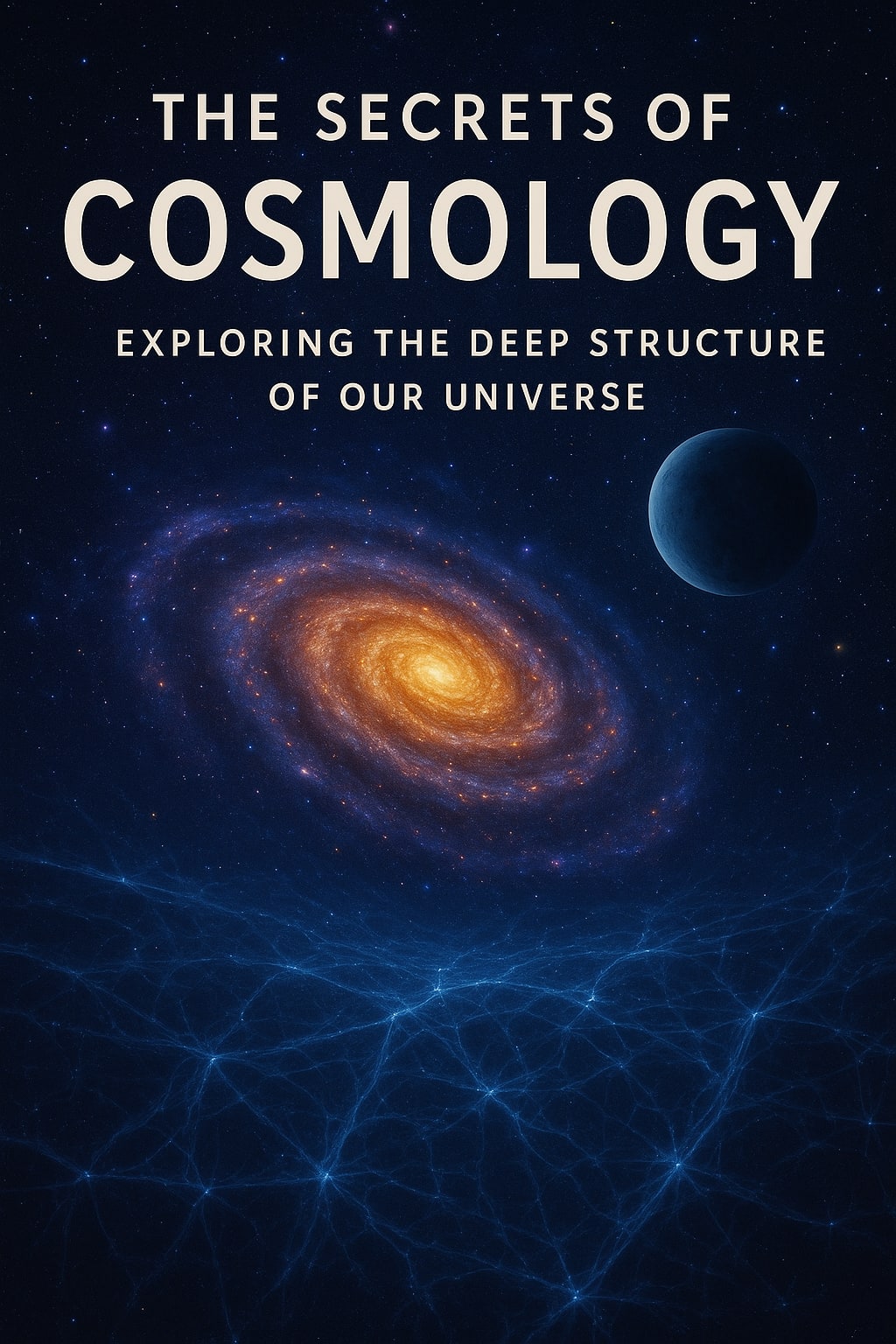
The Secrets of Cosmology: Exploring the Deep Structure of Our Universe
Cosmology, the scientific study of the origin, evolution, structure, and ultimate fate of the universe, has transformed from ancient philosophical wonder into one of the most advanced fields of modern science. Today, cosmology sits at the intersection of physics, astronomy, mathematics, and even philosophy, aiming to answer the biggest question humans have ever asked: Where did the universe come from, and what is its destiny? The last century has produced breathtaking discoveries — expanding space, dark matter, dark energy, cosmic inflation, and the mysterious cosmic microwave background. Each breakthrough brings us closer to understanding the vast cosmic story written across billions of years. In this article, we journey deep into the world of cosmology, unraveling the universe’s hidden structure, its unseen forces, and the mysteries that continue to challenge the world’s brightest scientists.

What Is Cosmology?
Cosmology is the science that studies the universe as a whole. Unlike astronomy, which focuses on stars, planets, and galaxies individually, cosmology examines:
The large-scale structure of the universe
The origin and evolution of cosmic space
The physical laws governing everything
The ultimate future of all matter and energy
Cosmology blends observations with high-level theories like general relativity, quantum mechanics, and particle physics to explain how the universe works at its deepest level.
The Big Bang: The Universe Begins
The most widely accepted cosmological model is the Big Bang Theory, which states that the universe began around 13.8 billion years ago as a tiny, extremely hot, dense point often called a singularity.
Key phases of the Big Bang:
1. The Singularity
Everything — energy, matter, space, and time — was compressed into a single point.
2. Cosmic Inflation
A fraction of a second after the Big Bang, the universe expanded faster than the speed of light. This stretched tiny quantum ripples into massive cosmic structures.
3. Formation of Matter
As the universe cooled, protons, neutrons, and electrons formed. Later, these particles combined into hydrogen and helium.
4. First Stars and Galaxies
Gravity gathered gas clouds into stars and galaxies, eventually forming galaxy clusters and superclusters.
5. The Modern Universe
Today, the universe continues to expand, forming new stars and dispersing old galaxies into deeper space.
Dark Matter: The Hidden Mass of the Universe
One of cosmology’s greatest puzzles is dark matter, an invisible substance that makes up 27% of the universe.
What we know about dark matter:
It does not emit or reflect light
It cannot be directly detected
It interacts through gravity, not electromagnetism
It forms giant “scaffolds” that hold galaxies together
Without dark matter, galaxies would fly apart because their visible mass is too small to generate enough gravity.
Where is dark matter located?
Dark matter forms massive halos around galaxies, extending far beyond the stars we can see. It shapes cosmic structure at every scale — from small galaxies to superclusters.
Leading theories include:
WIMPs (Weakly Interacting Massive Particles)
Axions
Sterile neutrinos
Modified gravity theories
Though scientists cannot “see” dark matter, they can observe its gravitational fingerprint everywhere.
Dark Energy: The Force Accelerating the Universe
In 1998, cosmologists made a discovery that shook the foundations of physics: the universe is not just expanding — the expansion is accelerating.
This acceleration is caused by something called dark energy, a mysterious force that makes up 68% of the entire universe.
What is dark energy?
A form of energy that pushes space apart
Responsible for the universe’s accelerating expansion
Stronger over large distances
Completely invisible
Dark energy may be related to Einstein’s “cosmological constant,” or it might be a dynamic field called quintessence. Its true nature remains unknown, making it one of the greatest cosmic mysteries.
The Cosmic Microwave Background: The Universe’s Baby Picture
The cosmic microwave background (CMB) is the oldest light in the universe, a faint glow left over from when the universe was only 380,000 years old.
Why the CMB is important:
It proves the Big Bang happened
It maps early temperature variations
It reveals the seeds of galaxies
It helps measure the universe’s age, shape, and composition
This ancient radiation fills the universe uniformly but includes tiny fluctuations — the fingerprints of primordial structures.
Cosmic Inflation: The Universe’s First Split Second
To solve several cosmological mysteries, physicist Alan Guth proposed inflation, a period of sudden expansion immediately after the Big Bang.
Inflation explains:
Why the universe is nearly uniform
Why space is flat
Why galaxies formed the way they did
Why we see similar conditions everywhere
During inflation, space expanded exponentially faster than light, smoothing out irregularities and stretching quantum fluctuations into galaxy-forming structures.
The Large-Scale Structure of the Universe
Cosmologists have mapped the universe across billions of light-years. They discovered that matter forms a cosmic web made of:
Galaxies
Galaxy clusters
Superclusters
Filaments
Voids (huge empty areas)
This cosmic web resembles neural networks or spiderwebs — a beautiful, gigantic structure created by dark matter and gravity.
How Will the Universe End?
Cosmologists propose several possible fates:
1. Heat Death (Most likely)
The universe expands forever, stars burn out, and everything fades into cold darkness.
2. Big Rip
Dark energy grows stronger, tearing galaxies, stars, planets, and atoms apart.
3. Big Crunch
Gravity stops expansion and the universe collapses into a single point.
4. Big Bounce
The universe cycles through expansions and collapses.
For now, data suggests eternal expansion powered by dark energy.
Why Cosmology Matters
Cosmology is not just about stars or galaxies—it is about understanding our place in the universe.
It helps answer:
Where did everything come from?
Why does the universe have structure?
What is matter made of?
Why do physical laws work the way they do?
Are we alone in the cosmos?
Cosmology connects humanity to the grand cosmic story spanning billions of years.
Conclusion
Cosmology remains one of the most awe-inspiring scientific fields ever developed. It explores deep time, invisible forces, and the origin of reality itself. Though we have uncovered many cosmic secrets, countless mysteries remain — dark matter, dark energy, and the true nature of the universe’s beginning and end.
As new telescopes and technologies emerge, we stand on the threshold of a new era of discovery. The universe is vast, mysterious, and breathtaking — and cosmology is the key to unlocking its hidden truths.
About the Creator
Keep reading
More stories from shahkar jalal and writers in Education and other communities.
The Solar System — Hidden Mysteries You Never Knew
1. The Birth of the Solar System — A Cloud of Cosmic Dust The Solar System formed about 4.6 billion years ago from a massive cloud of gas and dust called the solar nebula. When a nearby supernova triggered the collapse of this cloud, gravity pulled the material inward to form the Sun.
By shahkar jalal2 months ago in Education
Beyond Deals: Building Alliances That Truly Scale
Strategic partnerships for growth help companies expand faster and smarter. They enable two or more businesses to work together to create shared value. Each partner brings skills, reach, or resources that the other lacks. When done right, strategic partnerships create long-term growth that feels natural and steady.
By Rushi Manche6 days ago in Education


Comments
There are no comments for this story
Be the first to respond and start the conversation.