
The Secret Relationship Between SEO and CRO
How They Work Together for Business Success

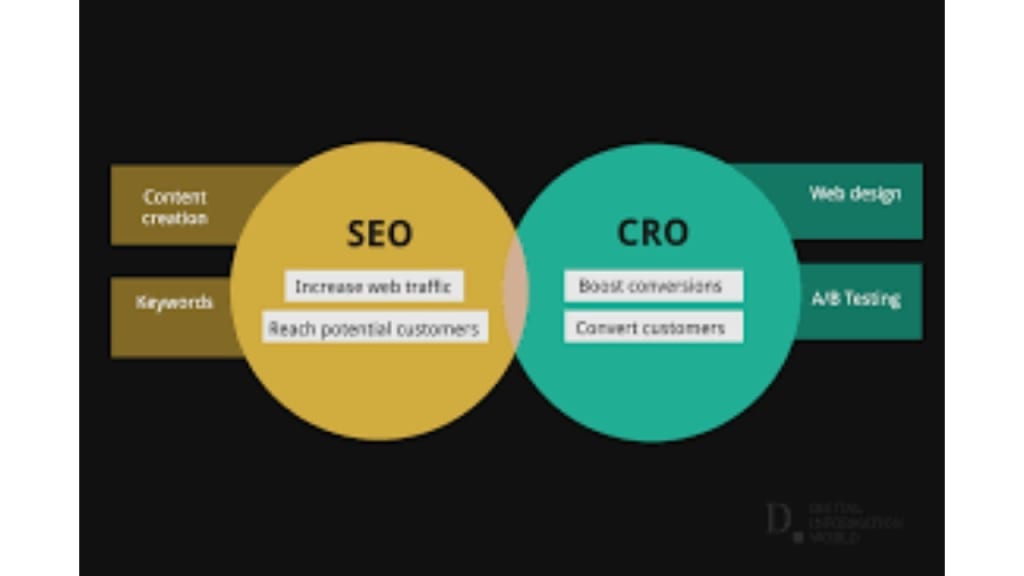
Search Engine Optimization (SEO) and Conversion Rate Optimization (CRO) are two powerful tools that every business needs to master. While they are often treated as separate strategies, these two optimization techniques have a closely intertwined relationship that can significantly impact your business's online success.
In this blog, we’ll explore the secret connection between SEO and CRO, and how combining both can boost your website’s visibility, traffic, and conversions, ultimately leading to sustainable business growth.
What is SEO?
SEO focuses on optimizing your website to improve its ranking on search engine results pages (SERPs). The goal of SEO is to attract more organic traffic by making your website more discoverable to search engines like Google, Bing, and others.
Key SEO elements include:
Keyword research and optimization
On-page SEO (title tags, meta descriptions, header tags)
Off-page SEO (backlink building, social signals)
Technical SEO (site speed, mobile-friendliness, secure HTTPS connections)
SEO drives traffic to your website by targeting specific keywords and improving your site’s overall search engine ranking.
What is CRO?
CRO, on the other hand, focuses on improving the percentage of website visitors who complete desired actions, such as filling out a form, making a purchase, or signing up for a newsletter. The aim of CRO is to optimize your website's user experience and ensure that the traffic you generate turns into customers.
Key CRO elements include:
A/B testing different layouts or calls-to-action (CTAs)
Simplifying the navigation and checkout process
Using clear and persuasive messaging
Analyzing user behavior through heatmaps and analytics
CRO is all about increasing your conversion rate and ensuring that your website performs well in converting traffic into tangible business results.
The Secret Relationship: How SEO and CRO Work Together
Though SEO and CRO have distinct goals, they are closely related and often depend on each other for success. Here’s how they work together to improve your business's online performance:
1. SEO Brings Traffic, CRO Converts It
At its core, SEO helps your website attract relevant traffic by improving its search engine rankings. The more optimized your site is for search engines, the more likely it is to appear when users search for keywords related to your business. However, simply driving traffic isn’t enough—you also need to turn those visitors into leads, customers, or subscribers.
That’s where CRO comes in. CRO ensures that once visitors land on your site, they are more likely to take action. Without CRO, all the traffic that SEO brings can go to waste if users don’t find your site user-friendly, informative, or easy to navigate.
In short: SEO brings users to your door, but CRO ensures they walk through it.
2. CRO Helps Reduce Bounce Rate, Boosting SEO
Bounce rate refers to the percentage of visitors who leave your website after viewing only one page. A high bounce rate can negatively affect your SEO because search engines interpret it as a sign that your site isn’t providing value to visitors.
By improving user experience and optimizing your landing pages, CRO helps reduce bounce rates. When users stay longer on your site, navigate multiple pages, and interact with your content, search engines recognize this as a positive signal, which can improve your rankings.
For example, a well-optimized landing page with a clear and compelling CTA will encourage users to explore more, thus improving your SEO performance.
In short: A well-executed CRO strategy can reduce bounce rates, which indirectly boosts your SEO rankings.
3. SEO and CRO Together Improve User Experience
Both SEO and CRO contribute to a better user experience (UX). Google and other search engines prioritize websites that offer a smooth, intuitive, and mobile-friendly experience. Similarly, CRO focuses on making the website more user-friendly by improving navigation, site speed, and overall functionality.
For instance, if your site is mobile-optimized and loads quickly (SEO factors), visitors are more likely to stay and interact with your content (CRO impact). On the flip side, if your website provides a seamless user experience through CRO practices, it encourages more engagement, which benefits your SEO efforts.
In short: Good UX is a common goal of both SEO and CRO, and both work together to achieve it.
4. SEO Insights Can Guide CRO Strategies
SEO data is a goldmine for understanding user behavior, and this data can be invaluable for CRO. By analyzing which keywords are driving traffic, which pages users are landing on, and how visitors interact with your site, you can identify which areas need improvement for better conversions.
For example, if a particular blog post is attracting a lot of organic traffic but not converting well, you can use CRO techniques like adding better CTAs, improving content clarity, or making the page more visually appealing. CRO can then optimize high-traffic pages to maximize conversions.
In short: SEO provides the data, and CRO uses it to improve conversion rates.
5. CRO Can Improve SEO by Increasing Dwell Time
Dwell time refers to the amount of time a visitor spends on your website after clicking through from a search engine results page. Search engines use dwell time as a ranking factor; longer dwell times indicate that users find your content valuable and relevant.
CRO helps improve dwell time by making your content more engaging and user-friendly. For example, if your website has engaging videos, interactive elements, or compelling product descriptions, users are more likely to spend time on your site, which can improve your SEO rankings.
In short: CRO strategies that increase dwell time can enhance your SEO performance.
6. SEO and CRO Lead to Higher Quality Leads
The end goal of both SEO and CRO is to attract and convert high-quality leads. SEO brings in traffic that is relevant to your business through targeted keywords, ensuring that visitors are already interested in your offerings. CRO then takes this targeted traffic and fine-tunes the experience to encourage conversions.
For example, an SEO strategy might attract users searching for "best digital marketing services," while CRO ensures that once these users land on your site, they see clear messaging, trust signals, and an easy-to-navigate site that encourages them to fill out a form or make a purchase.
In short: Together, SEO and CRO help businesses attract and convert high-quality leads.
Conclusion
While SEO focuses on attracting visitors, and CRO aims to convert those visitors into customers, the two strategies are interconnected in a way that maximizes the effectiveness of your online marketing efforts. By combining the power of SEO and CRO, you can ensure your website is not only driving traffic but also converting that traffic into tangible business results.
To achieve long-term success, it’s essential to strike a balance between both. By leveraging SEO to bring in high-quality traffic and CRO to enhance user experience and drive conversions, businesses can enjoy sustainable growth in a competitive digital landscape.
About the Creator
Maria sultana
Hello this is Maria SEO Executive at Next Bell Ltd.
Visit my company page : https://www.nextbell.com/
Keep reading
More stories from Maria sultana and writers in Education and other communities.
How to Write an Article About Your Website on Google and Drive Traffic with SEO
To make it visible and drive traffic, search engine optimization (SEO) is key. If you're aiming to write an article about your website and ensure it ranks well on Google, here's a step-by-step guide on how to do it while incorporating effective SEO techniques.
By Maria sultana2 years ago in Education
What Should Be Your Main Focus During an Online Limited Radiology Tech Program
Well, the short answer is that there is not a single module that you should strictly focus on. If you want to become a X-ray technician, you need to develop both technical and soft skills.
By Meaghan Howe4 days ago in Education
How Law Promotes Justice and Equality in Society
Law is one of the cornerstones of organized society. Its role extends far beyond punishment or regulation; it is designed to ensure fairness, uphold rights, and create equality among individuals. By setting clear rules and standards, the law provides a framework that governs behavior, resolves conflicts, and protects the most vulnerable members of society. In promoting justice and equality, legal systems reinforce the principles that allow communities to function peacefully and fairly.
By Juan Monteverdeabout an hour ago in Education




Comments
There are no comments for this story
Be the first to respond and start the conversation.