
The Roman legion (creating killers)
The legion
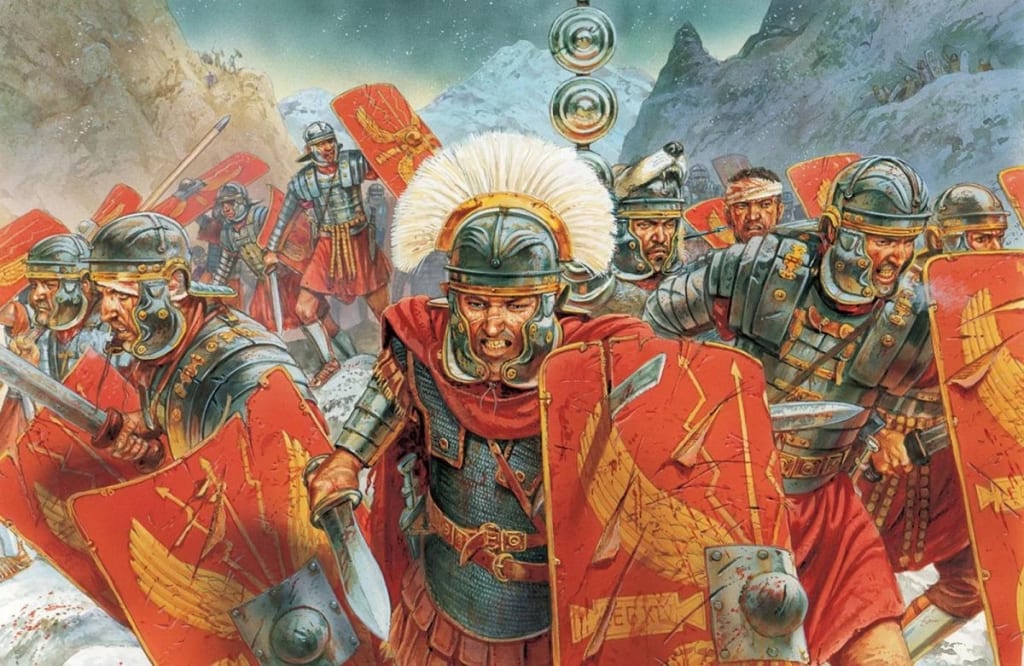
Absolutely fearsome in battle.
Incredibly well-disciplined, and well-organized, the Roman army was arguably the most brilliant military force in the history of warfare, and this was no more evident than in its largest unit, the Roman Legion.
But what was it that transformed men from farms and villages into veritable fighting machines?
What did the Romans do that other societies didn’t, or at least as well?
That’s what we’ll find out today.
When we’re talking about the armed forces of Rome we are getting into a very complex topic.
Things changed a lot during the lifespan of Rome.
The Roman Kingdom goes back to the 8th century BC.
Then you had the Roman Republic from 500–31 BC and after that all the way until 395 AD, the Roman Empire.
Many things in the military changed over those centuries, from the size of the army to its tactics, to its weapons, and to how it was organized, but even though it was such a long period of time, many of the foundations of the military remained very similar.
If you were to ask when its heyday was, you’d get a lot of different answers, but many people in the know might tell you it was under the great Julius Caesar, who you’ll remember played a major part in the Republic becoming the Empire.
So, today, when we’re talking about the Roman legion, just remember that a few fundamental things changed over time.
Typically, around the era of Caesar and just before, the legion would be made up of anywhere from 4,000 to 5,000 men, and they’d be split into units.
The vast majority of men were part of the infantry and fewer men served as cavalry.
There were also non-Roman mercenaries fighting alongside the legion.
There were many reforms within the Roman military, especially during the period of the late Republic when Rome was expanding, fighting among itself, and so was constantly at war.
Rome was good at war partly because it had so much practice at it.
In the time of the late Republic, the army became more professional, when under the statesman Gaius Marius, there were what we now call the Marian reforms.
Prior to the reforms, men fought in the military but when the various campaigns ended, off they went back to wherever they’d come from.
This was not ideal in terms of having a professional army.
These men were divided into classes, and since the poorest couldn’t afford to buy their swords and other equipment, they were not expected to hold the battle line.
The higher classes had more weapons and more armor, and these men might have become very valuable veterans with a lot of experience. They certainly held the battle line.
They were the bee’s knees of fighting and strategy, and that’s what the Romans under the new reforms wanted all their soldiers to be.
There were still ranks, though.
The complex ranking of men is a thing in any military still today.
At the top of the classes was the cavalry, usually made up of wealthy Roman men who could afford a horse and the best equipment. It goes without saying that when all these men were fighting for Rome, they were followed by a large contingent of servants and slaves to work in the camps.
There were even specialist artisans who could knock you up a decent abode for when you were on the road.
But we said that kind of thing wasn’t ideal during a time of great expansion and war, so the reforms created a permanent army.An army that knew what killing felt like.An army that didn’t go back home after battle.
It also meant all men who joined the legions were able to retire with some land.
Dedicating much of their life to the military sometimes paid off, and so many men wanted to be in the legion. Ok, so how did a man become part of the legion? Firstly, he had to be a Roman citizen.
There were non-Roman soldiers who fought alongside the legion called the Auxilia, who might win citizenship one day, but the new recruits were all Romans.
Step one for them was proving their citizenship, and only then could they go through the process of being checked out.
This process was called the “probatio”, which, of course, we can think of as a probation period.
It ensured the person was legally Roman and that he wasn’t lying about his age.
Most recruits were usually aged between 17 and 23.
The Romans were keen to have men that looked physically powerful and healthy.
They didn’t have a clue about genes, but they had an idea of what you might call good fighting stock.
You would have struggled to get into the legion if you were vastly overweight or if you were as skinny as a bean pole.
There was also a medical examination.
There are papyrus records from the year 52 AD that tell us about a weaver that had firstgotten into the legion but then was kicked out because of his weak eyesight that was caused by a cataract. Seems Steve Rogers would’ve needed a super soldier serum to make into the Roman legion as well.
They wanted strong men, often tall men no shorter than 173 cm (five feet seven/eight). It seems the height stipulation changed over the years, and it also seems that if you were muscular and short, that would be taken into account.
Still, they definitely preferred taller types of guys.
The records show that strong backs and broad shoulders were also preferred.
Remember, these men would be going through hell.
They’d be doing heavy lifting, marching for miles and miles carrying the equipment we’ll talk about soon, and then fighting in battles.
The Romans only wanted the best kind of men for this, and this pickiness is another reason why their armed forces were so good.
The man’s background was also taken into consideration.
The Romans were aware that his upbringing could affect how good he was at being a soldier.
They preferred guys that had sweated it out in the countryside, living a hardcore rural life that had hardened them.
These folks were usually better recruits than the city kid who had lived a relatively comfortable life.
They wanted kids that were used to going hungry, that knew what toil felt like.
We get most of our knowledge on recruitment for the Legions from an ancient work known as “Epitoma rei militaris”, written by a Roman writer named Vegetius.
About the Creator
Knowledge about the world
I am very interested in improving my knowledge about the world and I know so are a lot of you, so welcome.
Keep reading
More stories from Knowledge about the world and writers in Education and other communities.
How Interest Rates Impact Real Estate Investments and Investor Decision Making
Interest rates impact real estate investments at every stage of the buying and owning process. From the first loan application to long term holding strategies, interest rates influence costs, demand, and overall returns. Many investors focus only on property price, but interest rates often play a larger role in success or failure. This article explains how interest rates affect real estate investments in a clear and simple way, using practical examples that are easy to understand.
By Manny Khoshbin5 days ago in Education
The Human Advantage Russia’s Soft Skills Renaissance in the Age of AI (2026)
In the rapidly shifting economic landscape of 2026, Russia has entered a new era of human capital development. For years, the Russian job market was dominated by a "Hard Skills First" mentality prioritizing technical degrees, engineering prowess, and tangible manufacturing expertise. However, as Artificial Intelligence (AI) and automation begin to handle the heavy lifting of data analysis and routine tasks, a fundamental realization has swept through the offices of Moscow and the industrial hubs of the Urals: technical skills get you the job, but soft skills keep the business alive. Today, soft skills training in Russia has evolved from a "corporate luxury" into a survival-critical investment, driven by a need for agility, emotional intelligence, and human-centric leadership in an increasingly complex world.
By Neeraj kumar3 days ago in Education




Comments
There are no comments for this story
Be the first to respond and start the conversation.