
The Rise of the Artificial Tongue
How Graphene Is Powering a New Era in Taste Technology

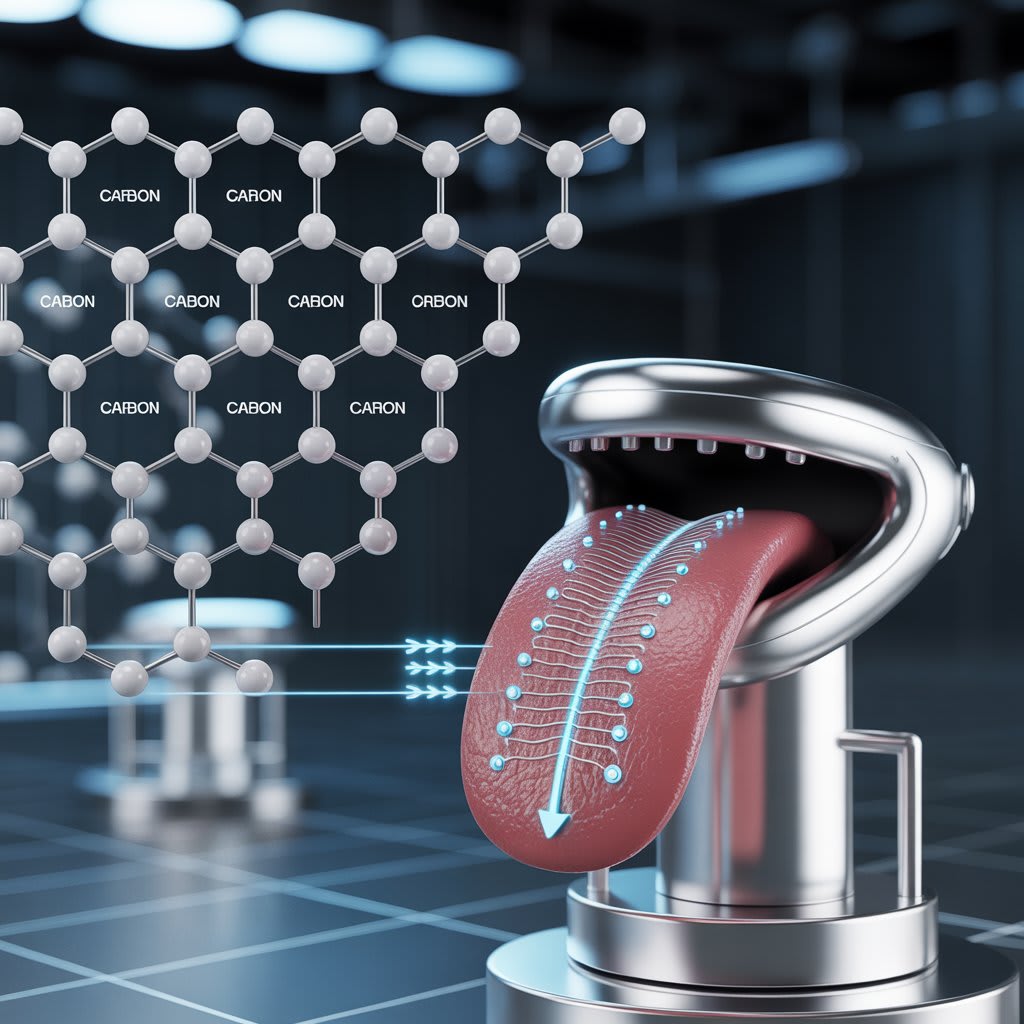
In a groundbreaking fusion of material science and artificial intelligence, researchers have developed a graphene-based artificial tongue capable of identifying complex tastes with remarkable accuracy. Recently published in the Proceedings of the National Academy of Sciences (PNAS), this innovation mimics human taste buds and even works under wet conditions — a feat that has eluded earlier sensory devices.
This revolutionary prototype not only pushes the boundaries of biosensing technologies but also opens exciting possibilities for healthcare, food safety, and artificial sensory systems.
What is a Graphene-Based Tongue?
Graphene, often hailed as a "wonder material," is a single layer of carbon atoms arranged in a hexagonal lattice. Its unique properties — including high electrical conductivity, flexibility, and extreme sensitivity — make it ideal for biosensors. The artificial tongue utilizes graphene oxide layers, which react differently to various taste molecules.
Paired with artificial intelligence algorithms, the system interprets these interactions much like human taste buds communicate with the brain. In effect, this device doesn't just "taste" — it thinks.
The Science Behind It
The device is composed of nanoscale graphene oxide membranes that mimic the functionality of human taste receptors. When these membranes come into contact with a solution, they generate electrical signals based on the chemical composition of the liquid.
An integrated AI model, trained on a database of over 160 known chemicals, interprets these signals. During tests, the artificial tongue identified known flavors with 98.5% accuracy and successfully categorized new, complex taste mixtures like coffee and cola with 90% accuracy.
But perhaps the most remarkable feature is that the device functions accurately even in moist environments, mimicking the exact conditions inside the human mouth. This has been a major limitation of earlier taste sensors, which typically degraded or malfunctioned in wet conditions.
Applications and Implications
The potential applications of this graphene-based artificial tongue are vast and promising:
1. Medical Use
For individuals suffering from neurological disorders, chemotherapy side effects, or stroke-related damage, the loss of taste can severely impact nutrition and quality of life. Future iterations of this technology could act as a sensory aid — similar to how cochlear implants help those with hearing loss.
2. Food and Beverage Industry
Imagine automated taste-testing machines that can standardize flavor quality across different batches of food and beverages. This could revolutionize quality control, ensuring consistency in products like wine, coffee, soft drinks, or even baby food.
3. Environmental Safety
The device could also serve as a chemical detector, identifying toxins or pollutants in water by "tasting" them, just as humans can detect bitterness as a signal of potential danger.
4. Human-Machine Interfaces
In the future, artificial tongues could be part of robotic systems with sensory perception — allowing machines to interact with their environment in more human-like ways.
A Glimpse into Sensory Technology's Future
Although the device is still in its prototype stage, its success offers a compelling vision for the future of sensory technology. It bridges the gap between biological systems and digital intelligence in a way that feels truly sci-fi.
Dr. Yashua Wang, the study’s lead author, stated in an interview with PNAS,
“Our aim is to replicate the entire human sensory processing — from detection to interpretation. This artificial tongue is one step closer to that reality.”
It is also worth noting that this is not the first time researchers have attempted to create artificial taste sensors. However, the combination of graphene and machine learning marks a significant leap in both sensitivity and accuracy compared to previous models.
Limitations and Future Challenges
Despite its promise, the artificial tongue still faces several hurdles before widespread use:
• Cost and Scalability: Graphene production is still expensive and difficult to scale for mass manufacturing.
• Calibration for Individual Preferences: Human taste is subjective and influenced by genetics, health, and even culture. Fine-tuning the AI for individual users remains a challenge.
• Long-Term Stability: More research is needed to ensure the device maintains accuracy over extended use in real-world conditions.
Still, the trajectory is clear. As material science, AI, and biotechnology continue to converge, devices like the artificial tongue will not just remain in labs — they will find their way into our homes, hospitals, and industries.
Conclusion
The creation of a graphene-based artificial tongue marks a significant milestone in sensory simulation and biomedical engineering. With applications ranging from healthcare to environmental monitoring, it offers a vivid example of how nanotechnology and artificial intelligence can work together to replicate — and perhaps one day enhance — our natural senses.
As this technology continues to evolve, we may soon live in a world where machines can not only see and hear but also taste, smell, and feel — a future where the boundaries between human perception and artificial intelligence blur in the most flavorful ways.
References
1. Wang, Y., et al. (2025). "Graphene-based Artificial Tongue for Accurate Taste Recognition." Proceedings of the National Academy of Sciences (PNAS).
2. Novoselov, K.S., & Geim, A.K. (2004). "The rise of graphene." Nature Materials.
3. Rao, C.N.R., et al. (2012). "Graphene for sensors." ACS Nano.
About the Creator
Ahmad shah
In a world that is changing faster than ever, the interconnected forces of science, nature, technology, education, and computer science are shaping our present and future.
Keep reading
More stories from Ahmad shah and writers in Education and other communities.
AI in Computer Engineering
In the field of computer engineering, artificial intelligence (AI) has emerged as a transformative force that has an impact on software and hardware design. The design, development, and optimization of computer systems, microprocessors, embedded systems, and network architecture have traditionally been the primary focuses of computer engineering. The scope of computer engineering has greatly expanded as AI has been incorporated. In addition to being a tool utilized by engineers, artificial intelligence (AI) is now a subject of research and development within the field itself. Powerful computing systems, innovative applications, and faster, more dependable designs are all made possible by this synergy.
By Ahmad shah8 months ago in Education
Five Paths a Student Can Follow to Build Wealth
In a small town lived a student named Karim. Karim was not rich, and his family lived a simple life. However, Karim always wondered how some people became wealthy while others struggled all their lives.
By Reflective Storiesabout 7 hours ago in Education
Reel Cap Components in Aerospace Electronics: History, Function, and Aviation Applications
Introduction: My Experience Exploring Reel Cap Components When I started researching aerospace electronic components, I discovered that even the smallest hardware pieces play a crucial role in aircraft systems. One such component that caught my attention was the Reel Cap, an often overlooked but essential element in electronic component packaging, aviation circuitry, and aerospace manufacturing systems.
By Beckett Dowhan6 days ago in Education



Comments
There are no comments for this story
Be the first to respond and start the conversation.