
The Rise and Power of Ancient Kingdoms (Covers Egypt, the Hittites, and Mesopotamia)
Early Civilizations of the Aegean and South Asia (Focuses on the Minoans, Mycenaeans, and the Vedic transition in India)

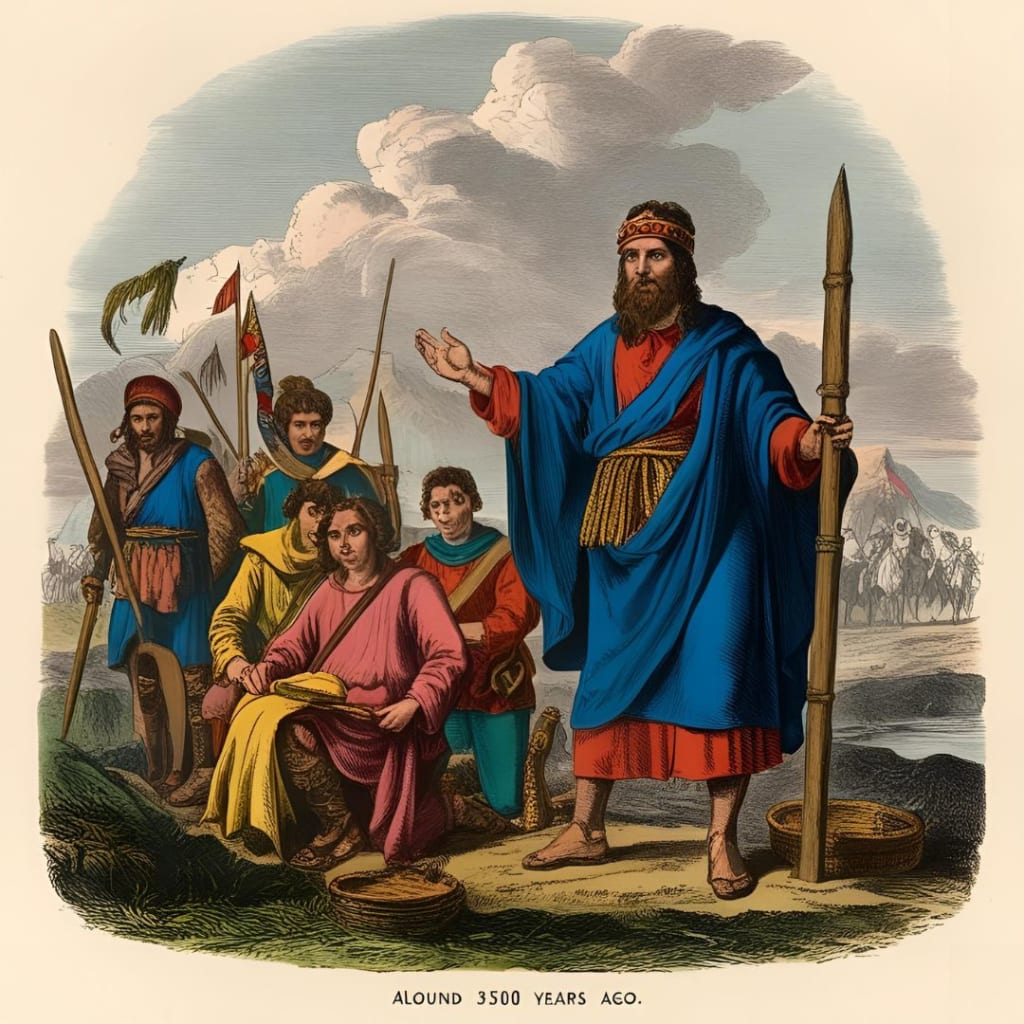
Description: The World 3,500 Years Ago (circa 1500 BCE)
This article explores the global landscape around 1500 BCE, a pivotal period marked by powerful empires, technological advances, and the foundations of major civilizations. It covers the height of Egypt’s New Kingdom, the rise of the Hittite Empire, and the transition in Mesopotamia under the Kassites. In the Aegean, the Minoan and Mycenaean cultures flourished, while in South Asia, the decline of the Indus Valley Civilization gave way to the early Vedic culture. In China, the Shang Dynasty reigned, laying the groundwork for Chinese civilization. Emerging societies in the Americas, like the Olmecs, also began shaping their cultural identities.
The article highlights key developments in religion, writing systems, trade networks, and early technologies like bronze and ironworking. Despite being separated by geography, these ancient cultures were increasingly connected through war, trade, and shared innovations, forming the roots of the world we know today.
Here's overview of the world around 3,500 years ago, which would place us around 1500 BCE. This was a fascinating period full of powerful civilizations, technological advancements, and cultural developments across different regions of the world.
A Glimpse into the World Around 1500 BCE
Around 1500 BCE, the world was a dynamic and complex place, filled with rising empires, intricate religious practices, and increasing contact between cultures through trade and warfare. Though much of history from this time is fragmentary, what we do know paints a vibrant picture of human civilization.
1. Egypt at Its Height
One of the most powerful civilizations at this time was Ancient Egypt, in the New Kingdom period. This was the golden age of Egyptian power, wealth, and influence.
• Pharaohs like Thutmose I, Hatshepsut, and later Thutmose III ruled during this time.
• Egypt was expanding its territory through military campaigns into Nubia and the Levant (modern-day Syria and Israel).
• Hatshepsut, one of the few female pharaohs, is remembered for her ambitious building projects and for expanding trade networks, including the famous expedition to Punt, a land rich in incense and gold.
• Temples like Karnak and Luxor were either built or greatly expanded in this era.
The Egyptian religion was deeply intertwined with daily life, and the pantheon of gods, elaborate burial practices, and belief in the afterlife were central to society. The practice of mummification had been refined by this period, preserving bodies in preparation for the journey into the afterlife.
2. The Hittite Empire in Anatolia
North of Egypt, in what is today Turkey, the Hittites were growing into a formidable empire.
• The Hittites were known for their use of iron—though still rare, iron was beginning to supplement bronze tools and weapons.
• They had a well-organized military and a legal system that is considered advanced for its time.
• Around 1500 BCE, the Hittite Empire was becoming a rival to both Egypt and Mesopotamian powers. They would later clash with Egypt in the famous Battle of Kadesh (c. 1274 BCE).
• The Hittites spoke an Indo-European language and left behind clay tablets written in cuneiform script.
3. Mesopotamia and the Rise of Kassite Babylon
Mesopotamia, the land between the Tigris and Euphrates Rivers (modern Iraq), remained a vital cultural and political region.
• After the fall of the Old Babylonian Empire and the decline of Hammurabi’s lineage, the Kassites, a people from the Zagros Mountains, took over Babylon and ruled for several centuries.
• The Kassites adopted Babylonian culture, gods, and language, keeping the city a center of learning and worship.
• Mesopotamian religion and mythology continued to thrive. Epic tales such as the Epic of Gilgamesh had already been composed in earlier centuries but were still widely copied and read in scribal schools.
4. The Minoans and Mycenaeans in the Aegean
In the Aegean Sea, two significant cultures were flourishing: the Minoans on the island of Crete, and the Mycenaeans on mainland Greece.
• The Minoans, with their capital at Knossos, had a vibrant, seafaring culture marked by palace complexes, frescoes, and religious ceremonies involving bulls. They wrote in a script known as Linear A, which has not yet been deciphered.
• Around 1500 BCE, the Minoans were beginning to decline, possibly due to the massive eruption of Thera (Santorini) a few decades earlier, followed by invasions or influence from the Mycenaeans.
• The Mycenaeans, considered the ancestors of later classical Greek culture, spoke an early form of Greek and used a script called Linear B, which has been deciphered.
• Mycenaeans built fortified palace complexes and were engaged in trade and possibly warfare with other Mediterranean cultures.
5. The Indus Valley and the Aryan Migration
In South Asia, the once-great Indus Valley Civilization (also known as the Harappan Civilization) had declined by 1500 BCE.
• Urban centers like Harappa and Mohenjo-Daro had been abandoned or reduced to smaller settlements.
• Scholars debate the reasons for this decline: climate change, shifts in river patterns, overuse of resources, or invasion/migration.
• Around this time, Indo-Aryan-speaking peoples were migrating into the Indian subcontinent. These migrations would lay the foundations for Vedic culture.
• The Rigveda, the oldest of the four Vedas (sacred texts of Hinduism), was being composed orally around this time.
This was a critical transition period, marking the end of urban Harappan culture and the beginning of a rural, pastoral culture that would shape the religious and social structures of later Indian history.
6. China in the Shang Dynasty
In East Asia, the Shang Dynasty ruled in the Yellow River Valley of China.
• The Shang are considered the first Chinese dynasty with direct archaeological evidence.
• They developed bronze metallurgy, used oracle bones for divination, and had a complex society ruled by a king and warrior elites.
• The Shang religion included ancestor worship and a pantheon led by Shang Di, a high god.
• Writing during this time was developing into recognizable Chinese characters, used primarily for religious or ceremonial purposes.
The Shang built walled cities and had a social structure that included nobles, artisans, farmers, and slaves.
7. The Americas: Olmec Beginnings and Andean Cultures
In the Americas, complex civilizations had not yet risen to the scale seen in the Old World, but the foundations were being laid.
• In Mesoamerica, the Olmec civilization was emerging around this time in the Gulf Coast region (modern-day southern Mexico).
• The Olmecs are often referred to as the “mother culture” of later civilizations like the Maya and Aztecs. They are known for their colossal stone heads, jade artistry, and early forms of writing and calendrical systems.
• In South America, cultures in the Andean highlands, like those at Caral and later Chavín, were beginning to develop complex societies, engage in long-distance trade, and construct monumental architecture.
8. Technological and Cultural Developments
Though technology was still primitive by modern standards, several important innovations were shaping societies around 1500 BCE:
• Bronze tools and weapons were widespread across much of Eurasia, giving this era the name Bronze Age.
• Early ironworking was beginning, especially among the Hittites, though widespread use of iron wouldn't come until centuries later.
• The wheel, plow, and irrigation systems continued to revolutionize agriculture.
• Writing systems were in use in several regions: cuneiform in Mesopotamia, hieroglyphics in Egypt, Linear A and B in the Aegean, and oracle bone script in China.
• Long-distance trade networks connected distant regions. Lapis lazuli from Afghanistan was traded to Mesopotamia and Egypt. Tin, necessary for making bronze, was sourced from places as far as Central Asia and possibly even Europe.
9. Religion and Worldview
Religious belief around 1500 BCE was deeply entwined with the cosmos, natural forces, and kingship.
• Most cultures practiced polytheism, with gods representing natural elements like the sun, rivers, storms, and fertility.
• Divination and omens were common ways of seeking guidance from the gods.
• Rulers were often considered divine or semi-divine, or at least chosen by the gods.
• Sacrifice—animal and, in some cultures, human—was used to appease gods or gain favor.
10. A Connected Yet Fragmented World
Even though most regions developed independently, there were growing connections:
• The Levant (modern Syria, Lebanon, Israel, Palestine) was a cultural crossroads. Egyptian, Hittite, and Mesopotamian influences mixed here.
• The Mediterranean Sea was a major highway for trade and cultural exchange.
• Knowledge, goods, and sometimes even people moved long distances—soldiers, slaves, traders, and ambassadors played a role in linking ancient civilizations.
Conclusion
The world in 1500 BCE was diverse, full of rising and falling powers, spiritual complexity, and technological ingenuity. It was an age when myths were written down, empires clashed, and foundational cultures emerged that would influence human history for millennia.
Though much remains unknown about this distant time, archaeology and historical texts give us a window into a world that was both alien and strangely familiar—marked by the same ambitions, fears, and creativity that drive humanity today.
About the Creator
Kazi Mirajul Islam
I am expert in digital Marketing .I am also E- book writer & story writer. I am committed to delivering high-quality content.Also create social media account like Facebook,twitter account ,Instagram ,you tube account create and mained.
Keep reading
More stories from Kazi Mirajul Islam and writers in Education and other communities.
Bollywood Actress Biography
Raashii Khanna is an Indian actress who works predominantly in Telugu and Tamil films. She made her acting debut in a supporting role with the Hindi film Madras Cafe and subsequently appeared in Telugu film Oohalu Gusagusalade, which won her the SIIMA Award for Best Female Debut – Telugu. Wikipedia
By Kazi Mirajul Islam9 months ago in Education
Can You Really Earn Money With Transcription? The Real Income Reality
The short answer is yes—you can earn money with transcription. But the more honest, useful answer is this: transcription only becomes worthwhile when you understand how the income actually works, not how it’s often presented online.
By Mahesh Kumar4 days ago in Education
Beyond the Transcript: What Extracurriculars and Essays Reveal That Grades Cannot
Colleges today look far beyond GPAs and test scores to understand who applicants truly are. While academic metrics indicate preparedness for coursework, they fail to capture personality, resilience, passion, and potential contributions to campus life. This is why essays, extracurricular activities, and other non-academic elements of an application hold significant power. They offer admissions officers a fuller, richer, more human version of the student—one that no number can represent.
By Carmen Reid7 days ago in Education
Ludacris and Nelly draw backlash over bookings at MAGA-coded music festival
Ludacris and Nelly headlining a mostly right-wing event is good for them. It’s also great for the genre of hip hop. The two rap veterans have showcased their talents on other stages. Why can’t they perform for mostly MAGA folks and grab that bag?
By Skyler Saunders4 days ago in Beat



Comments
There are no comments for this story
Be the first to respond and start the conversation.