
The Removal of the Preamble from NCERT Textbooks: An Educational Perspective
Removal of the Preamble
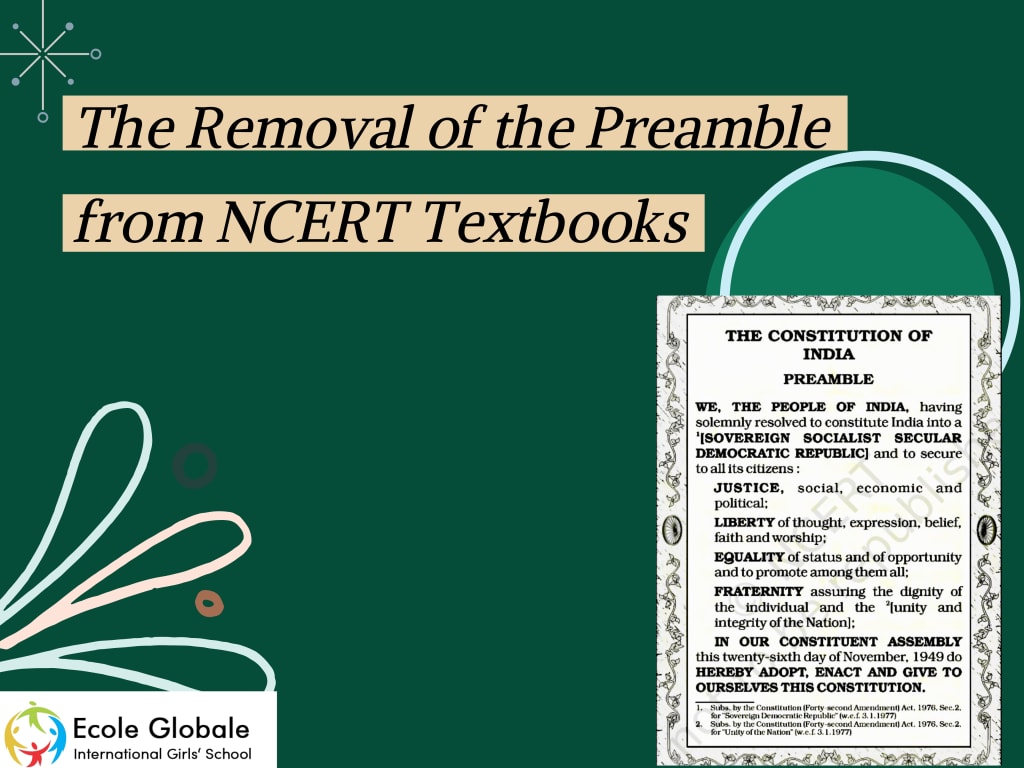
Recent changes in the National Council of Educational Research and Training (NCERT) textbooks have sparked a significant debate. The removal of the Preamble to the Constitution from some Class 3 and Class 6 textbooks has raised questions and concerns among parents, educators, and students. As an educational expert, it is crucial to analyze these changes, understand the rationale behind them, and provide a balanced perspective on their implications.
Overview of the Changes
The NCERT, in line with the National Education Policy (NEP) 2020, has revised several textbooks. This revision has led to the exclusion of the Preamble from certain textbooks while incorporating other Constitutional elements like fundamental rights, duties, and the National Anthem.
Specific Changes in Textbooks
Class 3 Textbooks:
The Preamble has been removed from new textbooks for Hindi, English, Mathematics, and "World Around Us" (which replaces Environmental Studies or EVS).
Previously, the Preamble was included in the EVS book "Looking Around" and the Hindi book "Rimjhim 3."
Class 6 Textbooks:
The Preamble is included in the new Science book "Curiosity" and the Hindi book "Malhar."
It is not present in the Social Science book "Exploring Society: India and Beyond," which covers fundamental rights and duties instead.
The new English textbook "Poorvi" includes the National Anthem, and the Sanskrit textbook "Deepakam" features both the National Anthem and the National Song, but not the Preamble.
Rationale Behind the Changes
The NCERT's revisions are guided by the NEP 2020, which emphasizes a holistic approach to education. The council's decision to distribute Constitutional values across various textbooks aims to provide a more integrated understanding of these principles.
NCERT’s Clarification
Holistic Education:
According to Professor Ranjana Arora, Head of the Department of Curriculum Studies and Development at NCERT, the removal of the Preamble should not be viewed in isolation.
Constitutional values are also imparted through other elements such as fundamental rights, duties, and the National Anthem.
This approach aligns with the vision of NEP 2020, which focuses on comprehensive child development.
Diverse Sources of Constitutional Learning:
NCERT emphasizes that relying solely on the Preamble to teach Constitutional values is a narrow approach.
Fundamental duties, rights, and the National Anthem are equally important for imparting these values.
This broader inclusion ensures that students receive a well-rounded education on Constitutional principles.
Implications for Students and Educators
The changes in the NCERT textbooks have several implications for students and educators, impacting how Constitutional values are taught and understood.
Benefits of the Revised Curriculum
Integrated Learning:
By incorporating Constitutional values across different subjects and textbooks, students gain a more comprehensive understanding.
This approach ensures that these values are reinforced through multiple contexts, making them more relatable and easier to grasp.
Focus on Fundamental Duties and Rights:
Emphasizing fundamental duties and rights alongside the Preamble helps students understand their responsibilities as citizens.
This focus encourages a balanced perspective on rights and duties, promoting civic responsibility.
Challenges and Concerns
Public Perception:
The removal of the Preamble has led to concerns and misconceptions among parents and the public.
Clear communication and education about the rationale behind these changes are essential to address these concerns.
Teacher Preparation:
Educators need to be adequately prepared to teach the revised curriculum effectively.
Professional development and training programs should be implemented to help teachers adapt to these changes.
Practical Insights and Examples
To illustrate the practical implications of these changes, consider the following examples and insights:
Example 1: Teaching Fundamental Duties in Science
Contextual Learning:
In the new Class 6 Science textbook "Curiosity," lessons on environmental conservation can be linked to fundamental duties.
Students learn about their duty to protect the environment through practical activities and experiments.
Holistic Understanding:
This approach helps students connect their scientific knowledge with their responsibilities as citizens, fostering a deeper understanding of both subjects.
Example 2: Integrating Rights and Duties in Social Science
Comprehensive Coverage:
The Social Science book "Exploring Society: India and Beyond" covers fundamental rights and duties, providing a detailed explanation of each.
Activities and discussions encourage students to reflect on these principles and their relevance in daily life.
Interactive Learning:
Role-playing exercises and debates on fundamental rights help students engage with these concepts actively.
This interactive approach makes learning more engaging and memorable.
Conclusion
The removal of the Preamble from certain NCERT textbooks is part of a broader strategy to align with the National Education Policy 2020. This policy aims to provide a holistic and integrated education, emphasizing various facets of the Constitution through multiple subjects. While the changes have sparked debate, they also present an opportunity to enhance students' understanding of Constitutional values in a more comprehensive manner.
Key Takeaways for Parents and Students:
Broader Perspective: The revised curriculum aims to provide a more integrated and comprehensive understanding of Constitutional values.
Holistic Development: Emphasizing fundamental rights, duties, and the National Anthem alongside the Preamble supports holistic child development.
Engaged Learning: Practical activities, discussions, and interactive learning methods are key to making Constitutional education engaging and effective.
At Ecole Globale Schools, we are committed to providing a well-rounded education that prepares our students to be responsible and informed citizens. By embracing these curriculum changes, we aim to foster a deeper understanding of Constitutional values and principles among our students, ensuring their growth into well-rounded individuals.
About the Creator
Keep reading
More stories from Priyangini and writers in Education and other communities.
Effective Classroom Management Strategies: Fostering an Engaging and Productive Learning Environment
Classroom management is a critical component of successful teaching, as it directly impacts student learning, engagement, and overall classroom climate. Effective classroom management strategies go beyond simply maintaining order - they create an environment conducive to academic achievement and personal growth. In this comprehensive article, we'll explore 20 research-backed classroom management techniques that can help educators foster an engaging and productive learning environment.
By Priyangini about a year ago in Education
The Road That Taught Him Silence
In the small village where the mountains met the fields, mornings arrived quietly. The sun did not rise in a hurry there; it climbed slowly, as if respecting the stillness of the land. Birds were the first to greet the light, their soft calls weaving through the narrow lanes and mud-brick houses. Aamir had learned to wake before the village did. At first, this habit was forced. Sleepless nights, heavy thoughts, and restless dreams had pushed him out of bed before dawn. He did not know where to go, only that staying inside the house made his chest feel tighter, his breath shorter, his mind louder. One morning, without purpose, he stepped outside and began walking toward the path that lay between the barley fields and the low, blue mountains. That path soon became his silent companion. Every day, he walked there — sometimes quickly, sometimes slowly, sometimes stopping for long minutes to watch the wind bend the crops like a green ocean. The path was narrow and uneven, yet it carried him faithfully, never asking where he was going or why. In its quiet presence, he found a strange comfort. Aamir was not unhappy in the usual sense. He had food, family, and education. He taught children in the village school and was respected by many. Yet inside him lived a deep confusion — a soft but constant question: Am I becoming what I was meant to become? He had dreams once — of writing, of speaking beautifully, of guiding others not only through lessons but through life itself. But responsibilities had grown faster than courage. Slowly, without noticing, he had begun to doubt himself. And doubt, unlike pain, does not shout. It whispers. On one such morning, when the mist still clung to the fields like a thin veil, Aamir noticed footprints beside his own. They were not fresh, but they were regular — the marks of someone who walked the same road every day. A few minutes later, he found their owner. An old man sat on a flat stone near the edge of the path, a wooden staff resting beside him, a small flock of sheep grazing quietly nearby. His beard was silver, his clothes simple, and his eyes clear in a way that surprised Aamir. Those eyes did not seem tired by age; they seemed polished by time. “Peace be upon you,” Aamir greeted. “And upon you, peace,” the old man replied warmly. “You walk early.” “So do you,” Aamir smiled. The old man nodded. “The morning is honest. It shows you who you are before the world begins to tell you who you should be.” The words struck Aamir gently, like a leaf touching water. From that day onward, they met often. Sometimes they spoke, sometimes they shared long silences. The old man never asked many questions, yet somehow Aamir found himself speaking — about his students, his ambitions, his fear of wasting his abilities, his constant comparison with others who seemed more confident, more successful, more certain. One morning, Aamir confessed, “I feel as if I am standing still while the world moves ahead.” The old man watched the sheep for a moment, then said, “Have you seen a tree grow?” “Yes.” “Does it run to become tall?” “No.” “Yet it becomes tall.” Aamir smiled faintly. “But people judge trees by their height.” “They do,” the old man agreed. “But trees are not planted to impress people. They are planted to become themselves.” The sentence stayed with Aamir long after the walk ended. Days turned into weeks, and weeks into months. With each walk, something inside him shifted — slowly, almost invisibly. He began to notice small beauties he had ignored before: the way dew rested on grass like tiny mirrors, the rhythm of his own breathing, the calm dignity of the mountains that never hurried yet never failed to stand firm. One morning, Aamir arrived to find the stone empty. No sheep. No staff. No silver-bearded teacher. For several days, he returned at the same hour, hoping to meet the old man again. But the path remained silent, as if it had never known such a presence. Disappointment crept into his heart. On the seventh morning, as he walked farther than usual, he noticed a small bundle placed carefully beside the path. Inside it lay a worn notebook and a folded piece of paper. The note read: “To the one who walks with questions, Do not search for me again. I was only a mirror, not a guide. The road has taught you silence. Silence has taught you clarity. Now let clarity teach you courage. Remember: You are not late. You are not lost. You are simply growing underground.” Aamir sat there for a long time, holding the paper with trembling hands. That day, when he returned home, he opened his old notebooks, the ones where unfinished writings slept like forgotten seeds. For the first time in years, he wrote not to impress, not to compete, but to understand himself. He began to speak more gently to his students, not only teaching lessons, but listening to fears. He encouraged them to walk, to observe, to think, to trust their own pace. And every morning, he still walked the same path. The road never answered his questions directly. But slowly, quietly, it returned something far more precious: The belief that becoming oneself is not a race — It is a journey best taken in silence, With steady steps, And an honest heart.
By Muhammad yaseen4 days ago in Education
Financial Intelligence: The Secret Weapon Behind Exceptional Hospitality Performance
Hospitality is no longer driven by service alone—it’s shaped by smart decisions, strong planning, and real-time awareness of costs and performance. Financial intelligence is now a key advantage that helps hotels, resorts, and restaurants maintain quality while staying profitable in a competitive market. With rising guest expectations and shifting demand patterns, leaders must balance excellence with efficiency every day.
By Asad Malik2 days ago in Education




Comments (2)
Thanks for sharing
Interesting one