
The Pros and Cons of Online vs. Offline Math Tournaments
Online vs. Offline Math Tournaments: Which One is Right for You?

Mathematics tournaments offer students a platform to showcase their problem-solving abilities, compete with peers, and enhance their critical thinking skills. With technological advancements, these competitions are now conducted in both online and offline formats. Each format has its own advantages and drawbacks. This article explores the pros and cons of offline vs. online math tournaments to help students, parents, and educators make an informed choice.
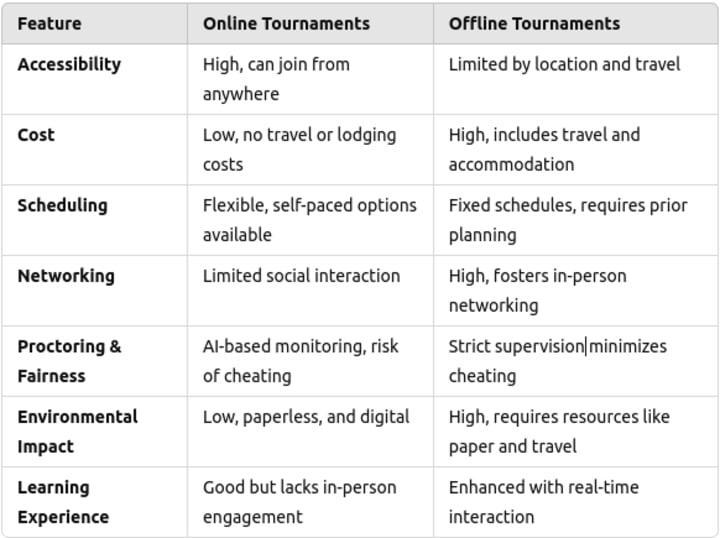
Comparison Table: Online vs. Offline Math Tournaments
Online Math Tournaments
Pros
Accessibility and Convenience
Online math tournaments allow participants from different geographical locations to compete without the need for travel. This makes it easier for students in remote areas to participate.
Cost-Effective
Online competitions eliminate expenses related to travel, accommodation, and venue costs, making them more budget-friendly for participants and organizers.
Flexibility in Scheduling
Many online math tournaments offer flexible schedules, allowing students to participate at a time that suits them best.
Instant Results and Feedback
Digital platforms can provide instant grading and feedback, enabling participants to learn from their mistakes immediately.
Eco-Friendly
Online tournaments reduce paper usage and carbon footprints, making them an environmentally friendly option.
Cons
Technical Issues
Internet connectivity problems, software glitches, and device malfunctions can hinder a participant’s performance.
Risk of Cheating
The possibility of using external resources or unauthorized assistance increases in online competitions, raising concerns about fairness.
Lack of Social Interaction
Unlike in-person tournaments, online competitions limit face-to-face networking opportunities, reducing interpersonal engagement.
Limited Proctoring
While some online tournaments use AI-based monitoring, it may not be as effective as in-person supervision.
Screen Fatigue
Extended screen time can lead to eye strain and fatigue, affecting a student’s performance and concentration.
Offline Math Tournaments
Pros
Enhanced Engagement and Networking
In-person competitions foster better engagement, allowing participants to interact, form study groups, and build academic connections.
Improved Focus
Without online distractions, students can better concentrate on problem-solving during offline tournaments.
Authenticity and Fairness
Strict proctoring in physical venues minimizes the chances of cheating, ensuring a fair competition.
Experiential Learning
Competing in a physical setting enhances problem-solving under pressure, improving confidence and adaptability.
Opportunities for Travel and Exposure
Offline tournaments provide students with opportunities to visit new places, experience different cultures, and compete at prestigious institutions.
Cons
Higher Costs
Travel, lodging, and registration fees make offline tournaments more expensive compared to online alternatives.
Limited Participation
Students from remote locations may find it difficult to attend due to financial and logistical constraints.
Time-Consuming
Offline tournaments often require extensive planning and travel, consuming more time than online alternatives.
Restricted Scheduling
Unlike online tournaments, offline competitions follow fixed schedules, which may not be convenient for all participants.
Environmental Impact
Physical tournaments require printed materials, transportation, and venue arrangements, contributing to a higher carbon footprint.
Which Format is Better?
The choice between online and offline math tournaments depends on individual preferences, accessibility, and goals. If affordability, convenience, and flexibility are top priorities, online tournaments are ideal. However, if networking, hands-on experience, and authentic competition matter more, offline tournaments are the way to go.
Ultimately, a balanced approach that incorporates both formats can help students gain a well-rounded competitive experience, leveraging the best aspects of each.
Are you ready to test your mathematical skills? Join an online math tournament today! Visit Official Math Olympiad Website to explore upcoming competitions and prepare for success!
FAQs
1. Which type of math tournament is more competitive, online or offline?
Both formats are competitive, but offline tournaments often have stricter proctoring, making them more challenging in terms of fairness and problem-solving under pressure.
2. Are online math tournaments recognized for academic achievements?
Yes, many prestigious online math competitions are recognized by schools and universities, adding value to a student’s academic profile.
3. How can students prepare for online math tournaments?
Students should ensure they have a stable internet connection, practice time management, and avoid distractions while participating.
4. What skills do offline math tournaments develop?
Offline tournaments enhance problem-solving, time management, public speaking, and networking skills.
5. Can students participate in both online and offline math tournaments?
Yes, many students participate in both formats to maximize their learning, exposure, and experience.
About the Creator
Everyday Motion Explained, What Modern Kinesiology Teaches Us About How We Move
Modern kinesiology has changed how we understand the way people move each day. It examines how muscles, joints, and nerves work together during simple actions such as walking, reaching, or sitting. Instead of focusing solely on sports or injury, modern kinesiology studies daily movement and its effects it comfort, balance, and energy. This field shows that small habits shape how the body feels over time, even when pain is not present.
By Kelln Small7 days ago in Education
The New Career Compass: How AI Is Redefining Work and Opportunity
Artificial intelligence has moved from science fiction into everyday working life. It now shapes how people find jobs, perform tasks, and plan long-term career paths. From creative fields to technical roles, AI is changing what skills matter and how success is measured. Instead of replacing ambition, this technology is becoming a powerful tool that helps workers adapt, grow, and stay relevant in a fast-moving job market.
By Greg Deshields6 days ago in Education
Trouble at the Tea Leafing Café
The rain had started right around the time that Annie was buttering her second thick slice of homemade toast for breakfast, and hadn’t paused since. Not that anyone could tell. The windows of the café were fogged over, and with every seat filled with happy customers munching on fresh baked pastries or steaming bowls of the delicious soup of the day, it was hardly surprising. Annie looked around the room, finally taking a moment to breathe after the lunch time rush. Her old life already felt like a bad memory, a part of her history, always, but just that. History.
By Hannah Moore2 days ago in Fiction



Comments
There are no comments for this story
Be the first to respond and start the conversation.