
THE PROGRAMMING ARE USED TO DEVELOPE A WEBSITE
"Mastering the Fundamentals: An Introduction to Programming Languages for Web Development"
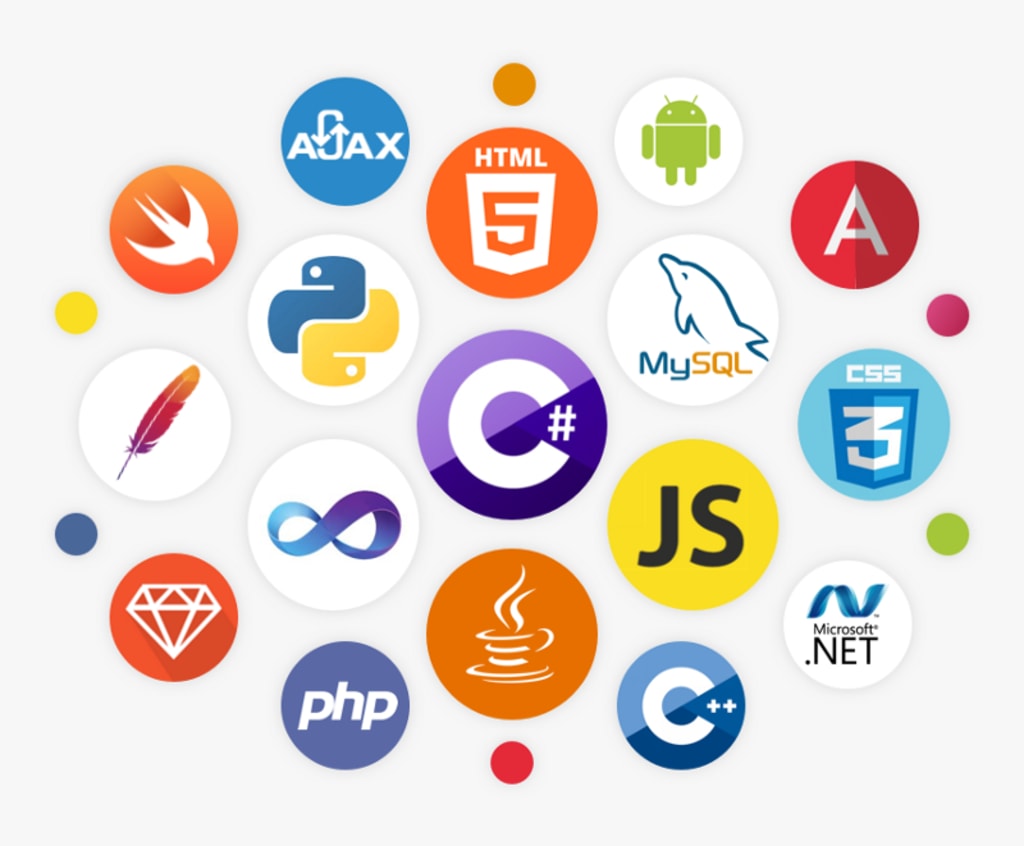
There are many programming languages that can be used to develop a website. Some of the most popular include:
*HTML (Hypertext Markup Language) for creating the structure and content of a website.
*CSS (Cascading Style Sheets) for styling and layout.
*JavaScript for adding interactivity and dynamic functionality.
*PHP (Hypertext Preprocessor) or other server-side languages for server-side logic and database integration.
*SQL (Structured Query Language) for managing relational databases.
In addition to these core languages, there are also many frameworks and libraries available (such as React, Angular, and Vue.js) that can be used to simplify and speed up the development process.
HTML
HTML (Hypertext Markup Language) is the standard markup language used to create web pages. It provides the structure and layout for web pages by using a set of tags and attributes.
HTML documents are made up of a series of elements, which are represented by tags. These tags are enclosed in angle brackets, and typically come in pairs: an opening tag and a closing tag. For example, the paragraph element is represented by the "p" tag, and a paragraph of text would be marked up as follows:
<p>This is a paragraph of text.</p>
HTML tags can also have attributes, which provide additional information about the element. For example, the "img" tag (used to embed images in a web page) has a "src" attribute that specifies the URL of the image file:
<img src="image.jpg" alt="A description of the image">
HTML5 is the latest version of HTML and it has some new feature like semantic elements, multimedia elements, and also it has improved form controls. The new semantic elements like <header>, <nav>, <main>, <article>, <aside>, <footer> make it easy to create structured and meaningful documents.
HTML is often used in conjunction with other web technologies like CSS and JavaScript to create interactive and dynamic websites. It is supported by all web browsers, making it a widely-used and accessible technology.
CSS
CSS (Cascading Style Sheets) is a styling language used to describe the presentation of a document written in a markup language like HTML. It is used to control the layout, colors, fonts, and other visual aspects of a website.
CSS selectors are used to target specific HTML elements and apply styles to them. For example, the following CSS code will make all the text inside all the <p> tags on a page blue:
p {
color: blue;
}
CSS also provides a way to specify the layout of a web page by using a layout model called box model. It helps in positioning elements on the page, controlling their size and also helps in creating responsive design by using media queries.
CSS also provides a wide range of features like responsive design, animations, transitions, and more. With the introduction of CSS3, it has become more powerful than ever and has many new features like color manipulation, text effects, and more.
CSS is also often used with preprocessors like SASS and LESS, which add additional features and make the writing and maintaining of CSS easier.
CSS is an essential part of web development, as it provides a way to separate the presentation and layout of a website from its content and structure (defined by HTML). This separation allows for a more flexible and maintainable codebase, and makes it easier to apply consistent styles across a website.
JAVASCRIPT
JavaScript is a programming language that is commonly used to add interactivity and dynamic functionality to web pages. It is a client-side language, which means that it runs on the user's browser rather than on a server.
JavaScript allows you to add interactivity to a web page by responding to user actions, such as clicks, form submissions, and page scrolling. For example, you could use JavaScript to change the content of a webpage in response to a button click or to validate a form before it is submitted.
JavaScript also allows you to manipulate the Document Object Model (DOM), which is the structure of a web page as it is represented in the browser. This makes it possible to change the layout, style, and content of a web page in real-time, without the need to refresh the page.
JavaScript can also be used to create dynamic effects like animations, image sliders, and interactive maps. It can also be used to create dynamic web apps and complex single-page applications(SPA) using modern frameworks like React, Angular, and Vue.js.
JavaScript is supported by all modern web browsers and has become an essential part of web development, allowing developers to create engaging and interactive web experiences. It is also commonly used with other web technologies such as HTML, CSS, and web APIs to create a comprehensive and dynamic web experience.
PHP
PHP (Hypertext Preprocessor) is a server-side programming language that is commonly used to add server-side logic and database integration to web applications. It is executed on the server, and the output is sent to the client's browser as plain HTML.
PHP allows you to perform a wide range of server-side tasks, such as:
Accessing and manipulating databases (using SQL)
Authenticating and managing user sessions
Processing form data
Sending email
Generating dynamic HTML pages
Creating and manipulating files on the server
PHP can be easily integrated with a variety of databases, including MySQL, PostgreSQL, and SQLite, making it a popular choice for web applications that need to store and retrieve data. PHP also has built-in support for working with cookies and sessions, which allows for easy management of user data.
It also has a large community and many frameworks are available like Laravel, CodeIgniter, and Symfony, which can be used to simplify and speed up the development process.
PHP is widely supported and is particularly well-suited for small to medium-sized web applications. It is also commonly used with other web technologies such as HTML, CSS, and JavaScript.
Other server-side languages that can be used for server-side logic and database integration include:
Python (Django, Flask)
Ruby (Ruby on Rails)
Java (Spring, JavaServer Faces)
C# (ASP.NET)
Each of these languages has its own advantages and disadvantages and the choice of which one to use depends on the specific requirements of the project.
SQL
SQL is a programming language used for managing and manipulating relational databases. It is used to insert, update, and query data in a database. Some common SQL commands include SELECT, FROM, WHERE, INSERT INTO, UPDATE, and DELETE. SQL is used in a wide variety of applications and is an essential tool for working with relational databases.
About the Creator
How the Sun Shapes Planetary Orbits: The Gravitational Power Behind the Solar System
The Sun’s Gravitational Dominance The Sun contains more than 99.8% of the total mass of the solar system. Because gravity depends on mass, the Sun’s enormous mass gives it overwhelming gravitational influence.
By shahkar jalal7 days ago in Education
Silken Chains
Silhouettes of the female form were given flesh and bone. Silken skin glistened under the spotlight. Dry ice rose around our Icons as they danced atop their podiums in the Square. Heralded for their beauty, their movements were slight, powerful, and sensual.
By Paul Stewart4 days ago in Fiction




Comments
There are no comments for this story
Be the first to respond and start the conversation.