
The Physics of Colors
An in-depth explanation on color theory and light.
Introduction:
There are three main wavelengths visible to the eye. Red, Green, and Blue. They have wavelengths of approximately R 700nm, G 550nm, and B 470nm, respectively. These are referred to as the spectral colors because they are monochromatic. Any other color is either another similar wavelength between 300-1000nm (generous range) or a mix of at least two of these colors. Interestingly though there are only three primary colors of light. There are also different kinds of primary colors. Primary colors of light are not the same as primary colors of pigments.
Violet is not the same as ultra violet.
Biological Aspects:
The human eye has two kinds of cells for vision, rods and cones. Rods are responsible for brightness and actual vision and shapes; while cones are responsible for picking up what color something is. There are three kinds of cones that emit a signal to our brain for its respective color. Red cones, Green cones, and Blue cones. Colors aren't really physical tangible things that can be measured. Colors are entirely something your brain creates, for example if you were to stimulate the blue cones in your eyes through some alternative means such as electrical impulses, you would see the color blue even though you may be in a pitch black room. Even if you lost your eyes, you would still be able to have dreams in color.
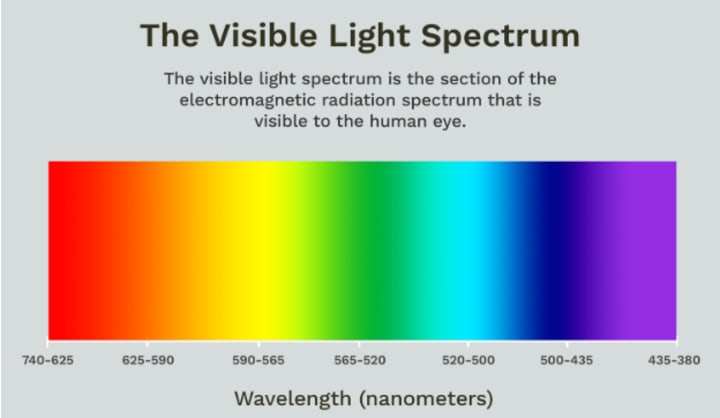
The visible light “spectrum” comes from the fact that wavelengths inbetween red, green, blue, and violet also stimulate the cones in our eyes with overlap which creates the effect of other colors coming from another wavelength. For example the wavelength of cyan which is 510nm stimulates the blue and green cones and none of the red cones in our eyes which makes the wavelength appear cyan (this wavelength is hardly visible and is very dim in a rainbow). This applies to every wavelength from red to violet. Magenta does not have a unique wavelength because red and blue are on complete opposite sides of the spectrum. Wavelengths of equal brightness or number of photons might appear as dimmer versions of their color than a monochromatic wavelength because the eye is less sensitive to picking up those wavelengths. What this means is that there are some colors that cannot be created from unique wavelengths, a particular example being magenta.
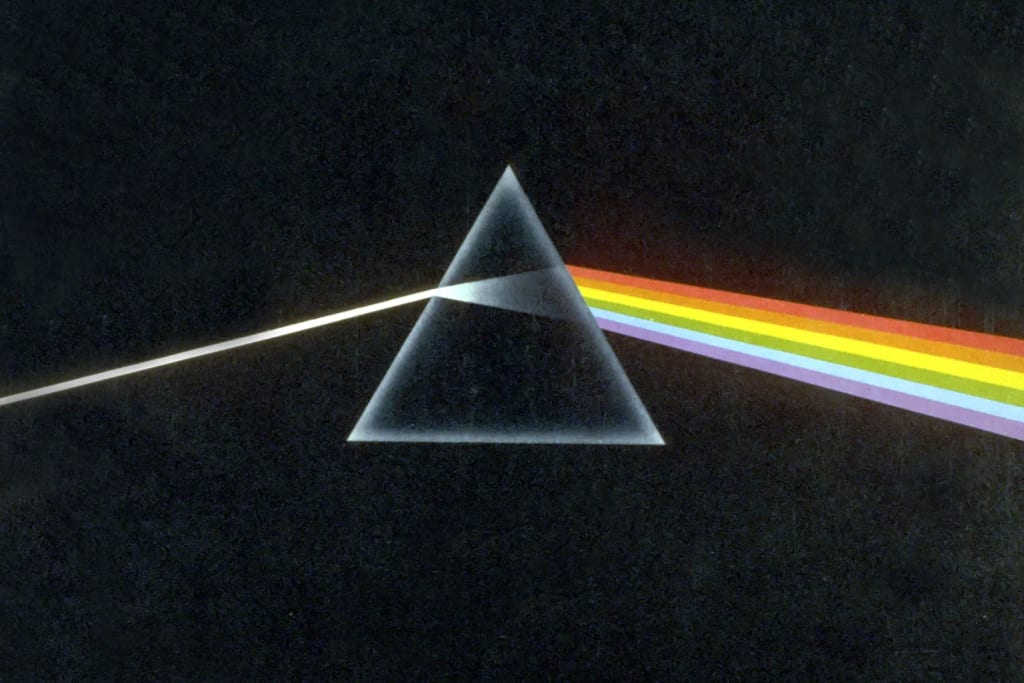
In Issac Newton’s book “Opticks” he divided the visible light spectrum (rainbow) into six colors but added a seventh to create ROYGBIV because of superstitious beliefs that seven is a perfect number. What we today call indigo is not a very visible unique wavelength like in the diagram below. What Issac Newton probably called Indigo was most likely what we today called blue and his blue was what we call cyan. It was later discovered that when light is split through a wider aperture prism more defined edges are seen and that the colors in the rainbow were actually produced by an overlap of the colors. (source)

Types of Lights:
Incandescent light is emitted from an incandescent bulb which is made up of a filament and can emit a spectrum of wavelengths (including the spectral colors) depending on the kind of filament used. Generally though they are an orangish yellow but they may come in white varieties.
Light Emitting Diodes (LED) lights come in a variety of colors and are achieved through several means. Red green and blue leds are made by a filament that emits only its specific wavelength of color. For example a red led has a filament that emits wavelengths of approximately 700nm but not the wavelengths of any of the other spectral colors.
-White leds can be achieved through several forms which fundamentally change what wavelengths make it up. Usually white leds like the pixels on your screen are made up of three separate led filaments, the red, green, and blue emitting ones. Adjusting the brightness of these three filaments in a ratio to each other will change the color we perceive emitted by them and they can create any color including violet even though it has its own wavelength which I will address later. These kinds of leds when split with a prism cannot produce a full rainbow because they lack a spectral violet emitting filament.
Another way white leds are made is by using a very powerful blue or violet led filament and covering it with a white phosphorus housing. Blue or violet leds are used because they are the highest energy waves and can carry energy the most efficiently. The white phosphorus housing absorbs these high energy waves and re-emits them as white light.
Light amplification by stimulated emission of radiation (Lasers!) are a coherent beam of focused light. Lasers are not just focused light and must also be coherent. Light from an led or incandescent bulb is incoherent. For light to be coherent the peaks of its wavelengths need to be aligned.
There are a couple requirements for this. Since light moves in the shape of a sine wave, for the peaks of those sine waves to ever align the frequency of the photons must be the same so only one kind of frequency can be emitted at a time. Another requirement is that the peak of the waves are aligned with each other so that when a photon is at the peak of its wave the other photon must also be at the peak of its wave. The third requirement is that the waves are in the same orientation which is called polarization. Looking at a cross section of two light waves, if one is moving side to side and the other is moving up and down then that is incoherent; both must be moving up and down at the same time to be considered polarized and achieve coherence. If you want a more in depth explanation, this article explains very well and is also my source. Only certain colors of lasers are able to be produced (at least well) because since only one frequency of light can be emitted at a time, spectral colors in the visible light spectrum that aren’t all that visible will be very dim.
The way a laser is made is by running energy through something like glass or a gas and making its electrons go to a higher energy orbital level. The electrons then spontaneously go to a lower orbital and emit a photon. That photon is then reflected off of something and back into another atom which makes its electrons go to a higher orbital level. The electron then again spontaneously goes to a lower orbital level and emits two of the same photon as the original essentially cloning it. These photons continue to do this bouncing between the mirror and another semi transparent mirror through the medium until it exits through the semi transparent mirror which also polarizes the light.
There are other kinds of lights like fluorescent lights which our school uses that has a glass tube filled with gases and mercury that's electrified to ionize it and emit light. But there are too many kinds of lights that work many different ways and emit many spectrums of wavelengths. For the most part the sources that explain how these work are accurate from what I have seen so feel free to research them further!
Spectral Violet and Magenta:
Spectral violet is a unique wavelength of the spectral colors. This is because although we have cones for red, green and blue, there is no specific cone for spectral violet. We can still see spectral violet because it activates all of the blue cones and some of the red cones at a ratio of 127 parts red to 255 parts blue which our brain interprets as the color violet. This color can also be mimicked by using the same ratio above; 127 parts red light and 255 parts blue light will appear to be the same color as spectral violet although not containing the wavelength of spectral violet.
This is how in a rainbow, even though red and blue are separated from each other by a prism, violet (or a dark magenta) is still seen because it is its own wavelength shorter than the rest and extends past blue on the color spectrum.
This is also why computer screens only need pixels with red, green, and blue leds because the illusion of spectral violet (and any other color) can be created using red and blue. Which in the case of our eyes it can’t really distinguish between.
This lack of a spectral violet led in white leds is also why when a white led is split with a prism the rainbow only goes from red to blue and stops there without extending further.
sRGB Codes: More about sRGB
sRGB codes is a computer colorization standard that uses a scale from 0-255 to make a ratio of red, green, and blue to create the other colors. So for example the color code to create a color that mimics spectral violet would be R: 127, G: 0, B: 255. It’s both a ratio and a saturation scale. Saturation is essentially how bright a color is. For example pure orange is R: 255, G: 128, B: 0 at its maximum brightness and fully saturated; Brown is essentially just dark orange or orange with low saturation and its sRGB code is R:128, G: 64, B: 0. Brown still has the same ratio of colors as orange, just their values are halved.
A more real world explanation of what’s happening is the brown light gets brighter to make orange. Same thing with white and black. Black is a color but it's what your brain creates when presented with the absence of any light. In color code its R: 0 G: 0 B: 0, essentially means the pixels are just off or complete darkness. White is instead of all 0’s its all 255 which is all the pixels at their maximum brightness. Gray is just dim white light where all of the colors are somewhere in between 0-255 but at a ratio of 1:1:1.
Here is a link to a color picker if you want to play around with it.
The cones in our eyes work in a very similar way to sRGB in the way that they measure the amount of color something is reflecting which tells the brain what color something is. Its important to note that even with no cones in our eyes we still have rods which are responsible for actual vision. A completely colorblind person is still able to see things and tell if something is bright, just not what color those things are.
Primary Colors: (White light refers to RGB not including V)
There are several kinds of primary colors. There are pigment primaries Cyan, Yellow, and Magenta (CYM) and light primaries (RGB) and they work in fundamentally different ways. Mixing light primaries works additively by adding other wavelengths to each other, while pigment primaries work subtractively by filtering out wavelengths of light. This is observable by when you mix red, green and blue light it makes white light, but if you mix red green and blue play doh it usually makes a dark color like brown.

The primary pigments are created by substances that only subtract one of the primary colors of light from white light. For example if you mix red and green you get yellow in the first diagram, so a yellow pigment would be subtracting blue from white light which is why it appears yellow because the red and green is still being reflected. If you apply the same for the other two you get Cyan and Magenta because they each subtract only one of the primary light colors from the white light.
As seen in diagram three they remake the original RGB colors. This is because when you mix them together, for example Cyan and Yellow lenses which subtract red and blue light respectively from white light which only leaves green light to be reflected.
This only works for lenses. Any configuration where all three colors of white light are subtracted always creates black. For example a red and cyan lens makes black or yellow, cyan, and magenta lenses; even a blue and green lens would make black unlike in diagram 2 where it makes purple instead.
Pigments are its own thing. Pigments are pure substances that absorb and reflect any ratio of white light or other wavelengths in the visible light spectrum. For example a blue pigment absorbs red and green light and only reflects blue light. A cyan pigment only absorbs red light and reflects blue and green light. A purple pigment absorbs all green light and some blue and red light while the rest gets reflected. This is because purple is just dark magenta. Revisiting the sRGB system, magenta is R: 255 G: 0 B: 255 and purple is R: 127 G:0 B: 127. Same ratio just at different quantities. Composite pigments are pigments made up of other pigments that are not pure substances. For example, mixing a red and blue pigment like in diagram 2 makes a purple composite pigment. The composite pigment appears purple even though no part of it is purple. What's even more confusing is if red and blue light are being reflected why does it not appear magenta and appears purple instead. This is because like stated above purple is just dark magenta.
If you zoom in on 255 molecules of red play doh and every molecule reflected a red ray you would have 255 red rays, the same for blue play doh at a total of 255 blue rays. If you mixed them together to make purple play doh and zoomed in on 255 of its molecules half of them would be reflecting red and half of them would be reflecting blue, approximately 127 red rays and 127 blue rays and 0 green rays. Plugging this into the sRGB system would create the same color code as purple R: 127 G:0 B: 127. You can see this effect on a much larger scale with an artform called pointillism where different colors are made by mixing dots of other colors like below.

Polarization:
Like mentioned earlier in the lasers section polarization is the alignment of the peaks of electromagnetic waves. A way to achieve polarization is a polarized lens or reflecting off of non metallic surfaces like water which partially polarizes the light. A polarized lens works by filtering out any electromagnetic waves that move in an orientation other than the one it allows. This is achieved through various chemical processes and material sciences. For example a polarized lens that only allows completely vertical waves (with some tolerance) to pass through would not allow horizontal waves to pass through or anything other than completely vertical waves. Two vertical lenses can be combined to completely “block” (oversimplification) any light from passing through by turning one of them 90 degrees in orientation because any light passing through vertically would be stopped by the filter that now only allows horizontal light through. (Source). An interesting property is if a third lens is introduced at a 45 degree angle 50% of the light will be allowed through. This seems very counterintuitive according to classical physics but happens because of a quantum probability property. The light is not really “blocked”, just turned into a different form by being absorbed by the atoms of the lenses and remitting them at different energy levels.
Light bouncing off of non metallic objects like water also becomes partially polarized (source) perpendicular to polarized sunglasses which is why polarized sunglasses remove glare reflecting off of water and cars.
Modern physics equations for polarization.
The End
About the Creator
Keep reading
More stories from Talented Jester and writers in Education and other communities.
AI Usage Controversy
Disclaimers: 1. This article is written in cooperation with an AI tool, particularly Gemini. Although this article is not entirely written by a person. It was still fact checked and revised by one. Every sentence and idea is an intended part of this article even if the original content was not made by the author.
By Talented Jester3 months ago in Critique
Beyond the Bottle: Meet the Hidden Forces Shaping Modern Wine
In recent years, wine lovers have expanded their curiosity beyond labels and tasting notes. Today, they seek stories, craftsmanship, and authenticity. As a result, the spotlight has slowly shifted toward the people who work tirelessly behind the scenes. While celebrity winemakers and vineyard owners often receive recognition, many other contributors quietly shape every glass we enjoy. These professionals represent the true innovators of the wine industry, and they deserve far more attention than they currently receive.
By Joel Barjenbruch2 days ago in Education
Creating Lasting Impact by Building a Growth Mindset Culture Through Purpose-Driven Teaching
Schools have the power to shape how students see learning and themselves. Building a growth mindset culture through purpose-driven teaching helps students believe they can improve and understand why their growth matters. When students see both possibility and purpose, they engage more deeply and work with greater focus.
By Thomas Kuriakose, MD7 days ago in Education



Comments
There are no comments for this story
Be the first to respond and start the conversation.